Tony Pauline’s Final 2026 NFL Mock Draft: Chiefs Trade Up to No. 6 for Rueben Bain Jr., Steelers Move Up for Kadyn Proctor

Add us on Google
Tony Pauline’s Final 2026 NFL Mock Draft: Chiefs Trade Up to No. 6 for Rueben Bain Jr., Steelers Move Up for Kadyn Proctor
Add us on Google
Imago
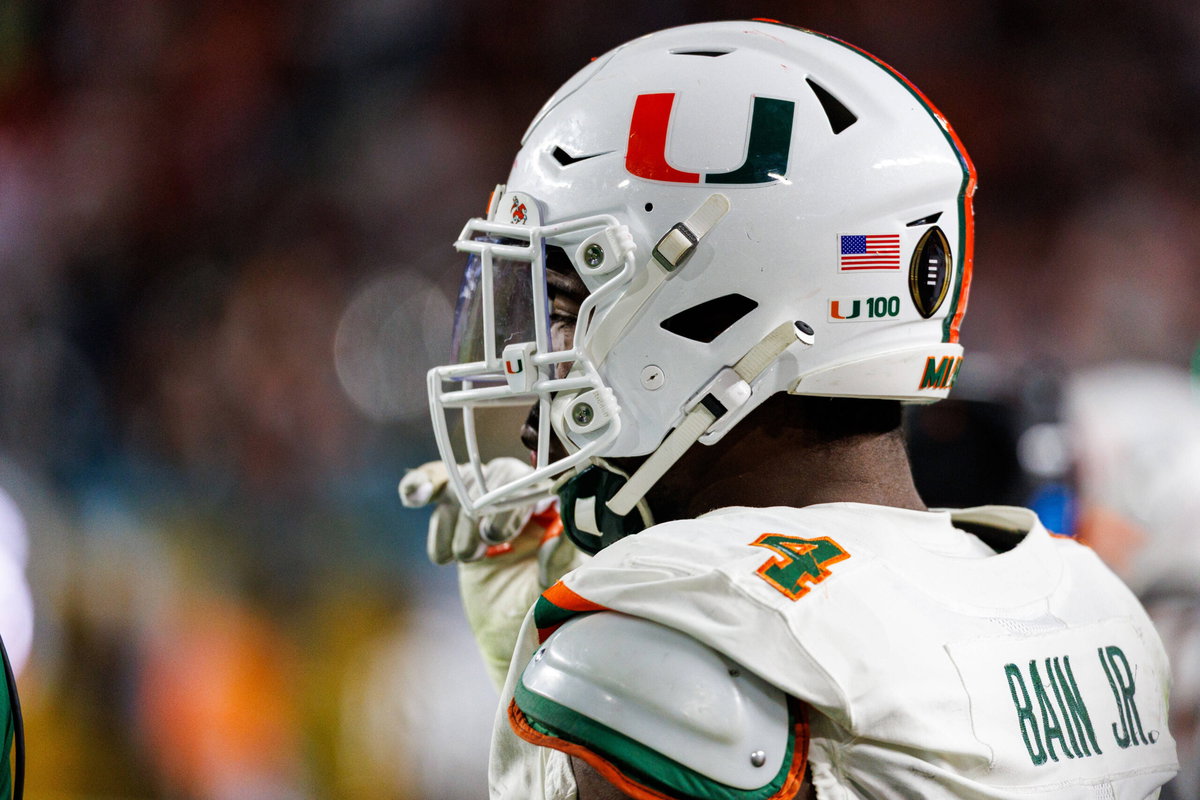
January 19, 2026: Miami defensive lineman Rueben Bain Jr. 4 during NCAA, College League, USA football game action between the Miami Hurricanes and the Indiana Hoosiers at Hard Rock Stadium in Miami Gardens, Florida. /CSM. Miami Gardens United States of America – ZUMAc04_ 20260119_zma_c04_361 Copyright: xJohnxMersitsx
Imago
January 19, 2026: Miami defensive lineman Rueben Bain Jr. 4 during NCAA, College League, USA football game action between the Miami Hurricanes and the Indiana Hoosiers at Hard Rock Stadium in Miami Gardens, Florida. /CSM. Miami Gardens United States of America – ZUMAc04_ 20260119_zma_c04_361 Copyright: xJohnxMersitsx
Here is the final mock draft at Essentially Sports, version 5.0, with the start of the event now less than 24 hours away. Unlike previous years, I’ve stepped out of character a bit and inserted hypothetical trades into the first round. The intrigue starts early this year, as one veteran insider told me, “It’s a day away from the draft, and we still don’t know who the second pick will be.” So let’s get at it!
I’ve projected three trades in this two-round mock draft, all occurring in the first round. They include:
Watch What’s Trending Now!
- Kansas City is moving from pick No. 9 to pick No. 6, presently owned by the Cleveland Browns.
- The Pittsburgh Steelers are moving from pick No. 21 to pick No. 16, presently owned by the New York Jets.
- The Arizona Cardinals are moving from pick No. 34 to pick No. 28, presently owned by the Houston Texans.
In return, the teams moving up will surrender a third-round pick as part of the trade.
Here’s round one of the mock draft:
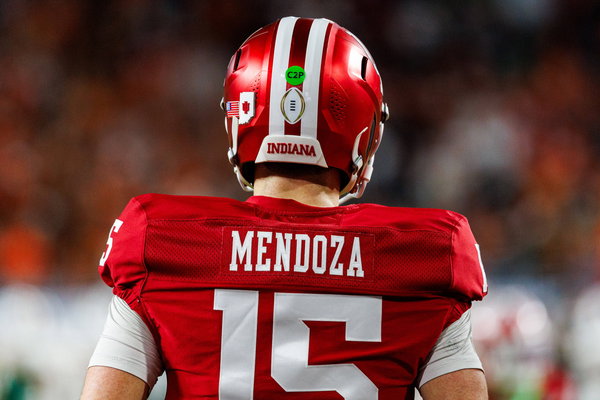
1- Las Vegas Raiders: Fernando Mendoza/QB/Indiana
This is a natural fit for a variety of reasons. The Raiders need a quarterback, and in a class where Mendoza has separated himself as the clear QB1 on multiple draft boards, passing on him at the top would be difficult to justify from a roster-building standpoint. Tom Brady will fall in love with Mendoza, especially given Mendoza’s size, pocket discipline, and decision-making profile that mirrors the kind of traditional structure-friendly quarterbacks Brady has historically praised.
Imago
January 19, 2026: Indiana quarterback Fernando Mendoza 15 during NCAA, College League, USA football game action between the Miami Hurricanes and the Indiana Hoosiers at Hard Rock Stadium in Miami Gardens, Florida. /CSM. Miami Gardens United States of America – ZUMAc04_ 20260119_zma_c04_372 Copyright: xJohnxMersitsx
Klint Kubiak has a young signal caller to mold, and Mendoza’s experience operating within a progression-based offense at Indiana makes him a cleaner projection into an NFL play-action system than most recent top quarterback prospects. The Hoosiers’ underclassman can be the franchise’s signal caller in the future, particularly after leading a 16-0 national championship season and producing one of the most efficient red-zone passing campaigns in college football, the kind of résumé that typically cements a quarterback as a legitimate No. 1-overall-level investment rather than merely a need-based selection.
2- NY Jets: David Bailey/Edge/Texas Tech
There’s definitely a chance the team takes Arvell Reese with this pick, who I believe is the better long-term player and ranks higher on the ES Big Board. Yet as of Wednesday, people around the league that I speak with believe Bailey, who will offer the instant results head coach Aaron Glenn needs, is the choice, particularly because Bailey profiles as one of the most NFL-ready edge defenders in the class with a refined pass-rush plan and early-down run-setting ability that typically earns rookies immediate snaps rather than developmental rotations.
Reese may ultimately carry the higher ceiling, but Bailey’s production profile and physical readiness make him the safer Year-1 impact projection for a coaching staff expected to stabilize the defense quickly.
3- Arizona Cardinals: Jeremiyah Love/RB/Notre Dame
For the longest time, I believed Love was the perfect fit for the Cardinals when you look at need and BPA. They could take Bailey if he’s available, yet recent word is that owner Michael Bidwill is pushing for Love. I mentioned last week that the Cardinals are open to moving this pick and trading down, so keep an eye on that, especially because Love is widely viewed as the only true top-five-caliber offensive skill player in this class and carries rare three-down value as both a vertical runner and receiving threat out of the backfield, traits that typically elevate a running back into early-Round-1 consideration despite positional trends.
4- Tennessee Titans: Sonny Styles/LB/Ohio State
With both Ohio State linebackers available, it will be a tough but good debate in the Titans’ war room. Excuse the pun, but Styles fits the style of linebacker new head coach Robert Saleh has had success with, particularly because Styles brings hybrid second-level range and coverage flexibility similar to the fast-flow linebackers Saleh previously deployed in San Francisco and New York.
As someone told me, “The way to rebuild your defense is with a fast Mike,” and Styles’ sideline-to-sideline pursuit ability and versatility against modern spread offenses make him one of the few linebackers in this class capable of immediately anchoring a multiple-front defensive structure.
5- NY Giants: Arvell Reese/LB/Ohio State
The Giants can’t go wrong with this pick, and any way the top four breaks, they will get a highly rated player to help their defense when they are called to the clock. The run defense needed a lot of help even before they traded Dexter Lawrence, and Reese begins to fill the void, particularly because Reese projects as one of the most complete run-fit linebackers in the class with the processing speed and downhill trigger timing needed to stabilize interior gap integrity in a front undergoing transition.
6- Kansas City Chiefs (via Cleveland): Rueben Bain Jr./Edge/Miami
I’m told that Kansas City prefers to hold onto both first-round picks, and moving up just three slots allows them to do just that and fill their need at edge rusher, particularly in a class where true top-tier edge defenders are expected to come off the board quickly, and Bain represents one of the few prospects capable of contributing immediately opposite an established pass-rush anchor. If they hold onto the ninth selection, I project them to draft Francis Mauigoa, whom I’ve had the team selecting in every mock draft since the Super Bowl, as Kansas City continues prioritizing long-term offensive line stability around its franchise quarterback window.
7- Washington Commanders: Caleb Downs/S/Ohio State
I’m contradicting myself, as just last week I reported the Commanders would not take Downs. But I also said they love Love, and others reported head coach Dan Quinn was in favor of Styles. I could very well see this pick being Downs’ teammate Carnell Tate or cornerback Mansoor Delane, but Downs is too good a value to pass up; he’s no ordinary safety, particularly because his coverage instincts, slot flexibility, and deep-field range allow him to function as a true defensive multiplier in Quinn’s coverage-rotation system rather than a traditional single-alignment safety.
8- New Orleans Saints: Mansoor Delane/CB/LSU
With Bain off the board, the Saints fill another pressing need at cornerback with a hometown player. Based on what I’ve heard, the team will wait until Day 2 before drafting a receiver, and Delane’s length and press-coverage profile fit the Saints’ long-standing preference for boundary corners capable of holding up in man-match concepts without consistent safety assistance.
9- Cleveland Browns (via Kansas City): Spencer Fano/T/Utah
The Browns will have the option to trade with the Chiefs or the Cowboys. They will pick up an extra first-round choice if they make the trade with Dallas, but they could get locked out of the top left tackle, which is what they need and want.
As I’ve previously reported, the team is comfortable moving Fano to the blind side, particularly because his movement skills and pass-set balance project cleanly to left tackle despite extensive right-side experience at Utah.
10- NY Giants: Carnell Tate/WR/Ohio State
Tate’s the top-rated receiver in the draft and fits a big need for the Giants, plus he doesn’t have an injury history, and his route-running polish combined with early separation consistency makes him one of the safest projection profiles among first-round receivers in this class rather than a traits-only developmental selection.
11- Miami Dolphins: Francis Mauigoa/T/Miami
Imago
Darren Yamashita-Imagn Images
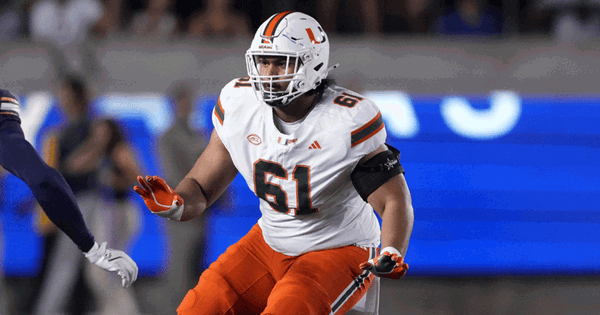
The Dolphins can sit and wait for the best player available to fall into their laps. Short of Love inconceivably falling to this spot, any highly rated prospect fills a hole on the depth chart, and Mauigoa represents one of the few tackles in this class with true early starter upside thanks to his pass-set consistency and experience handling high-level edge competition in a pass-heavy system similar to what Miami operates.
His positional flexibility across both tackle spots also gives the Dolphins insurance along an offensive line that has dealt with availability concerns in recent seasons, making him a value-meets-need selection rather than simply a board-driven pick.
12- Dallas Cowboys: Jordyn Tyson/WR/Arizona State
As I reported on Wednesday, Dallas will be locked out of the top defenders in the draft if it can’t swing a trade with Cleveland, and the Cowboys need a lot of help on that side of the ball. With the George Pickens situation up in the air, Tyson gives them stability at receiver, particularly because he brings vertical separation ability and route-tempo control that project cleanly into a featured boundary role rather than a complementary rotational receiver profile.
The surprise pick here could be safety Dillon Thieneman, whose range and coverage instincts would address the same defensive-backfield instability Dallas has been working to stabilize this offseason.
13- LA Rams (via Atlanta): Makai Lemon/WR/USC
Short of the Rams pulling a surprise and taking tight end Kenyon Sadiq, all signs since the combine point to the team drafting Lemon to shore up the receiver position, especially because Lemon’s short-area separation and route-structure discipline mirror the traits the Rams have historically prioritized in timing-based passing offenses under Sean McVay.
His ability to win from multiple alignments also gives Los Angeles flexibility as the roster transitions toward its next receiving core phase.
14- Baltimore Ravens: Olaivavega Ioane/G/Penn State
As of Wednesday, I heard it’s 50/50 between Ioane and Kenyon Sadiq. Despite signing John Simpson in free agency, the interior offensive line still needs help, particularly because Baltimore continues to prioritize depth and physicality inside as a foundation of its run-first identity.
Ioane’s power profile and interior leverage consistency project cleanly into the Ravens’ downhill blocking structure rather than requiring a developmental transition period.
15- Tampa Bay Buccaneers: Kenyon Sadiq/TE/Oregon
Tight end is probably third on the list of needs for Tampa Bay after edge rusher and linebacker, yet Sadiq is incredible value and much more of a downfield threat than Cade Otton, the team’s present starter at the position, particularly because Sadiq profiles as one of the few vertical-stretch tight ends in this class capable of impacting seam coverage structures early in his career.
That kind of mismatch ability typically elevates a tight end’s value into the middle of Round 1 when the board begins to flatten across defensive positions.
16- Pittsburgh Steelers (via NY Jets/Indianapolis): Kadyn Proctor/OL/Alabama
Interior offensive line is a pressing need for the Steelers, and left tackle may also rank high, given the recent news on Broderick Jones. Proctor can line up at either spot, but the Steelers must move ahead of Detroit to ensure selecting him, particularly because Proctor’s size-movement combination makes him one of the few linemen in this class capable of projecting as both an immediate interior stabilizer and a long-term tackle solution.
That positional versatility increases his trade-up value late in the first round.
17- Detroit Lions: Monroe Freeling/T/Georgia
The Lions may have to do some reshuffling on the offensive line after granting Taylor Decker his release. Proctor, who they just missed out on in this mock, is a better run blocker, though Freeling is more natural at left tackle, and his footwork consistency in pass protection makes him a cleaner long-term blind-side projection within Detroit’s protection structure.
Replacing Decker with a true left-tackle profile rather than a converted interior option keeps continuity in one of the league’s most stable offensive fronts.
18- Minnesota Vikings: Jermod McCoy/CB/Tennessee
The prevailing thought is that Dillon Thieneman will be the pick here, but as I reported on the Draftcast podcast this week, there are a lot of people who believe safety is too complex a position in the Brian Flores defense for a rookie to handle. The way the Vikings, or any team for that matter, view McCoy’s medicals will determine his landing spot, particularly because his coverage competitiveness and boundary physicality otherwise place him firmly in the first-round cornerback tier when healthy.
Medical clarity, more than positional value, is likely to dictate where he ultimately comes off the board.
19- Carolina Panthers: Dillon Thieneman/S/Oregon
The Panthers have done a terrific job filling needs this offseason, and Thieneman plugs another hole, particularly because his deep-field range and route anticipation profile allow him to function as a coverage stabilizer in a secondary that has prioritized versatility over traditional alignment roles.
That flexibility increases his value relative to other safeties projected in this range.
20- Dallas Cowboys (via Green Bay): Chris Johnson/CB/San Diego State
If Dallas can trade up, this selection could be owned by the Cleveland Browns. The Cowboys could also try and move down a few slots and then take Johnson. The surprise pick here is Emmanuel McNeil-Warren, though Johnson’s length and press-coverage profile fit the prototype Dallas has prioritized on the boundary as it continues reshaping its cornerback depth chart.
That scheme compatibility keeps him firmly in play anywhere in this section of the first round depending on how the defensive board falls.
21- NY Jets (via Pittsburgh): Denzel Boston/WR/Washington
The Jets need to come out of the draft with at least one receiver. Boston does not bring the explosion or vertical speed of an Omar Cooper, yet he’s bigger, sturdier, and more dependable, particularly as a possession-profile boundary receiver who consistently wins through physicality and catch-point reliability rather than pure separation speed, traits that often translate more quickly into early-down usage in developing passing attacks.
22- LA Chargers: Chase Bisontis/G/Texas A&M
The Chargers made some minor moves at the guard spot after releasing Mekhi Becton, but they still need a lot of help at the position. Bisontis may take a while to break into the starting lineup, yet his upside is incredible, especially given his combination of anchor strength and movement skills that project well into gap-scheme interior protections the Chargers continue to emphasize in their run-game structure.
23- Philadelphia Eagles: Max Iheanachor/T/Arizona State
Howie Roseman is very forward-thinking about the offensive line, and Lane Johnson can’t stick around forever. Two or three years down the road, Iheanachor could be the best offensive lineman from this class in my opinion, particularly because his developmental ceiling as a pass protector aligns with Philadelphia’s long-standing strategy of drafting tackle prospects early and allowing them to mature within one of the league’s most stable offensive line pipelines.
24- Cleveland Browns (via Jacksonville): KC Concepcion/WR/Texas A&M
Concepcion is a game-breaker who takes the top off the defense and brings impact as a return specialist, and his ability to threaten vertically from both outside alignments and motion concepts gives Cleveland an explosive element the offense has lacked in recent seasons.
His return-game value further increases his early contribution projection even if his receiving role develops gradually.
25- Chicago Bears: Kayden McDonald/DT/Ohio State
The Bears were near the bottom of the league in run defense last season. McDonald shores up the middle of the unit and is a better playmaker than given credit for, particularly because his interior disruption profile allows him to affect early downs as both a space-eater and penetration defender rather than functioning solely as a rotational nose presence.
26- Buffalo Bills: CJ Allen/LB/Georgia
Imago
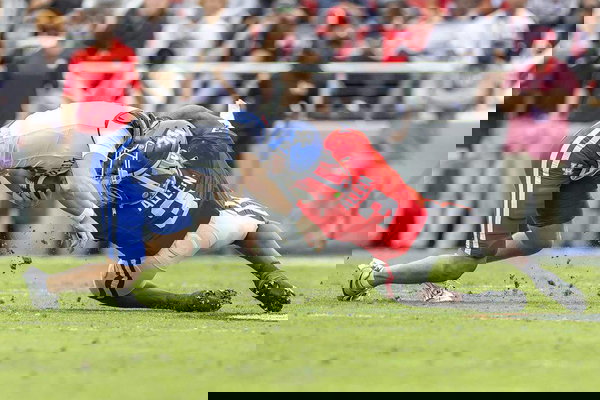
October 4, 2025: Kentucky quarterback Cutter Boley 8 is tackled by Georgia linebacker CJ Allen 3 at Sanford Stadium on Saturday, Oct. 4, 2025, in Athens, Georgia. – ZUMAm67_ 20251004_zaf_m67_014 Copyright: xRyanxC.xHermensx
The Bills needed help in several areas after the 2025 season ended, and off-ball linebacker is one area of need they have yet to address, particularly with Allen projecting as a three-down linebacker whose coverage range and processing speed fit Buffalo’s preference for second-level defenders capable of staying on the field in nickel personnel.
27- San Francisco 49ers: T.J. Parker/Edge/Clemson
Nick Bosa will be 29 years old this season, played in just three games last year before being sidelined with injury and has a contract that expires in 2027. At the very least, Parker, a tremendous player who is coming off a disappointing season, offers depth at the edge spot in 2026, and his length and burst profile still place him firmly within the first-round edge tier despite the statistical drop-off that followed his earlier breakout production.
28- Arizona Cardinals (Houston): Ty Simpson/QB/Alabama
I reported last week that the Cardinals will look to move into the back end of Round 1 for Simpson, and there will be plenty of opportunity for them to do just that, particularly because securing a quarterback late in Round 1 preserves the fifth-year option flexibility teams often prioritize when investing in developmental starters.
29- Kansas City Chiefs (via LA Rams): Omar Cooper Jr./WR/Indiana
The Chiefs will look to move down from this spot, but a receiver is needed as Xavier Worthy has yet to live up to expectations, Rashee Rice is often in trouble with the law, and Tyquan Thornton has yet to prove he’s a consistent starter, making Cooper’s vertical acceleration and separation ability a logical fit within Kansas City’s spacing-based passing attack.
His familiarity with Mendoza’s offensive structure at Indiana also strengthens his projection into a timing-based pro passing environment.
30- Miami Dolphins (via Denver): Zion Young/DE/Missouri
The Dolphins have spent a lot of early draft picks on edge rushers, yet the return has been minimal. Young brings talent and upside, particularly as a rotational pass-rush option whose length and first-step quickness still project developmental starter potential within Miami’s pressure-heavy defensive structure.
31- New England Patriots: Cashius Howell/Edge/Texas A&M
Are the Patriots making this pick for themselves? Or drafting someone who will be part of a trade for AJ Brown in five weeks? Either way, Howell is a solution for either, particularly because his pass-rush versatility across multiple alignments fits the Patriots’ long-standing preference for flexible front-seven defenders capable of adapting within shifting defensive fronts.
32- Seattle Seahawks: Keldric Faulk/DE/Auburn
The Seahawks would like to trade out of this pick and collect more selections. I’m told Faulk is a player they like, and he’s exceptional value to close out the first round, particularly because his size-power profile fits Seattle’s preference for long defensive-front players capable of contributing both as early-down edge setters and interior rush kick-ins in sub packages.
That versatility increases his value at the back end of Round 1 where scheme fit often outweighs pure positional ranking.
Round Two
33- NY Jets: Colton Hood/CB/Tennessee
34- Houston Texans (via Arizona): Emmanuel Pregnon/G/Oregon
35- Tennessee Titans: Akheem Mesidor/Edge/Miami
36- Las Vegas Raiders: Blake Miller/T/Clemson
37- NY Giants: Keylan Rutledge/G/Georgia Tech
38- Houston Texans (via Wash.): Peter Woods/DT/Clemson
39- Cleveland Browns: Avieon Terrell/CB/Clemson
40- Kansas City Chiefs: Treydan Stukes/DB/Arizona
41- Cincinnati Bengals: Anthony Hill Jr./LB/Texas
42- New Orleans Saints: Derrick Moore/Edge/Michigan
43- Miami Dolphins: Jacob Rodriguez/LB/Texas Tech
44- NY Jets (via Dallas): Lee Hunter/DL/Texas Tech
45- Baltimore Ravens: Christen Miller/DL/Georgia
46- Tampa Bay Buccaneers: Gabe Jacas/Edge/Illinois
47- Indianapolis Colts: De’Zhaun Stribling/WR/Mississippi
48- Atlanta Falcons: Chris Brazzell II/WR/Tennessee
49- Minnesota Vikings: Emmanuel McNeil-Warren/S/Toledo
50- Detroit Lions: Malachi Lawrence/Edge/Central Florida
51- Carolina Panthers: Chris Bell/WR/Louisville
52- Green Bay Packers: Caleb Lomu/T/Utah
53- Pittsburgh Steelers: Germie Bernard/WR/Alabama
54- Philadelphia Eagles: Ted Hurst/WR/Georgia State
55- LA Chargers: Jaishawn Barham/Edge-LB/Michigan
56- Jacksonville Jaguars: Jadarian Price/RB/Notre Dame
57- Chicago Bears: Josh Josephs/Edge/Tennessee
58- San Francisco 49ers: Gennings Dunker/OL/Iowa
59- Houston Texans: Jake Slaughter/C/Florida
60- Chicago Bears: Jalon Kilgore/South Carolina
61- LA Rams: Jake Golday/LB/Cincinnati
62- Denver Broncos: Josiah Trotter/LB/Missouri
63- New England Patriots: Eli Stowers/TE/Vanderbilt
64- Seattle Seahawks: Mike Washington Jr./RB/Arkansas