
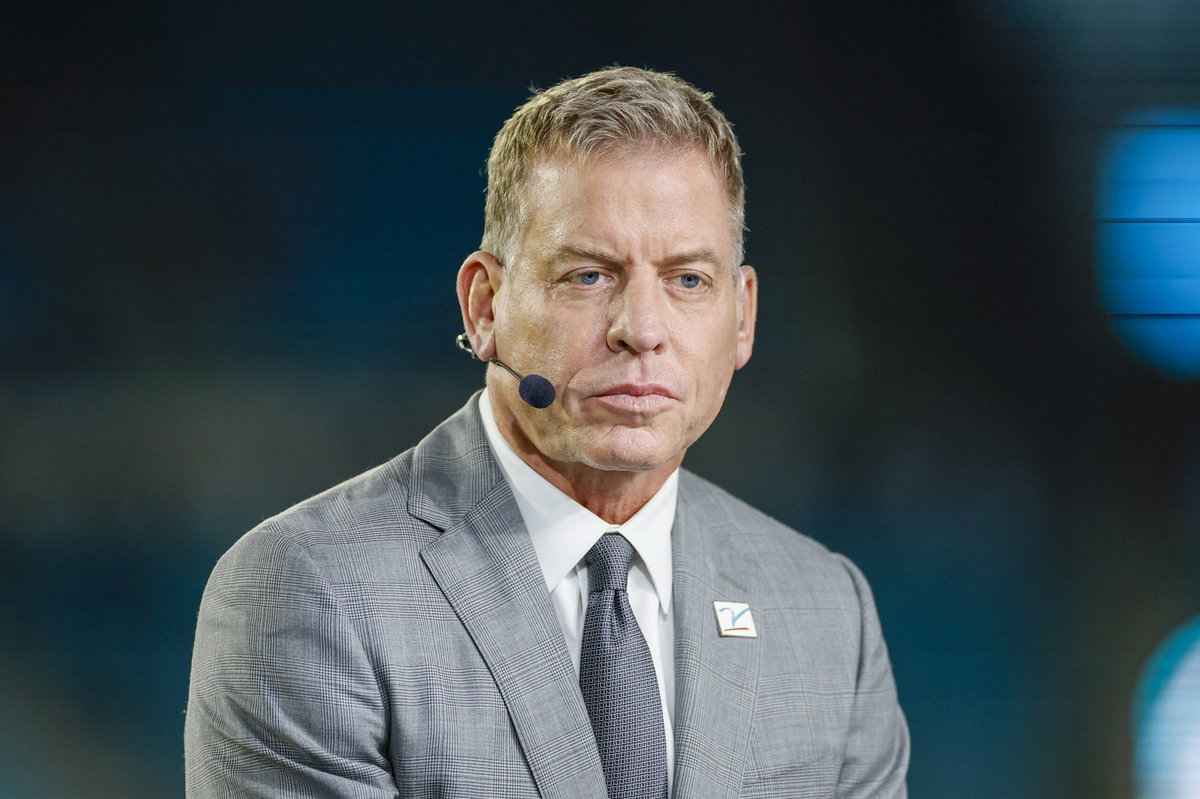
For years, Troy Aikman and Joe Buck have been among the NFL’s most recognizable broadcast pairings, moving together from Fox to ESPN’s Monday Night Football booth in 2022. So when ESPN reportedly locked Buck into a six-year, $108 million extension that keeps him as the voice of Monday Night Football into the 2030s, the natural assumption was that Aikman’s new deal would follow. But that hasn’t happened.
Watch What’s Trending Now!
Aikman’s own five-year, $90 million contract runs out after the Super Bowl this February, and the silence has started to speak louder than Buck’s news. Yet Aikman’s side of the equation appears far more complicated, and one possible reason has less to do with how ESPN values him than with the market Tom Brady created.
Shortly after Aikman signed at $18 million a year, Brady reset the market for game analysts with a 10-year, $37.5 million-per-year deal at Fox, which raises the question of whether that gap is now making a new Aikman contract harder to agree on. Front Office Sports reported that multiple sources warn no deal is imminent, and one of them put the delay bluntly.
“Why wasn’t Troy renewed at the same time as Joe?” writer Michael McCarthy wrote in his Front Office Sports report.
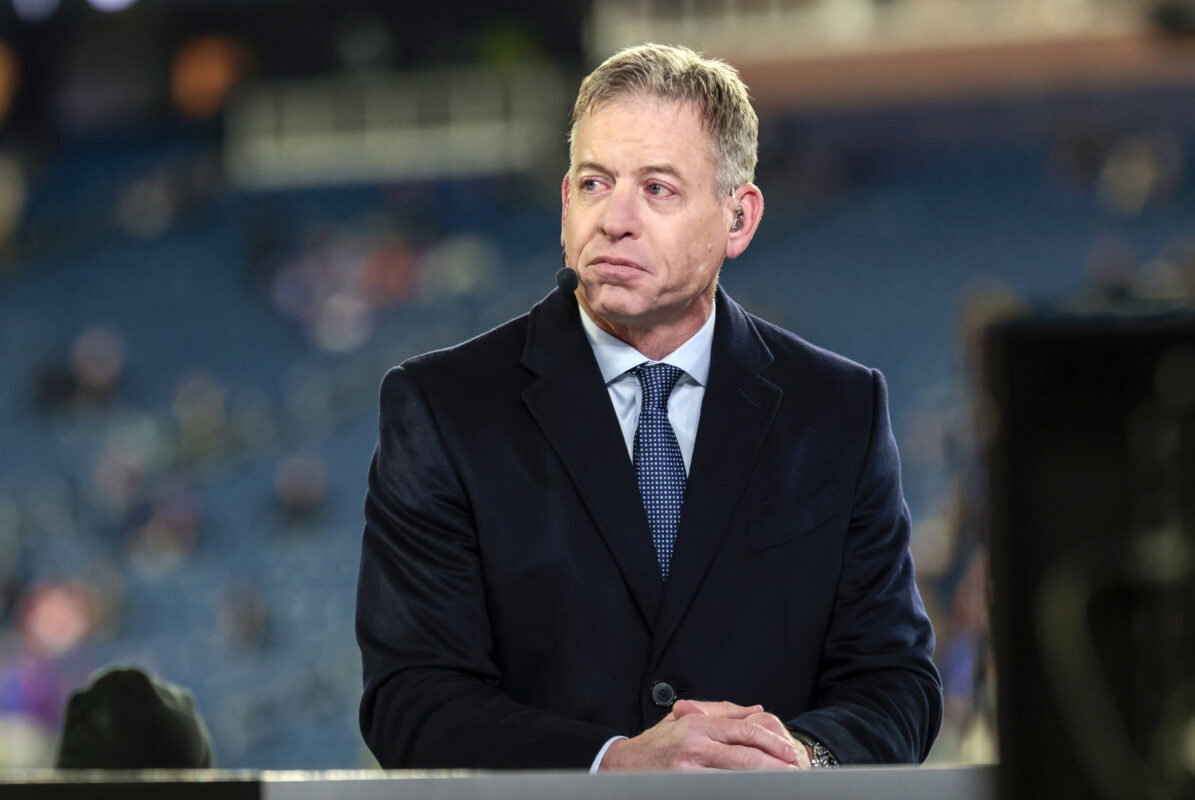
Imago
FOXBOROUGH, MA – DECEMBER 01: Troy Aikman on the panel for ESPNÕs Monday Night Countdown in warm up before a game between the New England Patriots and the New York Giants on December 1, 2025, at Gillette Stadium in Foxborough, Massachusetts. Photo by Fred Kfoury III/Icon Sportswire NFL, American Football Herren, USA DEC 01 Giants at Patriots EDITORIAL USE ONLY Icon482251201051
“Troy Aikman’s negotiations with ESPN have been complicated,” Front Office Sports wrote on X @FOS. “Despite Joe Buck landing a six-year, $100 million-plus extension, Aikman’s isn’t expected anytime soon, sources tell FOS.”
That question points to the first and most obvious obstacle: money.
Hall of Fame, Troy Aikman, is finishing a five-year contract that pays him $18 million a year, tying him with Tony Romo as the league’s second-highest-paid game analyst, per Spotrac. The problem is who sits above them. Shortly after Aikman signed in 2022, Brady arrived at Fox on a 10-year deal worth $37.5 million a year, roughly double what Aikman earns. Buck’s reported extension lifts his own salary from $15 million to $18 million, a 20% raise. Give Aikman the same bump, and he reaches $21.6 million, enough to pass Romo but still nowhere near Brady.
If Aikman is aiming for a Brady-sized payday, the two sides may simply be too far apart for a quick agreement.
But the money is only part of the story, and Aikman has shown before that pay isn’t always what drives his decisions. When Fox committed to Brady in 2022, Aikman had spent two decades there and called six Super Bowls alongside Buck. He later said his frustration wasn’t about dollars but about communication.
“They never made an offer,” he said, speaking to a Dallas sports radio station. “I didn’t have any conversations with Fox until I got a call to congratulate me on my new deal. So that was a decision they made—and it’s fine.”
He added that it was Fox’s decision to renew and that he was fine with it. That history matters now because it suggests Aikman puts a high value on being kept in the loop, which makes ESPN’s silence on his contract a more delicate subject than it might be for another star.
Then there’s the performance argument, which may be hard for ESPN to dismiss. As reported by multiple analysts, Brady improved noticeably in his second year on the air, but Aikman’s experience and willingness to speak bluntly still make him the top NFL analyst on television.
ESPN’s own numbers help his case.
His Week 1 Monday Night Football telecast between the Kansas City Chiefs and Denver Broncos averaged 23.2 million viewers, ESPN’s biggest Week 1 audience for the package since it landed Monday Night Football in 2006. With that kind of momentum, Aikman has a strong case for a raise, though ESPN could counter that Brady’s contract was an outlier that won’t be repeated.
The third factor is leverage, and both sides have some: Romo’s status at CBS is uncertain after he was placed on indefinite leave, and Greg Olsen, Kirk Herbstreit, and J.J. Watt all have deals expiring after this season. That gives Aikman possible suitors at CBS and Amazon, while ESPN could look to Olsen or Watt, or wait for a star like Travis Kelce or Sean McVay to move into broadcasting.
Aikman himself may also be another factor. He turns 60 in November, has been calling games for 25 years, and has told Richard Deitsch he doesn’t see himself behind a microphone at 70. He said there are things he wants to see and do.
“I’ve not had falls off since I was a kid,” Aikman said. “So there’s just things I want to be able to go do, and things I want to see, before my time on Earth is done. And I want to be able to do it in the fall,” he said.
A long-term extension may not fit that plan.
ESPN’s Stance on Troy Aikman’s Future Emerges After Joe Buck’s Contract Extension
For now, ESPN isn’t saying much.
“With this historic season for ESPN now underway, our entire focus is on bringing fans the best possible football coverage, culminating with our first Super Bowl,” the network’s communications executive, Josh Krulewitz, said.
Meanwhile, Aikman was equally candid about where things stand.
“I thought it would be done. It’s not. When it might get done, if it gets done, is anyone’s guess,” Aikman told Deitsch. “And it’s just something that I’m really putting a lot of energy into.”
Adding that when a deal might come, or whether it will, is anyone’s guess. He also said he’s putting a lot of energy into it. The smart money still favors the two sides reaching an agreement, but if they don’t, Aikman could become the biggest free agent in sports television since Brady.