
While the rumor and speculation mill starts early, with analysts and fans often feeling confident they can predict where a player will land, some prospects are hard to fully project. This year is no different. Positional value has dominated how NFL teams think going into the event, but with safeties, running backs, and linebackers among the strongest position groups in this year’s class, there’s a real argument for teams to rethink that approach. It makes for some really interesting conversations going into the draft about the ceiling/floor for prospects.
Watch What’s Trending Now!
10 names stand out to me when discussing their true landing spot in the draft this year. Here’s where I see their ceilings, floors, and best fits in the NFL.
Sonny Styles, LB, Indiana
Ceiling: No. 2 Overall
Floor: No. 7 Overall
Best Fit: New York Giants
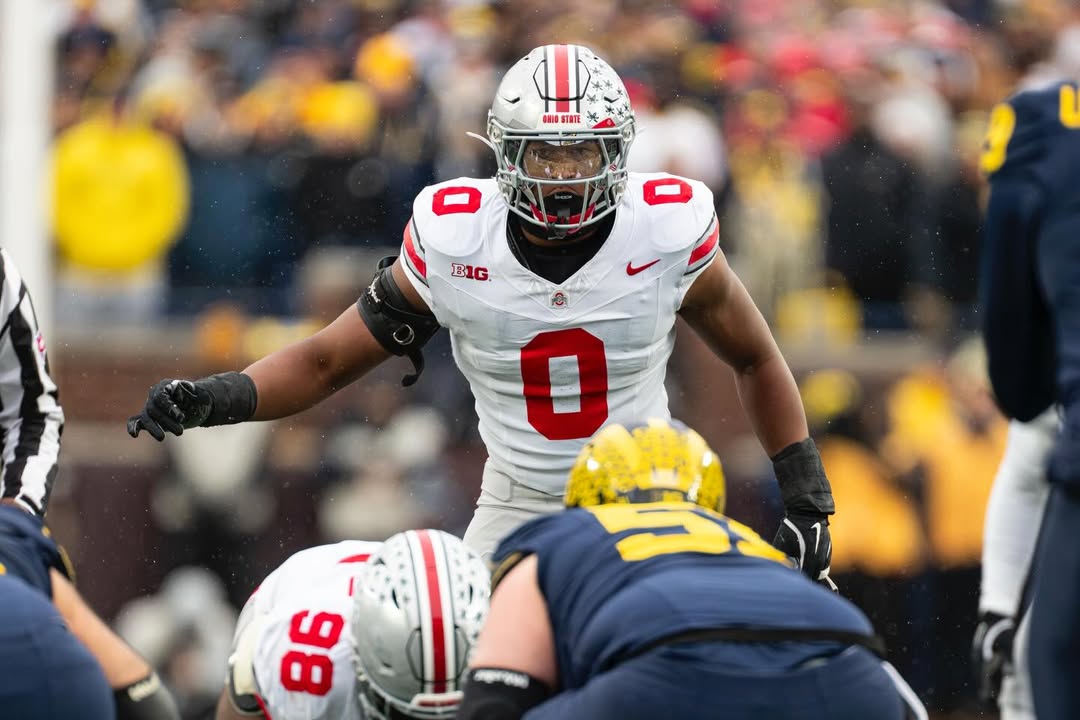
Styles will be a top-10 pick in this draft. There’s just no way I see him falling past the Washington Commanders at No. 7 overall. He’s widely viewed as the top off-ball linebacker in the class and one of the rare second-level defenders with true three-down versatility, which keeps his projection insulated even in a draft that traditionally deprioritizes the position. He has the moxy and the playstyle that would excite a head coach like Dan Quinn. Quinn’s defenses historically lean on length, speed, and second-level range to unlock pressure looks without always sending extra rushers—Styles checks every one of those boxes. The ceiling part is where it gets interesting. Will the New York Jets consider taking a linebacker at No. 2 overall? It probably won’t happen, but I believe there should be a conversation.
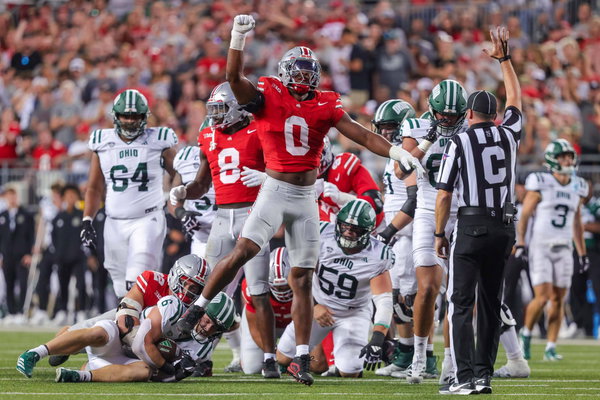
Imago
September 13, 2025, Columbus, Ohio, U.S: Ohio State Buckeyes linebacker Sonny Styles 0 reacts after a defensive stop during the game between the Ohio Bobcats and the Ohio State Buckeyes at Ohio Stadium, Columbus, Ohio. Columbus U.S – ZUMAs304 20250913_zaf_s304_038 Copyright: xScottxStuartx
The Jets didn’t get an interception last season, and pass rush helps with that, but having a dominant linebacker leading your defense can help, especially one whose background as a former safety still shows up in coverage spacing, route recognition, and sideline-to-sideline closing burst. New York signed Demario Davis in free agency, but he’s 37 years old. That’s not the long-term solution; if New York wanted a difference maker, Styles is an option. More importantly, Styles profiles as the kind of movable second-level defender who can erase tight ends, carry backs vertically, and still trigger downhill against the run, traits that are increasingly rare at his size and exactly why his ceiling discussion belongs inside the top two picks even if positional value argues otherwise.
In terms of best fit, the New York Giants would make perfect sense. The team has a versatile and dangerous defensive line that’ll allow Styles to operate as freely as he did at the Ohio State Buckeyes football. He’s at his best when kept clean and allowed to attack gaps decisively rather than stack blocks snap after snap, and New York’s front structure already creates those kinds of second-level run lanes. My comp for Styles was Tremaine Edmunds, who is around the same size at 6-foot-4 and 251 pounds. Like Edmunds early in his career, Styles wins first with length, range, and coverage flexibility before refinement as a block-disengager fully catches up to his physical profile. Edmunds could help Styles acclimate to the NFL, and at the very least, the head coach (likely defensive decision-makers in New York’s current structure) would also like to have a dynamic weapon like Styles on his defense.
Carnell Tate, WR, Ohio State
Ceiling: No. 4 Overall
Floor: No. 16 Overall
Best Fit: New Orleans Saints
I’ve had Tate as an option for the Tennessee Titans at No. 4 overall for months. The argument for giving Cam Ward help is a legitimate one, and while many automatically go to Jeremiyah Love as that help, it is fair, but the Titans have a decent running back room with Tony Pollard and Tyjae Spears. Their receiving room is led by Calvin Ridley, and the team just signed Wan’Dale Robinson to a $78 million contract. They could use Tate’s vertical threat. More importantly, Tate profiles as a true boundary “X” receiver with elite ball-tracking ability and one of the most reliable catch radii in the class, which gives a young quarterback a margin-for-error target rather than just another complementary weapon. For a team building around Ward’s downfield aggression and timing throws outside the numbers, that type of receiver becomes a structural fit rather than a luxury pick.
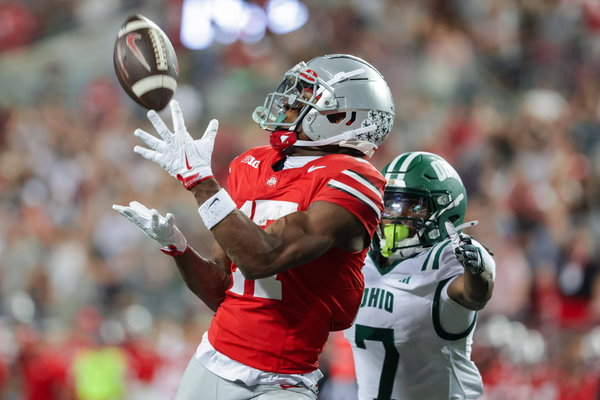
Imago
September 13, 2025, Columbus, Ohio, U.S: Ohio State Buckeyes wide receiver Carnell Tate 17 catches a pass in front of Ohio Bobcats cornerback Tank Pearson 7 for a touchdown during the game between the Ohio Bobcats and the Ohio State Buckeyes at Ohio Stadium, Columbus, Ohio. Columbus U.S – ZUMAs304 20250913_zaf_s304_010 Copyright: xScottxStuartx
There have been rumors that the Jets would trade up from 16 to the top 10 to pick Tate. As we get closer, I think that’s likely, but in terms of floor for Tate, he won’t make it past the Jets with the 16th overall pick. That floor makes sense when you consider Tate is widely viewed as either WR1 in the class or firmly in the top receiver tier, and polished route technicians with his contested-catch consistency and separation efficiency rarely slide deep into the middle of Round 1. Even teams that don’t need a pure vertical burner still value receivers who consistently win leverage, track the ball cleanly over the shoulder, and convert tight-window throws, traits Tate already shows at an NFL-ready level.
The New Orleans Saints have to be the best option for Tate. The team needs the type of weapon he is, and he’ll fit in perfectly into what Tyler Shough loves to do as a quarterback: push the ball down the field. Shough’s profile has always leaned toward attacking intermediate and vertical windows outside the numbers, and Tate’s stride length, timing at the catch point, and boundary awareness naturally expand that part of the field. He doesn’t have to worry about carrying the offense with playmakers like Chris Olave and Travis Etienne on the roster. Instead, Tate would project as the kind of high-volume secondary perimeter target who benefits from coverage rotation toward Olave while still giving the Saints a reliable third-down and red-zone option early in his career, a role that matches his current strengths as a precision separator and quarterback-friendly target rather than a pure yards-after-catch creator.
Makai Lemon, WR, USC
Ceiling: No. 8 Overall
Floor: No. 24 Overall
Best Fit: Los Angeles Rams
Lemon is a slot receiver, which limits his ceiling, but with the Saints at No. 8, I can see head coach Kellen Moore loving his toughness and twitch as a receiver. Moore’s offenses have consistently leaned on quick-processing slot targets who can win early in routes and keep the passing game on schedule, and Lemon’s short-area burst and spatial awareness make him exactly that type of chain-moving option. He’d fit right into the slot and give Shough even more weapons to target as the Saints try to find out what they truly have in Shough moving forward. More importantly, Lemon profiles as the kind of receiver who separates with timing and leverage rather than pure speed, which tends to translate quickly for quarterbacks still settling into a system.
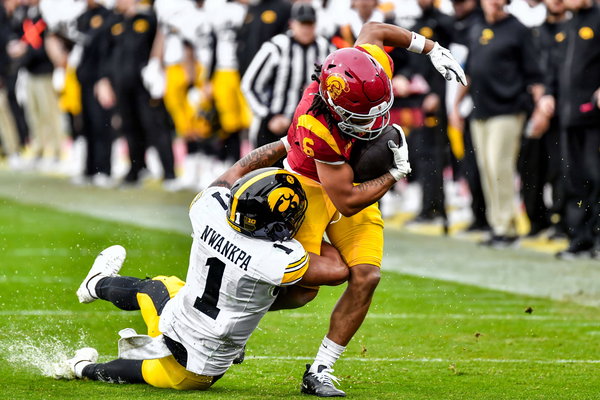
Imago
November 15, 2025 Los Angeles, CA.USC Trojans wide receiver Makai Lemon 6 makes the catch as Iowa Hawkeyes defensive back Xavier Nwankpa 1 fends and makes the tackle in action in the third quarter during the NCAA, College League, USA Football game between the Iowa Hawkeyes and the USC Trojans at the Coliseum in Los Angeles, California..Mandatory Photo Credit: /Cal Media Los Angeles United States of America – ZUMAc04_ 20251115_zma_c04_1250 Copyright: xLouisxLopezx
The floor is steep here with the Cleveland Browns at 24 overall, but honestly, I feel like Lemon could slip into the 20s. He’s a true slot receiver who is 5-foot-11 and ran a 4.5 40. He doesn’t have elite athletic ability or the measurables that warrant a top-10 pick. Historically, that archetype, slot-leaning receivers without elite size or verified top-tier long speed, often gets pushed down boards despite strong production and route polish, simply because teams still prioritize boundary traits early in Round 1.
Looking at the tape, it’s understandable why some have him as their No. 1 receiver, but given how the NFL values first-round picks, I can see a world in which Lemon falls short due to his natural size. At the same time, his ability to consistently uncover against man coverage and adjust through contact at the catch point keeps his floor from sliding too far, which is why the low-20s range feels like a realistic landing window rather than a true drop.
Los Angeles Rams head coach Sean McVay would be giddy to add Lemon to his offense. McVay’s system has long prioritized receivers who can win quickly inside structure and create throwing windows between the numbers, and Lemon’s route tempo, body control, and awareness against zone coverage align naturally with that philosophy. Puka Nacua, Davante Adams, and Lemon would be a nightmare for NFL teams. With coverage already tilted toward Nacua’s physicality and Adams’ boundary precision, Lemon would project as the movable interior separator who stresses nickel defenders and linebackers in motion-heavy looks. Any offensive player should dream of going to the Rams, because quite frankly, it’s one of the best cultures to enter in the NFL.
For Lemon specifically, it’s also the type of environment where slot receivers are featured as primary progression options rather than complementary pieces, which raises both his early-career impact and long-term ceiling within the offense.
Monroe Freeling, OT, Georgia
Ceiling: No. 6 Overall
Floor: No. 24 Overall
Best Fit: Philadelphia Eagles
It’s funny how the ceiling and floor are both the Browns for Freeling, but that’s the most likely scenario. After the combine, there were reports that the Browns wanted Freeling at No. 6 overall following his workout. That interest makes sense when you consider how rare his movement profile is for a tackle his size, teams consistently prioritize length and edge-mirroring ability when projecting franchise left tackles, and Freeling checks both boxes at a high level. He has the size and strength to be a dominant left tackle in the league, and when you mix that with elite athleticism, it’s understandable why teams would want him in the top-10. In fact, some evaluators view him as one of the highest-upside tackle prospects in the class precisely because his frame, reach, and recovery ability allow him to stay attached to speed rushers in ways most college tackles cannot.
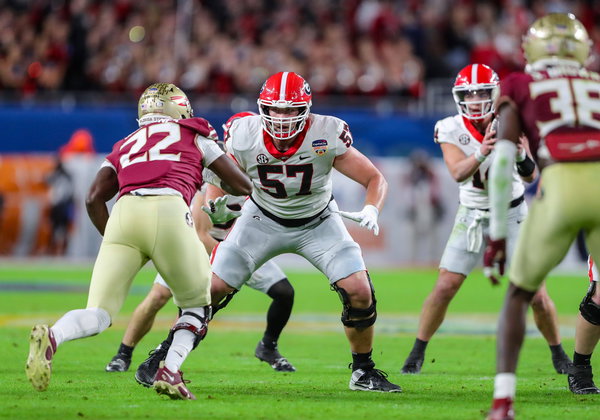
Imago
NCAA, College League, USA Football 2023: Capital One Orange Bowl Georgia vs Florida State Dec 30 December 30, 2023:.Georgia Bulldogs offensive lineman Monroe Freeling 57 blocks Florida State Seminoles defensive lineman Jaden Jones 22 during the second half of the Capital One Orange Bowl between the University of Georgia Bulldogs and the Florida State University Seminoles at Hard Rock Stadium in Miami Gardens, FL. Ron Lane/CSM Credit Image: Ron Lane/Cal Media Miami Gardens FL United States of America EDITORIAL USE ONLY Copyright: xx ZUMA-20231230_zma_c04_434.jpg RonxLanex csmphotothree217364
The problem is his up-and-down tape. He’s very raw as a prospect, which is why I don’t see him going in the top-10, but I don’t envision a world where he makes it past Cleveland with its second first-round pick. That inconsistency shows up mostly in his hand timing, leverage control, and balance through contact, common issues for long-framed tackles who are still learning to play within their body, but they’re also the exact type of technical flaws teams believe they can clean up at the next level. Because he’s still relatively inexperienced as a full-time starter, his evaluation becomes more projection-based than production-based, which explains both the top-10 ceiling and the mid-first-round floor existing at the same time.
Philadelphia would be a great landing spot for Freeling. The team has an impending tackle need amid uncertainty about how much longer Lane Johnson will play in the NFL. With the development Freeling would need, he’d benefit from sitting behind Johnson and Jordan Mailata for a year to learn and take over if one of them went down with an injury. More importantly, Philadelphia has consistently been one of the league’s best environments for developing offensive linemen, especially longer tackles who need refinement in pass-set timing and anchor strength. Freeling wouldn’t be forced into early snaps there, which is exactly the type of developmental runway a traits-heavy prospect like him typically needs before reaching his ceiling as a long-term blindside protector.
Keldric Faulk, EDGE, Auburn
Ceiling: No. 11 Overall
Floor: No. 30 Overall
Best Fit: Chicago Bears
It’s another player on this list where I feel like the ceiling and floor are with one team. The Miami Dolphinscan go anywhere in the first round of this draft, and one player who keeps getting linked to them is Faulk. He’s 20 years old and has had only two sacks this season with Auburn; he’s raw and needs time to develop. That limited sack production is part of the evaluation challenge with Faulk, because his projection is built more on traits than finish numbers; teams are betting on his size, length, and alignment versatility, translating into pressure once his pass-rush plan becomes more consistent.
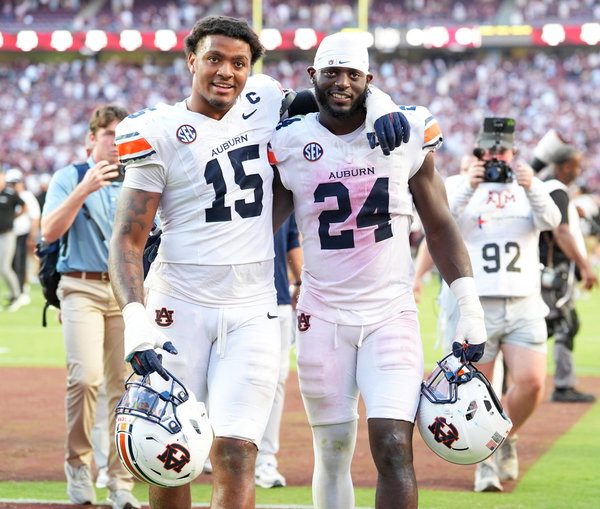
Imago
September 27, 2025, College Station, Texas, USA: Auburn defensive end KELDRIC FAULK 15 and Auburn defensive end KEYRON CRAWFORD 24 after a college football game between the Texas A&M Aggies and the Auburn Tigers on September 27, 2025 in College Station, Texas. Texas A&M won, 16-10. College Station USA – ZUMAc201 20250927_zap_c201_025 Copyright: xScottxColemanx
There’s no better place to do that than a team that clearly isn’t ready to win now. Faulk wouldn’t have to worry about being productive in his first year, and he can develop with the help of head coach Jeff Hafley. I think he fits the 3-4 defense the Dolphins would run, so I feel like his floor has to be the Dolphins at 30th, and he can go as high as 11 to the Dolphins. More importantly, Faulk’s frame and play style already resemble the kind of two-gap capable edge defenders teams value in hybrid fronts, where setting the edge on early downs matters just as much as generating pressure. That versatility is exactly why his range realistically stretches across the middle of Round 1 rather than slipping into Day 2 territory.
The fit is a hard one to project for Faulk, because there are plenty of teams where I feel he can thrive. I ended up going with the Chicago Bears because of what defensive coordinator Dennis Allen typically likes in his edges. The Bears play in the NFC North, and they’ll face teams that like to run the ball, and at the very least, Faulk can help in that aspect of the game. Allen’s fronts have historically leaned on long, strong edges who can control tackles at the point of attack before expanding their pass-rush roles over time, and Faulk already shows that kind of early-down reliability.
He’s an elite run defender with his heavy hands, despite the lack of pass-rushing numbers he put up in college. At 6-foot-6 and roughly 280 pounds with uncommon length, he consistently holds the edge and disrupts run fits, which gives him a higher early-career floor than his sack totals alone might suggest.
Jacob Rodriguez, LB, Texas Tech
Ceiling: No. 20 Overall
Floor: No. 46 Overall
Best Fit: Buffalo Bills
Rodriguez is one of the more polarizing players to try to predict. He finished fifth in Heisman voting and was an ultra-productive linebacker for Texas Tech this past season. That level of national recognition for an off-ball linebacker is rare and reflects just how central he was to Texas Tech’s defensive production, especially as both a tackling presence and coverage disruptor. His worry was his speed, but after a 4.57 40 at the combine, there aren’t many questions remaining about his game. For evaluators, that testing result mattered because it confirmed what showed up on tape: Rodriguez consistently plays faster than expected when triggering downhill or carrying routes across the middle.
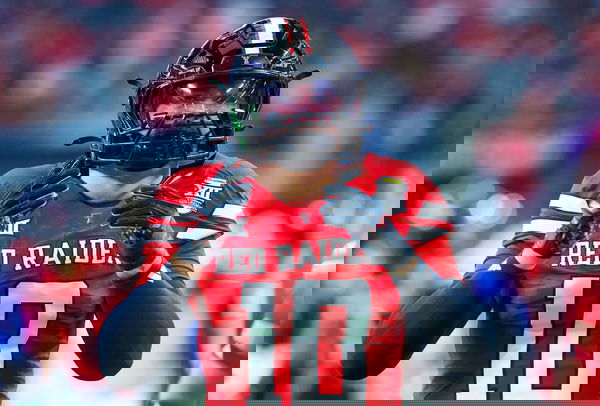
Imago
NCAA, College League, USA Football: Big 12 Championship-BYU vs Texas Tech Dec 6, 2025 Arlington, TX, USA Texas Tech Red Raiders linebacker Jacob Rodriguez 10 warms up before the game against the BYU Cougars at AT&T Stadium. Arlington AT&T Stadium TX USA, EDITORIAL USE ONLY PUBLICATIONxINxGERxSUIxAUTxONLY Copyright: xKevinxJairajx 20251206_krj_aj6_00012851
That’s why his ceiling is Dallas Cowboys at 20; they need a linebacker, and if they can’t land Styles via trade, Rodriguez could be a real option for them at 20, since they don’t have a second-round pick. Without a Day-2 selection to address the position later, Dallas has added incentive to secure a three-down linebacker early, and Rodriguez’s instincts and tackling reliability make him one of the safer projections available in that range.
The floor is the Tampa Bay Buccaneers in the second round. I can see Rodriguez falling this far, but I can’t imagine Tampa Bay passing on him, especially after the retirement of Lavonte David. They need a playmaker on the second level of their defense, and Rodriguez can be that. Tampa Bay’s defense has long depended on rangy inside linebackers who can stay on the field in passing situations, and Rodriguez already profiles as that type of modern second-level defender rather than a run-only specialist.
His best fit would be the Buffalo Bills for me at 26. I know Buffalo wants a receiver in this slot, but the run defense wasn’t good last season, and they need a difference maker on that side of the ball. The team is switching from a 4-3 to a 3-4, and Rodriguez has the speed and knack for finding the ball to play as one of the two inside backers. His processing speed between the tackles and ability to diagnose blocking concepts quickly translate well to interior linebacker responsibilities in hybrid fronts, where reaction time often matters more than pure size. He’s the best pass coverage linebacker in this class, with his elite instincts. What separates him in coverage is his route anticipation and comfort dropping into intermediate windows rather than simply reacting after the throw, which is why several evaluators view him as one of the more scheme-flexible coverage linebackers available in this draft class.
Zion Young, EDGE, Missouri
Ceiling: No. 15 Overall
Floor: No. 31 Overall
Best Fit: Los Angeles Chargers
The range for Young starts at 15 for me with Tampa Bay, and simply because they need pass rush help. I’ve had them circled as a team that needs a pass rusher in the first two rounds, and the heavy hands of Young would fit into head coach Todd Bowles’ defense easily. Bowles’ fronts have consistently relied on long, physical edge defenders who can compress the pocket from wide alignments while still setting a firm edge against the run, and Young already shows that kind of early-down strength at the point of attack. That combination of power through contact and leverage control is part of why he projects as a reliable rotational contributor early rather than a developmental-only pass rusher.
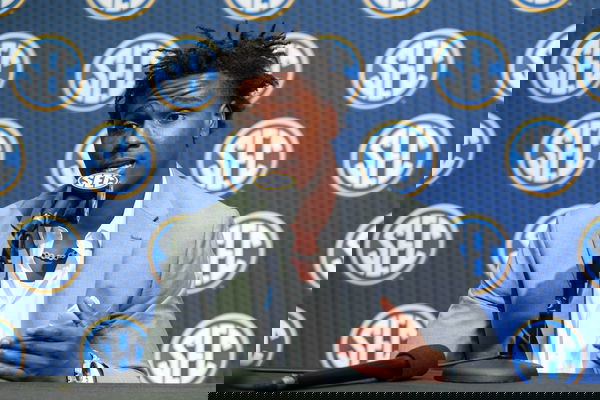
Imago
NCAA, College League, USA Football: SEC Media Day Jul 17, 2025 Atlanta, GA, USA Missouri Tigers defensive end Zion Young talks to the media during the SEC Media Days at Omni Atlanta Hotel. Atlanta Omni Atlanta Hotel GA USA, EDITORIAL USE ONLY PUBLICATIONxINxGERxSUIxAUTxONLY Copyright: xJordanxGodfreex 20250717_jhp_th5_0212
I fully expect Young to be a first-round pick on Thursday. The floor has to be the New England Patriots. Young’s playstyle and willingness to play the run are traits that head coach Mike Vrabel would love. Vrabel-led defenses historically prioritize edges who play with discipline on early downs before expanding their pass-rush toolbox, and Young’s physicality against tackles and tight ends fits that mold well. Even if his sack production hasn’t fully matched his pressure flashes yet, teams tend to trust prospects who consistently win the edge-setting phase of the rep, which helps stabilize his late-first-round floor.
In terms of development and being able to truly learn how to rush the passer, the Los Angeles Chargers have to be the best fit for Young. The team re-signed Khalil Mack to a one-year deal, and Mack shares the same power profile Young uses in his rushes. Mack could help Young develop as a pass rusher and help him take the next step in his game. More importantly, learning behind a veteran power-based edge like Mack would give Young time to refine his hand usage, counter sequencing, and inside moves, areas where his flashes already show up, but consistency is still developing. That kind of developmental runway is exactly what allows traits-heavy edge defenders with strong run-defense floors to convert pressure into finishing production at the next level.
Kadyn Proctor, OT, Alabama
Ceiling: No. 6 Overall
Floor: No. 29 Overall
Best Fit: Detroit Lions
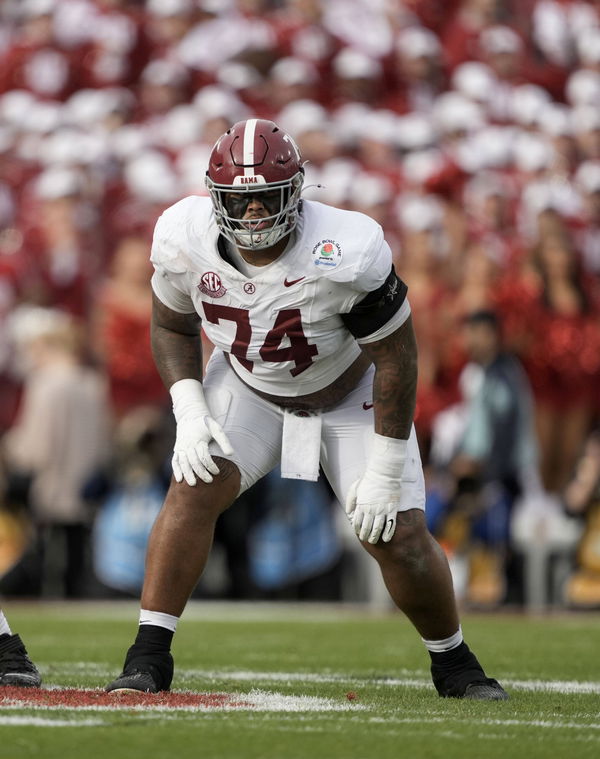
The Browns have such an obvious tackle need that every single tackle in this class seems to be linked to them, and they reportedly have Proctor high on their board. His range for me starts with them at No. 6 overall come Thursday. That connection makes sense because teams looking for long-term blindside protectors consistently prioritize length and frame projection early in Round 1, and Proctor’s physical profile fits the prototype of a franchise left tackle, even if his technique is still developing.
Imago
January 01, 2026 Alabama Crimson Tide offensive lineman Kadyn Proctor 74 in action during the College Football Playoff Quarterfinal between the Indiana Hoosiers and the Alabama Crimson Tide at the Rose Bowl in Pasadena, California. Mandatory Photo Credit : /CSM Pasadena United States of America – ZUMAc04_ 20260101_zma_c04_567 Copyright: xCharlesxBausx
There’s a world, it’s all smoke with Proctor in the top-10, and he falls. He’s a big man at 6-foot-7 and 352 pounds and has the size of an elite NFL tackle. The tape is just inconsistent. That’s why there’s a world I can see Proctor falling into the 20s. Most of that inconsistency shows up in pass-set timing and leverage control rather than effort or physical limitations, which is why evaluators still view him as a high-upside projection instead of a risky profile.
I don’t think the Kansas City Chiefs would go tackle in the top-10, which is why I don’t have him making it past them with the 29th pick. For teams picking later in Round 1, that kind of traits-heavy tackle prospect often becomes especially attractive because the developmental timeline is easier to manage when he isn’t expected to anchor the offensive line immediately.
Just reading the size of Proctor, doesn’t it seem obvious Detroit Lions head coach Dan Campbell would love this guy? The Lions would be a perfect fit for Proctor to start immediately at left tackle and get reps at the NFL level. Detroit’s offensive line identity has consistently leaned toward powerful, movement-capable tackles who can generate displacement in the run game while growing into their pass protection roles, and Proctor’s frame naturally fits that approach. He has the size to be dominant; he just needs to work on the power.
Once his lower-body anchor and hand placement become more consistent, he has the physical tools to handle both speed-to-power rushers and wide alignments on the edge, which is why his ceiling remains firmly inside the top 10 despite the uneven tape.
Chris Johnson, CB, San Diego State
Ceiling: No. 20 Overall
Floor: No. 44 Overall
Best Fit: Seattle Seahawks
Cowboys need help at corner, and Johnson’s ceiling should start with them at 20. Expecting Mansoor Delane and Jermod McCoy to be gone by then, Johnson would be the next corner on my board. He didn’t play the hardest competition at San Diego State, but that shouldn’t be used to knock a player who only allowed a 16.1 passer rating this season with the Aztecs. Production like that still translates across levels because evaluators care less about opponent strength and more about coverage consistency, route recognition, and ball-tracking reliability, areas where Johnson’s tape remains strong regardless of competition tier.
With him playing at San Diego State, I could see him falling to Day 2. I just don’t see a world in which he makes it past the Jets with the 44th pick. New York had zero interceptions in 2025, and Johnson has the elite eyes and aggressiveness to help address that. Corners who consistently trigger downhill on throws and trust their leverage in off coverage tend to generate turnover opportunities even before they become true shutdown defenders, which is why Johnson’s instincts give him a realistic early-impact projection at the next level.
Any cornerback in this draft should be praying to land in Seattle. The team let Riq Woolen walk in free agency, leaving them with an outside corner need. Head coach Mike Macdonald is an absolute psycho when it comes to calling defenses, and with the elite eyes Johnson has, he could thrive in Seattle’s scheme.
Macdonald’s defenses rely heavily on disguise and pattern-match principles that reward corners who process route combinations quickly rather than simply relying on recovery speed, and Johnson’s anticipation skills fit naturally into that type of structure. That makes Seattle an especially strong landing spot for a corner whose strengths show up most clearly when he’s allowed to read and react instead of playing purely mirror-man coverage every snap.
Peter Woods, DT, Clemson
Ceiling: No. 19 Overall
Floor: No. 49 Overall
Best Fit: Houston Texans
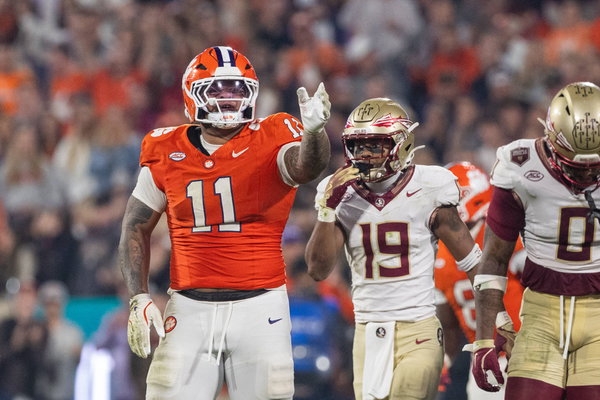
The Panthers don’t necessarily need a defensive tackle, but they need help in terms of pass rush. Woods is a smaller tackle and has the versatility to line up along the entire defensive line. It’s not a likely pick, but I can see this as the ceiling for Woods on night one of the NFL draft. He brings more pass rush juice and can push the field vertically; he’s also capable of stopping the run. That interior pass-rush ability is what keeps Woods in the Round-1 conversation, because disruptive penetration from defensive tackles has become one of the most valuable traits in modern fronts that prioritize collapsing the pocket quickly.
Imago
NCAA, College League, USA Football 2025: Florida State At Clemson Nov 08 November 8, 2025: Clemson Tigers defensive tackle Peter Woods 11 celebrates after getting a first down against the Florida State Seminoles in the second half of the NCAA Football matchup at Memorial Stadium in Clemson, SC. Scott Kinser/CSM Credit Image: Scott Kinser/Cal Media Clemson Sc United States EDITORIAL USE ONLY Copyright: xx ZUMA-20251108_zma_c04_241.jpg ScottxKinserx csmphotothree440242
I see Woods falling to the second round, but not that far. The Minnesota Vikings have a defensive tackle need, and it’s hard to imagine they’ll pass on him at 49. He gives them the needed pass-rush ability, especially with reports that the team will trade Jonathan Greenard before next season. Interior defenders who can create pressure without requiring blitz support tend to stabilize defensive fronts quickly, which makes Woods a logical fit for teams looking to generate disruption from the inside rather than relying exclusively on edge pressure.
The Texans’ front is always attacking and wants to push the pocket. That’s where Woods would thrive. Having edges like Will Anderson Jr. and Danielle Hunter, who are problems on the edge, would give Woods more one-on-one pass rush opportunities where he’ll thrive. I can’t imagine a better fit for Woods going into the NFL. With protections often sliding toward Anderson and Hunter on passing downs, Woods would likely see favorable interior matchups early in his career, which is exactly the environment where penetrating three-technique defenders tend to translate production fastest at the next level.
Written by

Edited by

Kinjal Talreja