
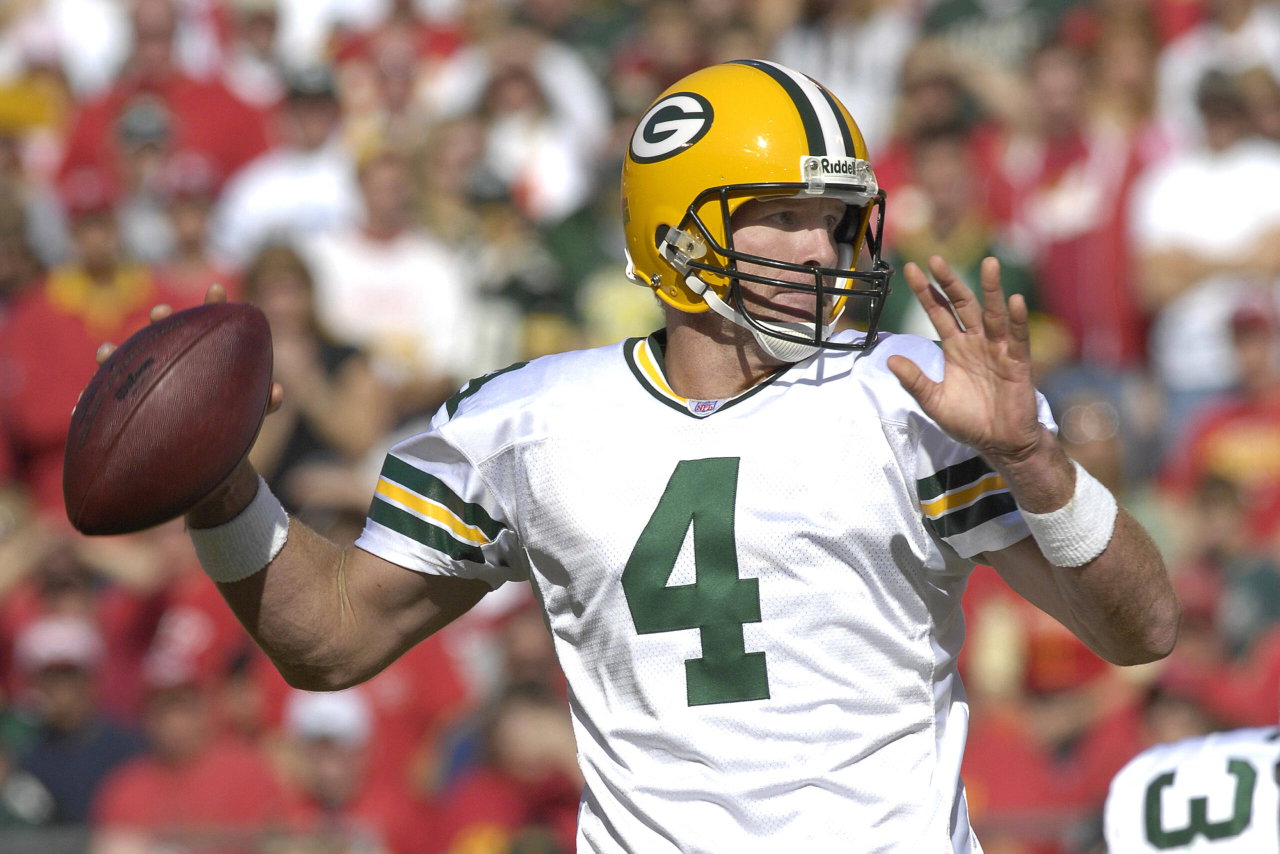
Brett Favre spent his early Green Bay Packers years working under a coaching staff that would go on to define an entire generation of NFL football. Sitting down recently with Jon and Jay Gruden on the Gruden Family Football Show, the Hall of Fame quarterback revisited a single late-game decision that could have derailed everyone’s career if it had gone wrong.
Watch What’s Trending Now!
It’s December 18, 1994, the Packers’ final game at Milwaukee County Stadium. Trailing the Atlanta Falcons late in the fourth quarter, Green Bay reached Atlanta’s 9-yard line with no timeouts left and the season’s playoff hopes on the line. In the huddle, Favre said then-head coach Mike Holmgren gave him one clear instruction: Do not run. Gruden saw it all playing out from the sideline.
Favre scrambled with only seconds left on the clock and ran the remaining distance to the end zone for a score.
“That took a lot of b—s, though,” Gruden, an assistant coach in the Packers’ staff at the time, said during the interview. “If you don’t make it, we lose. We probably all get fired. All of us. Andy Reid, Holmgren, all of us. If you get tackled and we lose that game because you scramble, we’re fired.”
Favre explained what actually went through his head in that moment.
“Well, I really leaned on what I trusted the most at that time. I don’t believe the post was there. I mean, I would have had to really squeeze one in, and that would have probably been riskier than the scramble itself. Most of my plays like that, similar plays like that, were spontaneous. Obviously, it was not thought out. It was not a big process. It just felt like the right thing to do,” Favre said.
Green Bay needed a play, and Brett Favre made it himself. He rolled to his right, found a lane, and stretched the ball over the goal line for a 9-yard touchdown. It finished off a 1:58 drive and gave the Packers a 21-17 lead. Favre finished the game 29-of-44 for 321 yards and two touchdowns, while the win kept the Packers’ playoff hopes alive going into the final week.
The decision was not something Favre had carefully mapped out before the snap.
“I have no idea. Half the things I do out there just happen,” Favre said of the moment. “I used to make bad decisions and get into trouble. This was one where I felt I could get in.”
Brett Favre was always a gunslinger, as he had been labeled once by Holmgren himself. He was always ready to make the plays that needed guts, even if it required him to put himself on the line.
In a conversation with ESPN SportsCenter in 2016, Holmgren recalled how an injured Brett Favre played through the risk of aggravating the blow vs. the Chicago Bears. The quarterback had not practiced in the days leading up to the game, and Holmgren was hesitant to trot him out. However, Favre played and posted five passing touchdowns in that game. He could not run because of the injury.
That mindset and style of play won Favre three straight NFL MVP awards and a Super Bowl XXXI title in 1996, helping turn that Packers staff into some of the most sought-after names in football.
Andy Reid, who was a first-time NFL assistant coach in his stint with Green Bay, left for his own head-coaching job with the Philadelphia Eagles in 1999, and Gruden got his first shot with the Oakland Raiders in 1998 before later winning a Super Bowl with Tampa Bay.
Green Bay went on to beat the Buccaneers the following week to clinch a playoff berth, then defeated the Detroit Lions in the Wild Card round for a second straight year, a stretch built in part on a quarterback who, even early in his career, trusted his instincts over the play call in his ear.
Three decades later, sitting across a coach who lived through that moment on the sideline, Favre made clear the decision was never as calculated as it looked.