
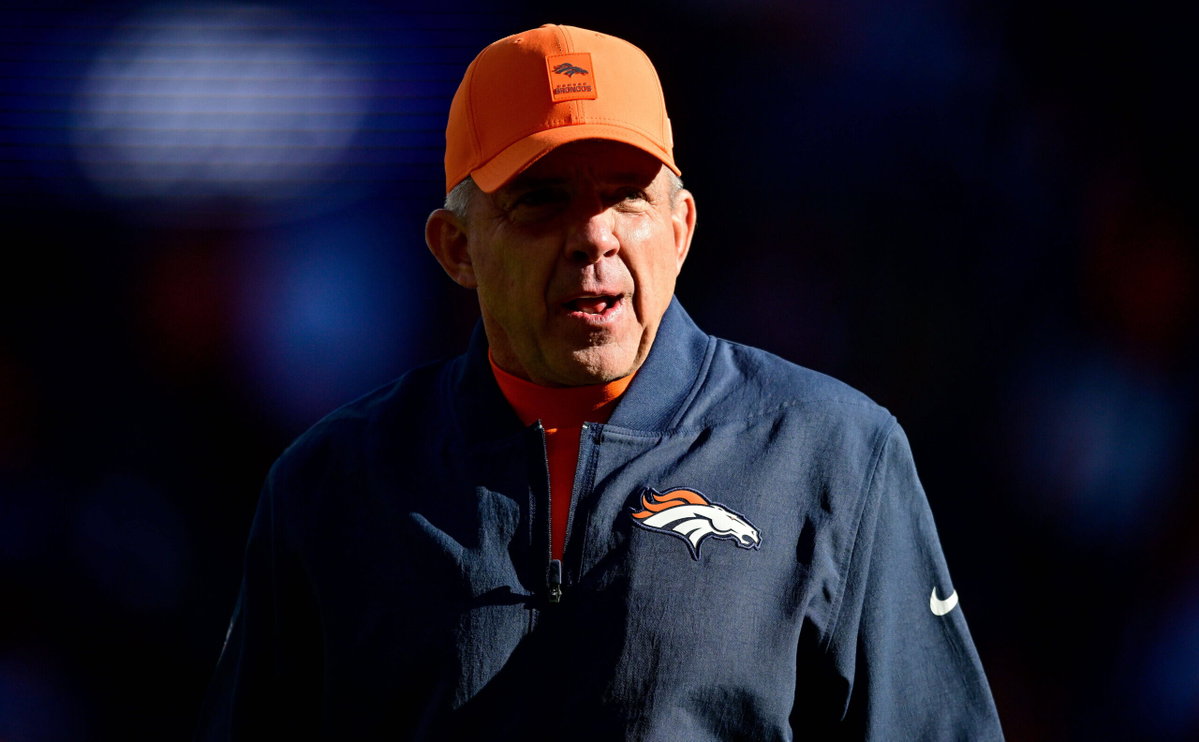
Who would have thought that a simple, fun conversation would turn into a massive mess? While Mike Macdonald’s later said that his comments about Sean Payton were not “intend[ed] for public use,” questions have nonetheless been raised about his intentions. And Shannon Sharpe was right out there pointing it out.
Watch What’s Trending Now!
“You got to say off the record,” Shannon Sharpe said on the Nightcap podcast. “Off the record. Anything that you say, and you say, ‘ You know what, Shannon, can you do me a favor? You know I said X, Y, and Z. Can you take we take it out?
“We don’t try to put anybody in a bad light. People say what they said like, “Oh, you okay? You okay?” Because a lot of what we do most of the time on show, we’ll re-release it in its entirety.”
It was directed toward the public apology Mike Macdonald gave after the comments became public.
“It’s something that [the Broncos] have to deal with in real time that wasn’t really on their end. So that’s really where you’re like, ‘Crap.’ But it’s a lesson learned.” Macdonald said at the September 2026 press conference. “Honestly, I got to be better in that moment for understanding, like, look, I’m responsible for what I say, really no matter the circumstance, whether you’re mic’d up, whether you’re not, whether you have a certain type of understanding.
“So I fell short in that moment. So it stings for me, frankly, but it’s something that I’m definitely going to learn from. And just a good example that we just got to take responsibility for the things that we say.”
It all started when Macdonald was sitting with Graham Bensinger at his home and talking casually before their actual interview started. The crew was still preparing the cameras and equipment, so Macdonald believed they were just having a private conversation, and hence, shared a story about Sean Payton.
He explained that Broncos fans had filmed parts of Denver’s training-camp practices and posted those clips online, making the footage publicly available. Macdonald said the Seahawks used those videos to study Denver’s plays.
They used those clips to study how Denver played.
“So we took, like, 100 plays from their training camp,” Macdonald said. “We’re, like, scouting them.” Payton later found out about it and “lost it,” after Seattle had already beaten Denver 26-20 in Macdonald’s first game as a head coach in 2024.
According to Macdonald, Payton then contacted Seahawks general manager John Schneider and threatened to make the issue public.
Payton suspected the Seahawks had placed someone at training camp. Believing the accusation false, Macdonald said the team warned Payton that it would take legal action if he went public with the claim.
Macdonald said Payton eventually chose not to make the accusation public, so the dispute did not turn into a lawsuit or a public fight. Looking back, he compared the situation to a “Cold War” because both sides were prepared to respond, but neither side actually took the next step.
For now, there’s no bad blood between them. After Macdonald’s interview went viral, both had a word, and Payton eventually accepted his apology.
“He and I are good,” Payton said. “Lord knows I’ve been in his position, where you’re talking about something (privately and it becomes public).”
Plus, he also added how this incident actually helped them.
“I don’t think anything was intentional by fans,” Payton said. “We did some research online of what was available, and that’s kind of how we changed our policy. Talking with them, it allowed us to figure out how to handle our training camp relative to videos.”
After the 2024 situation, the Broncos changed their training-camp rules. Starting in 2025, fans were no longer allowed to record the team’s practices. Denver made this change after checking how much practice footage had been shared online and realizing that those videos could give other teams information about their plays.
The Broncos also made the new rule clear at the training camp with signs that read “PROTECT OUR PLAYS” and “NO RECORDING.” The policy continued in 2026, when fans were told to keep their phones away while practice was happening.
Despite the resolution, the incident highlighted risks in off-record media interactions.