
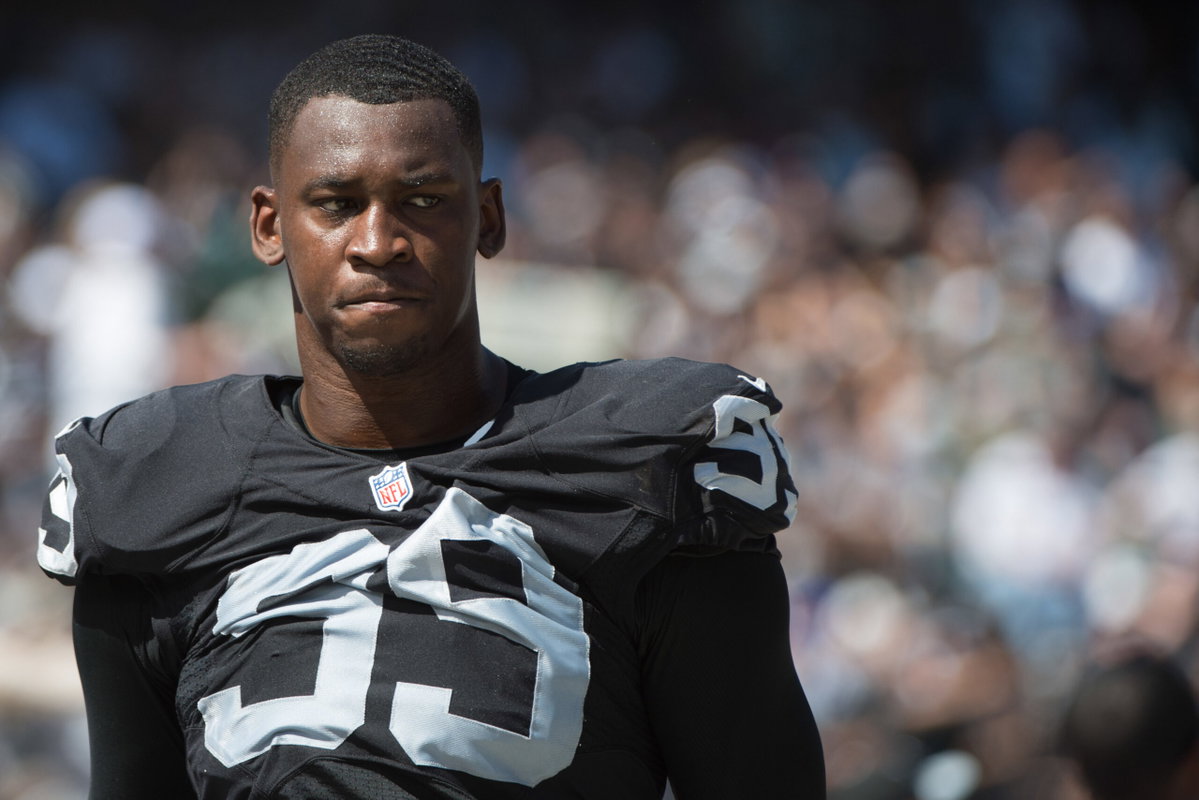
Hours before Aldon Smith tragically passed away, he was delivering pizza to homeless people in the Bay Area with his friend Amir Shirazi. The cause of his death remains unknown, but just a few days later, the former San Francisco 49ers star’s family has decided to look for answers themselves.
Watch What’s Trending Now!
“The family of Aldon Smith has decided to send his brain to medical experts in Boston to see if chronic traumatic encephalopathy [CTE] played a role in the former NFL defensive lineman’s death,” Adam Schefter reported on X.
Smith was found unresponsive in Shirazi’s car on Saturday morning, June 13. Shirazi, in an exclusive interview with the San Francisco Chronicle, revealed that when he found Smith, he was twitching slightly. Shiraz called former Niners RB Anthony Dixon to the scene for help along with 911, and Smith passed away at noon at Good Samaritan Hospital.
Following the incident, Smith’s family hired three lawyers: Harry Daniels, Bakari Sellers, and Wayne Kendall. On Tuesday, June 16th, they released a statement through Wukel Communication.

The family of Aldon Smith has decided to send his brain to medical experts in Boston to see if CTE played a role in the former NFL defensive lineman's death. espn.com/nfl/story/_/id…
“As with anyone who dies so suddenly at such a young age, we understand that there is a great deal of interest in and speculation about Aldon Smith’s passing, and we intend to get to the bottom of it,” the statement read.
“To that end, we have taken a number of steps including sending his brain to Boston where medical experts will examine it for CTE as well as other damage caused by years of concussion and additional trauma,” they continued. “In the meantime, we simply ask you to keep Aldon’s family in our prayers and respect their privacy as they struggle to come to grips with this terrible loss.”
Boston University’s CTE Center – a world leader in CTE diagnosis and study – will examine the brain. CTE is chronic traumatic encephalopathy, caused by repeated head trauma. Its symptoms include memory loss, depression, aggression, and cognitive decline, but it can only be diagnosed after death.
The damage accumulates over years of collisions, and defensive players face a higher risk due to the physical nature of their game. A 2023 study by BU researchers had found 345 CTE cases out of 376 brains they’d studied at the time – a 91.7% occurrence rate. This, however, does not mean CTE is prevalent in these NFL players.
Imago
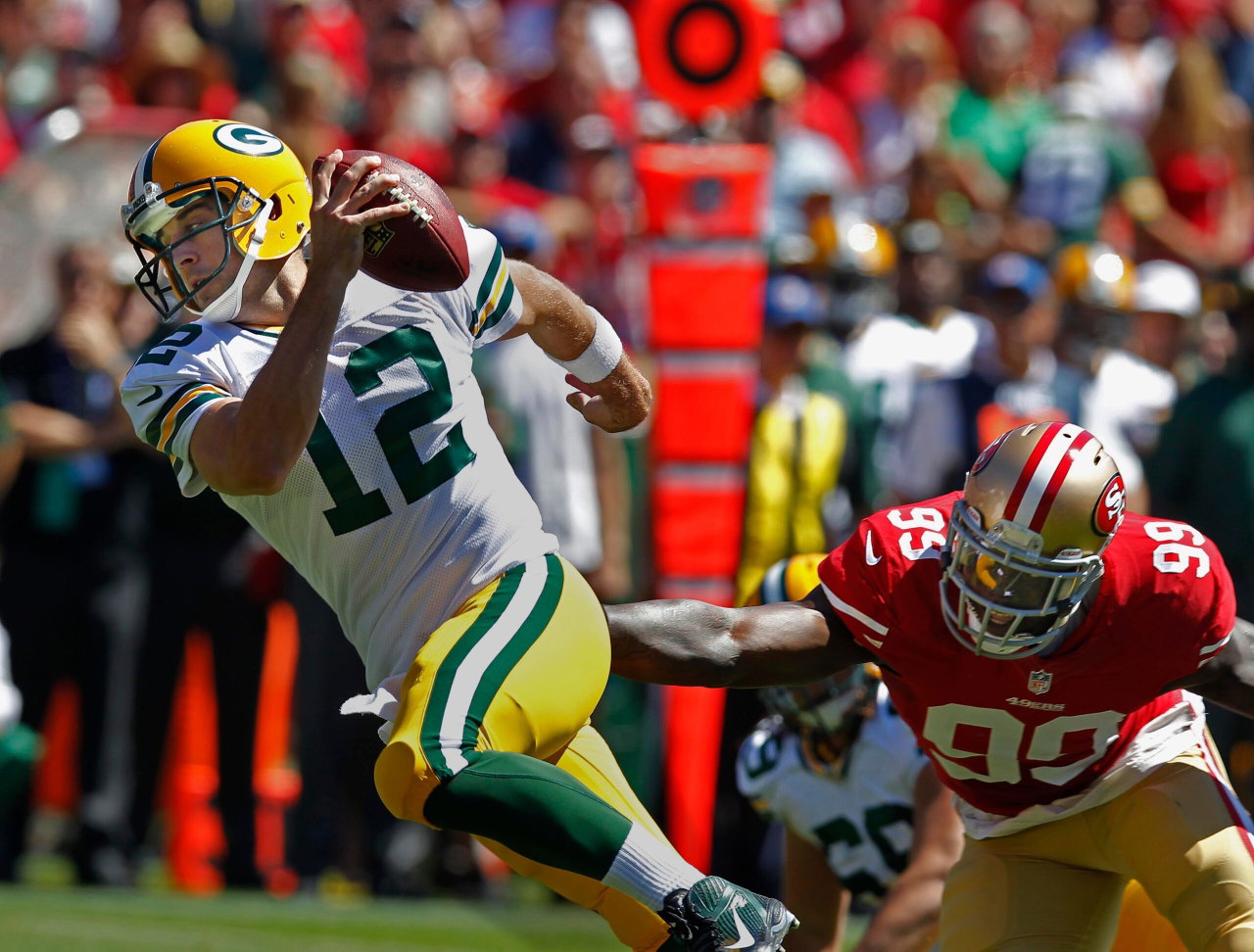
Green Bay Packers quarterback Aaron Rodgers (12) slips while trying to scramble out of the pocket away from San Francisco 49ers linebacker Aldon Smith (99) in the first half during the NFL season opener Sept. 8, 2013, where the San Francisco 49’rs beat the Green Bay Packers 34-28 at Candlestick Park in San Francisco, California.
The league had denied CTE’s connection to football for years until 2016, when an NFL official finally admitted the link. Since then, a lot of former NFL stars have been diagnosed with CTE posthumously. A 2023 Mass General Brigham study even found that 1 in 3 former NFL players believed they had CTE.
Aldon Smith had a very productive NFL season as a rookie, finishing with 14 sacks and the Defensive Rookie of the Year honor. The next year (2012), he posted 19.5 sacks to get the franchise record, and earned his only first-team All-Pro and Pro Bowl nod. Off-field issues kept derailing him throughout his football journey, which officially ended in 2021.
Aldon Smith’s sudden and untimely passing raised the question the league has faced for a decade: What happens to the players after collisions stop? His family won’t be waiting for the league to answer; they’re getting the truth themselves.