USA Today via Reuters
NFL, American Football Herren, USA NFL Draft, Apr 26, 2018 Arlington, TX, USA Dallas Cowboys former quarterback Troy Aikman throws a football from the stage prior to the first round of the 2018 NFL Draft at AT&T Stadium. Mandatory Credit: Matthew Emmons-USA TODAY Sports, 26.04.2018 18:05:47, 10806256, NPStrans, 2018 NFL Draft, NFL, NFL Draft, Troy Aikman, AT&T Stadium, Dallas Cowboys PUBLICATIONxINxGERxSUIxAUTxONLY Copyright: xMatthewxEmmonsx 10806256
USA Today via Reuters
NFL, American Football Herren, USA NFL Draft, Apr 26, 2018 Arlington, TX, USA Dallas Cowboys former quarterback Troy Aikman throws a football from the stage prior to the first round of the 2018 NFL Draft at AT&T Stadium. Mandatory Credit: Matthew Emmons-USA TODAY Sports, 26.04.2018 18:05:47, 10806256, NPStrans, 2018 NFL Draft, NFL, NFL Draft, Troy Aikman, AT&T Stadium, Dallas Cowboys PUBLICATIONxINxGERxSUIxAUTxONLY Copyright: xMatthewxEmmonsx 10806256
After the 1994 NFC Championship Game, while Dallas celebrated its win over San Francisco, Cowboys quarterback Troy Aikman sat in a dark hospital room, unable to tolerate light. During the game, Aikman had taken a brutal knee-to-helmet hit from 49ers defensive end Dennis Brown and suffered a severe concussion. Doctors later hospitalized Aikman with amnesia, but only a week later, the QB played in Super Bowl XXVIII. Now, 32 years later, Aikman revealed the circumstances that made it possible.
“In today’s league, with the protocols and the testing, I wouldn’t have been able to play,” Troy Aikman said recently on The Rodeo podcast. “Just there’s no way. So, fortunately or unfortunately, I don’t know how to really view that, but fortunately for me, I got to play, and there were no long-term effects from playing in that game. But a quarterback today or any player, if you had amnesia and had no recollection of playing the game just seven days earlier, you probably wouldn’t be playing.”
Watch What’s Trending Now!
Troy Aikman was hit early in the second half of the 1994 NFC Championship Game, with the Cowboys leading 28-7. Aikman still waved off Cowboys trainer Kevin O’Neill and took the next snap. Yet, soon after, the QB exited the game for good, and backup QB Bernie Kosar had to step in to lead the Cowboys in a 38-28 victory.
But while Dallas punched its Super Bowl ticket, Aikman headed to the hospital for overnight observation.
Doctors ran multiple tests on Aikman, including a brain scan, which showed no structural damage. Still, the situation deeply unsettled his agent, Leigh Steinberg, who had seen his fair share of injuries in the NFL.
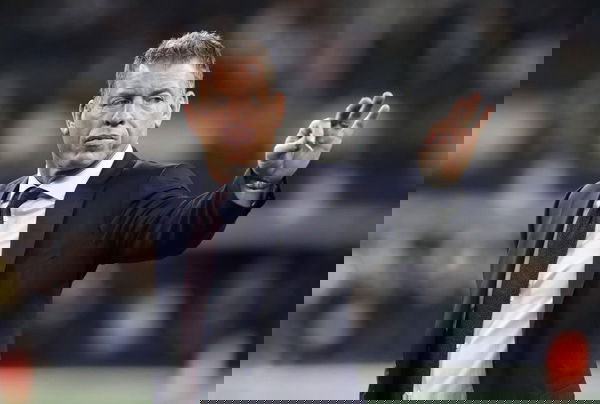
USA Today via Reuters
NFL, American Football Herren, USA New Orleans Saints at Dallas Cowboys, Nov 29, 2018 Arlington, TX, USA Troy Aikman waves prior to the game with the Dallas Cowboys playing against the New Orleans Saints at AT&T Stadium. Mandatory Credit: Matthew Emmons-USA TODAY Sports, 29.11.2018 18:21:42, 11755555, New Orleans Saints, NPStrans, NFL, Troy Aikman, AT&T Stadium, Dallas Cowboys PUBLICATIONxINxGERxSUIxAUTxONLY Copyright: xMatthewxEmmonsx 11755555
“He looked at me, and he said, ‘Leigh, where am I?’ And I said, ‘Well, you’re in the hospital,’ his agent said in an interview back in 2013. “And he said, ‘Well, why am I here?’ And I said, ‘Because you suffered a concussion today.’”
And because Aikman had no recollection, he further asked, “‘Well, who did we play?’ And I said, ‘The 49ers.’ And he said, ‘Did we win?’ ‘Yes, you won.’ ‘Did I play well?’ ‘Yes, you played well.’ ‘And so what’s that mean?’ ‘It means you’re going to the Super Bowl.’”
The NFL legend to this day has no memory of completing 14 of 18 passes for 177 yards and two touchdowns in that NFC title game.
Still, doctors at Baylor Medical Center gave Aikman a clean bill of health, and he quickly rejoined the Cowboys to prepare for Super Bowl XXVIII. But as Aikman just pointed out, today’s NFL protocols wouldn’t have allowed him to return to action in less than ten days.
Modern concussion protocols in the NFL demand a strict, five-step process.
- Phase One: Symptom-Limited Activity
The injured player is prescribed rest, limiting or, if necessary, avoiding activities (both physical and cognitive) which increase or aggravate symptoms.
If the player does not show an increase in his symptoms and does not develop signs of concussion on neurological examination, he may be cleared to proceed to the next phase.
- Phase Two: Aerobic Exercise
Phase Two involves a graduated exercise program. Under the guidance of the Club’s medical staff, the player should begin graduated cardiovascular exercise (e.g., stationary bicycle, treadmill) and may also engage in dynamic stretching and balance training.
Once the player is able to engage in cardiovascular exercise without an increase or aggravation of signs or symptoms, and his symptom burden is at or below his baseline, he may proceed to the next Phase.
- Phase Three: Football Specific Exercise
The player is allowed to practice with the team in sport-specific exercise for 30 minutes or less, with monitoring by the medical staff. Following the neurocognitive testing, the player may or may not move to contact activities (depending on how the test results turn out, as examined by the Club physician).
Once the player-patient has demonstrated their ability to engage in cardiovascular exercise and supervised strength training without an increase or aggravation of signs or symptoms, they may proceed to the next Phase.
- Phase Four: Club-based Non-contact Training Drills
All activities (cardiovascular conditioning, strength and balance training, team-based sport-specific exercise) at this Phase remain noncontact (i.e., no contact with other players or objects, such as tackling dummies or sleds).
If the player is able to tolerate all football-specific activity without recurring signs or symptoms of concussion, and if his neurocognitive testing has returned to baseline, he may be moved to the next Phase in the sequence.
- Phase Five: Full Football Activity/Clearance
After the player has established his ability to participate in non-contact football activity, the Club physician may clear him for full football activity involving contact in practice. Afterwards, the player must undergo an examination by the Independent Neurological Consultant assigned. Should the INC and the Club physician both clear the player’s concussion, he may participate in the next game or practice.
Back in 1994, however, NFL teams often dismissed concussions as simply getting ‘dinged.’ NFL players routinely returned to action far sooner than they should have. Aikman himself had admitted he might have come back even earlier if it had been a regular-season game.
Troy Aikman was fortunate enough to play in Super Bowl XXVIII despite the concussion
It was certainly fortunate for the Cowboys that Troy Aikman played against the Buffalo Bills in Super Bowl XXVIII. In that game, Aikman completed 19 of 27 passes for 207 yards and led the Cowboys to a 30-13 win, and showed no visible lingering effects during the game, as he can still recall every bit of it.
But with what we now understand about brain injuries, Aikman would not have wanted to play despite that concussion.
According to the Parkinson’s Foundation, even a single concussion can increase the risk of Parkinson’s disease by 57%. Multiple concussions further raise the likelihood of both dementia and Parkinson’s, as has been the case with Packers legend Brett Favre. Meanwhile, Troy Aikman retired from the NFL after 12 seasons with 10 documented concussions – numbers that make his decision to play football feel less like fortune and more like a gamble.
“I have been playing this game since I was 7 years old, and to all of a sudden recognize that you’re not going to do it anymore is hard,” Troy Aikman said during his retirement speech back in 2001.
“I know it’s the right thing for me because of my health, concussions, my back problems that I’ve had. It took its toll, and I know that to try to go out there and play another year was going to be a tough thing to do.”
While concussions forced Troy Aikman to miss multiple games throughout his NFL career, he ultimately pointed to chronic back issues as the main reason for his retirement. Still, the accumulation of head injuries clearly played a role in shaping Aikman’s decision. Today, the NFL treats concussions with far greater caution, with reduced reliance on smelling salts and quick returns.
So, looking back, Troy Aikman may call himself fortunate, as he played in a Super Bowl and won it while avoiding immediate consequences from his head injury. But given what we know now, it’s hard not to wonder if Aikman might’ve prioritized short-term wins over long-term health.
Related Newsletters