
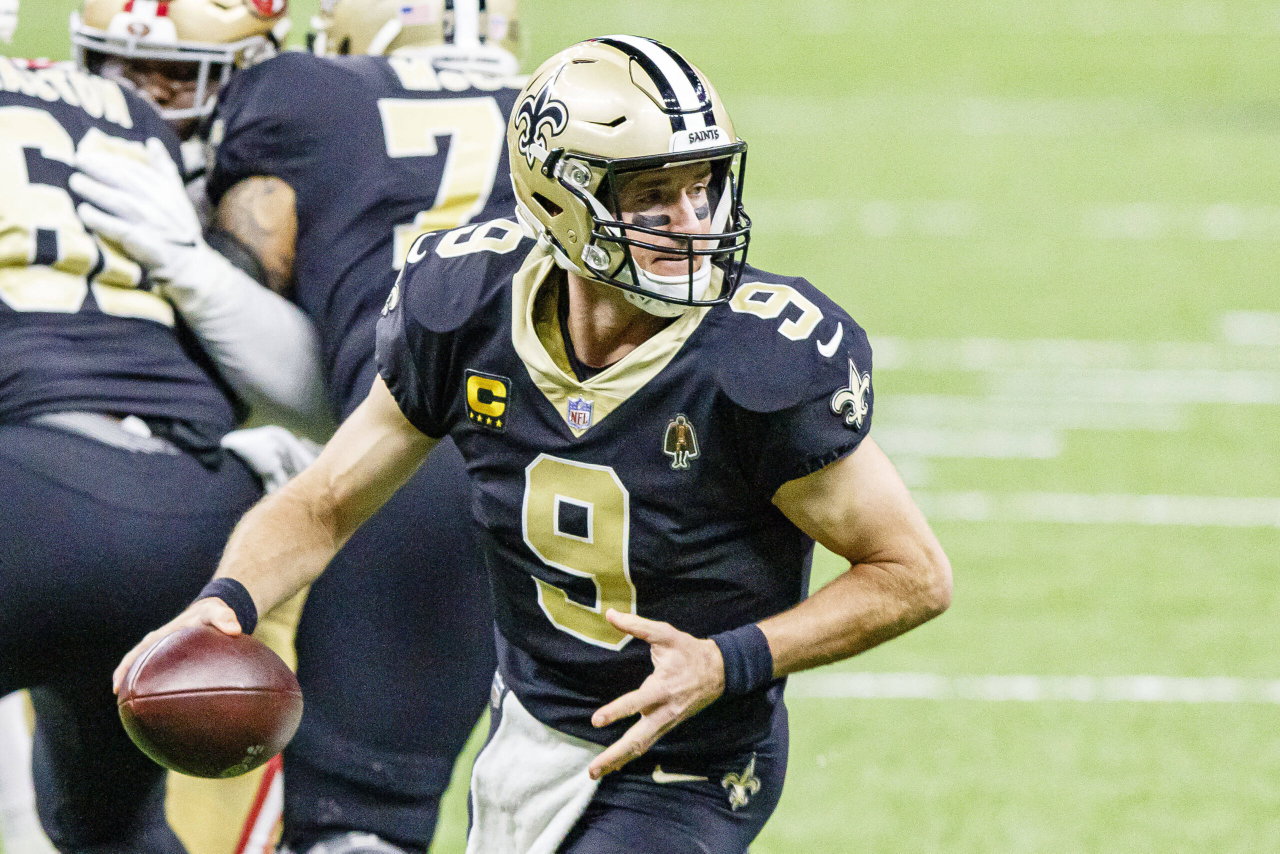
Weirdly enough, Drew Brees might not have been in the Pro Football Hall of Fame had he not faced the sheer uncertainty about his career in 2005. At that time, doors were closing on the quarterback’s still-salvageable career, with the San Diego Chargers already having drafted his backup. But after he suffered the ugly injury in the 2005 regular season finale, Brees thought it was all over.
Watch What’s Trending Now!
“I remember thinking to myself, this is definitely the last time I put on a Charger uniform,” Brees said on WFAN Sports Radio. “I knew there were some people in the building that just weren’t convinced that I was the guy, and they drafted Phillip [Rivers] and had a lot of draft capital there and wanted to see him play. There was the other half of the building that did, but this [shoulder injury] was kind of a convenient excuse. But then I started thinking, you know, ‘This could be the end of my career.'”
In 2005, Brees was playing the Denver Broncos. In the second quarter, Brees tried to land a pass when the Broncos defense knocked the ball loose from his hands at the goal line. He went to recover it, but Broncos defensive tackle Gerard Warren landed on him in such a manner that his arm bent at his shoulder in a nasty way.
Brees had dislocated his throwing shoulder, which had also suffered a complete tear of the labrum and a partial tear of the rotator cuff.
If the Chargers had kept Drew Brees using the franchise or transition tag, they would have had to pay him nearly $10 million for one season. Meanwhile, Rivers had emerged as the stand-in for the veteran quarterback, who suddenly became an expendable player. Naturally, the Chargers released him in 2006.
After leaving the Chargers, Brees received serious interest from only two teams: the Miami Dolphins and the New Orleans Saints. The Miami Dolphins wanted to sign him and made him their first choice at quarterback. But Brees failed the physical, and then-head coach Nick Saban was told he had only a 25% chance of returning to play.
Saban really wanted Drew Brees on the team. He said on The Pivot podcast that after learning about Brees’ physical, the coach also spoke with Dr. James Andrews, who treated Brees, and got confirmation that the quarterback could play. However, Saban made a tough call and informed Brees’ agent that the Dolphins would not go ahead with the deal. His agent, in turn, requested the veteran head coach not reveal that Brees had failed the physical, or he wouldn’t be able to sign with anybody.
It was only after the quarterback signed with the New Orleans Saints that the development was revealed. And the rest is history
Drew Brees turned the Saints into a marquee team with his 15 seasons as their starting quarterback. Before he arrived, the Saints had reached the playoffs only five times in their first 39 seasons. With Brees as their quarterback, the team made the playoffs nine times. Today, he is one of only 12 from the Saints to be a part of the Pro Football Hall of Fame.
“None of this is possible without Sean Payton and Mickey Loomis,” Brees said when he was named to the Hall of Fame. “Believing in me at a time when it was kind of hard for me to believe in myself, you know, coming off that injury. … I know New Orleans was looking for a quarterback then, but I promise you I needed New Orleans more than New Orleans needed me.”