
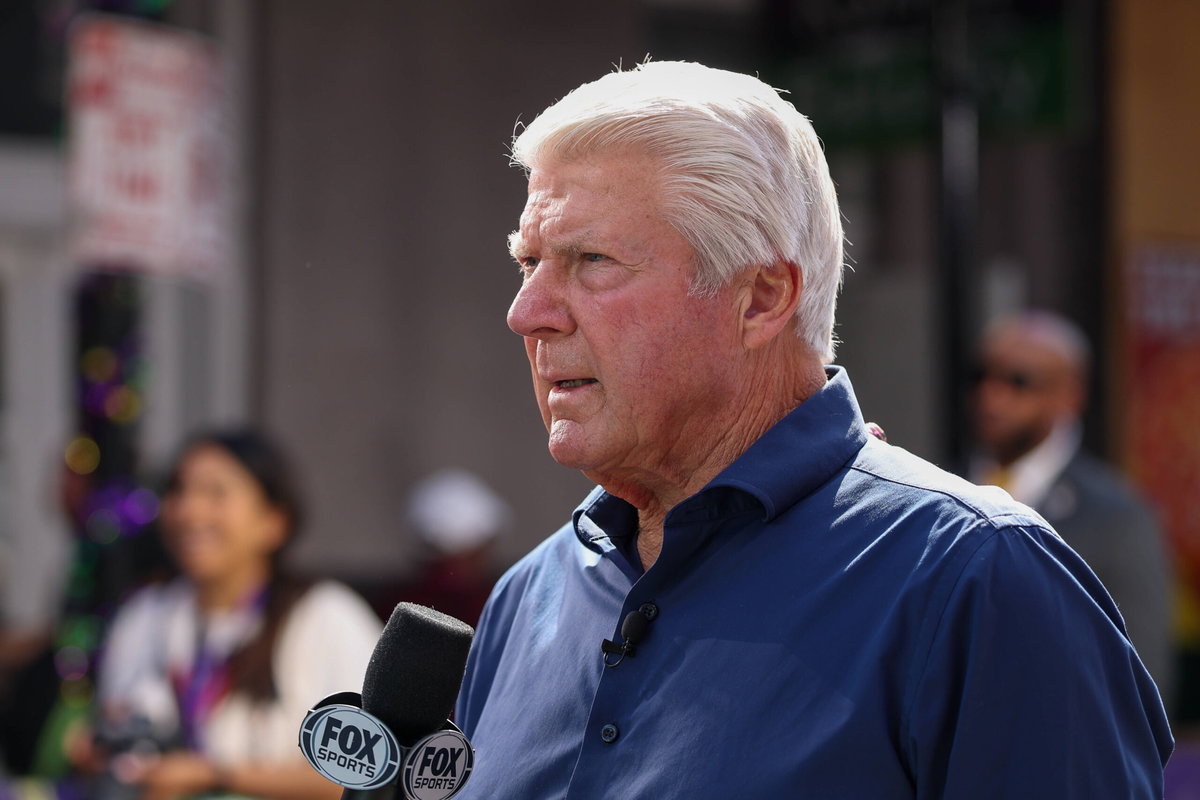
Jimmy Johnson had his own way of handling players and their conditioning. Despite his strict rules, however, he did give his former guard some leeway. This came even as former NFL offensive lineman Nate Newton openly accepted his shortcomings. Years later, Dave Campo, who worked closely with Johnson as a defensive assistant and later became the team’s head coach in 2000, recalled the incident.
“Jimmy was tunnel-visioned,” Campo said on Cowboys Country Football. “You know, it was his way or the highway. It was a dictatorship. It was like, you know, where you are on the ladder determined whether or not you got leeway. Well, Nate, we’re running one tens when we first got there. One tens was the measuring stick, right? So we’re running one tens. You had to do it at a certain time.
“Well, Nate took one look at that when he first got here, and he went to Jimmy, and he said, Jimmy, you might as well fine me right now because I’m not going to make the time on these. And Jimmy looked at him after watching him on film. He already knew who he was after watching him on film. He said, Nate, just keep your feet moving.”
Compo started as a defensive assistant under Johnson, then was promoted to secondary coach and later promoted to defensive coordinator in 1995 under Barry Switzer and also became the team’s head coach in 2000. Having worked closely with Johnson, he knew his coaching style and Newton’s game very well.
Former Cowboys fullback Daryl Johnston also outlined Johnson’s demanding conditioning routine during an interview with The Washington Post in Dallas on January 11, 1996, while discussing what training under Johnson was like for the Miami Dolphins players.
“Be extremely fit,” Johnston said. “In minicamp he’ll have them run 16 110-yard dashes. He breaks you down by position, and you run them in 15 seconds, 17, and 19, with 45 seconds rest in between. That was his conditioning test. We had the infamous asthma field down here. Guys couldn’t breathe. But we got better.
“Jimmy is pretty straightforward. He expects the most out of you on the field. He was insistent on guys staying around in the offseason. You put your job in jeopardy if you weren’t here.”
However, when it came to Newton, Johnson trusted his ability. During his time under Johnson, Newton struggled to control his weight, which remained a constant issue. According to InsideTheStar.com’s Dante Giannetta, Johnson once beat Newton in a race, showing him how much work he needed to do.
The Cowboys checked Newton’s weight every two weeks and fined him $25 for every pound he weighed over 320 pounds. Newton discussed those fines during an interview with Bill Plaschke for the Los Angeles Times in 1994.
“I give them so much money, they have a hell of a Christmas party with it,” Newton said. “But what am I supposed to do? I’m a human being. And it’s not how you look or how your breath smells. It’s how you play. Everybody focuses on my body mass. You make it a joke… but I’ve got to deal with it.”
Despite his conditioning problems, Johnson continued to believe in his ability and worked to get the best out of him.
That faith paid off as Newton became an important part of the Cowboys’ offensive line and helped the team win Super Bowls XXVII and XXVIII under Johnson in 1992 and 1993. Dallas won another championship under Barry Switzer in 1995.
Newton also earned individual recognition for his performances. He made five straight Pro Bowls from 1992 to 1996 and was named a first-team All-Pro in 1994 and 1995. His journey showed how he turned his fitness struggles into an opportunity to become one of the key players during the Cowboys’ championship years.
Now, after Johnson led the Cowboys to back-to-back Super Bowl victories and Switzer guided them to another championship in 1995, the franchise is still chasing its next Super Bowl win.