
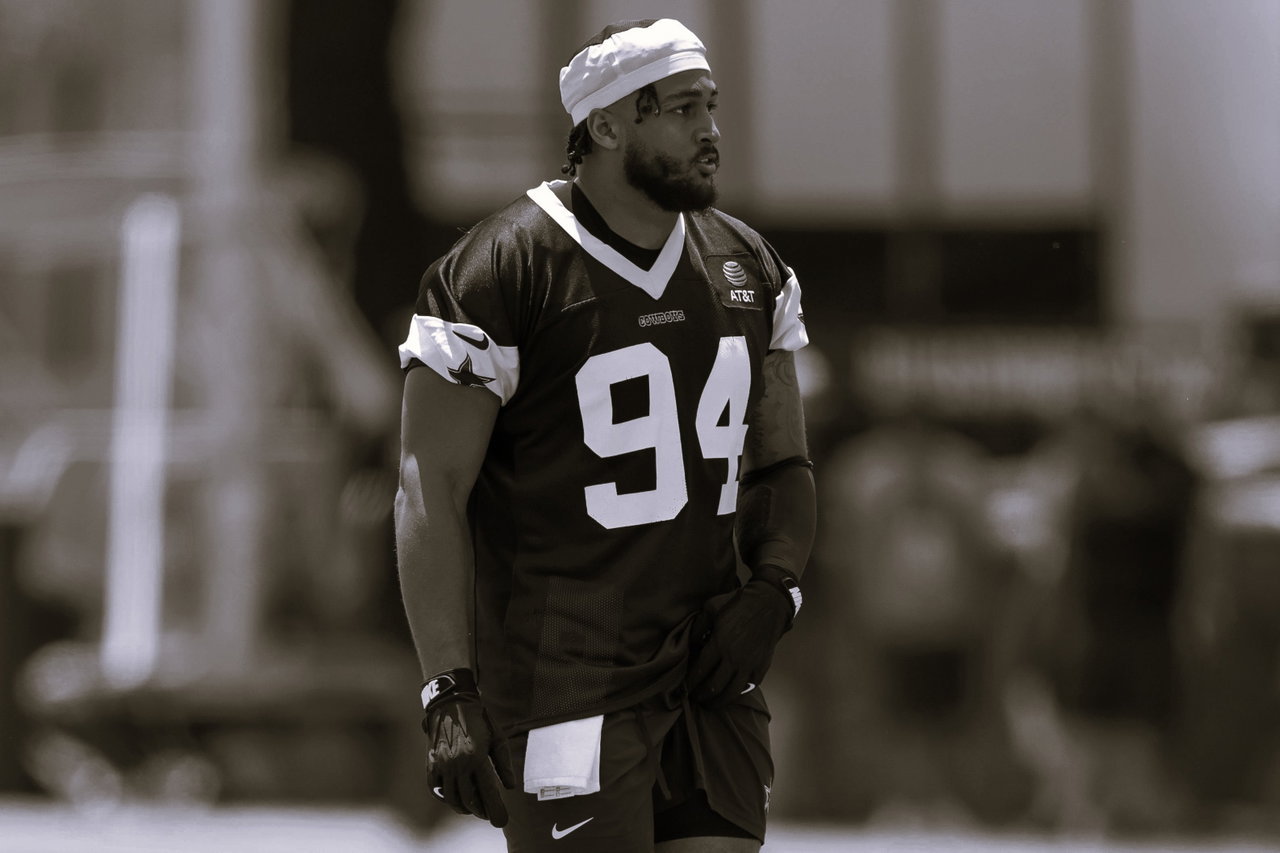
On November 6, 2025, Dallas Cowboys defensive end Marshawn Kneeland passed away from a self-inflicted gunshot wound. Now, months after the former Cowboys player’s demise, doctors confirmed he was living with Stage 1 CTE, which is a concerning brain condition.
Watch What’s Trending Now!
“Unfortunately, I was not surprised to find CTE in the brain of Mr. Kneeland, because we have found this progressive brain disease in nearly half of the athletes we’ve studied who have died before the age of 30,” said Dr. Ann McKee, director of the Boston University CTE Center (via ProFootballTalk). “Thanks to the generosity of our brain donor families, we now better understand the earliest stages of CTE, and it is bringing us closer than ever to diagnosing it during life. My team and I are fully dedicated to finding effective treatments and a cure for CTE.”

Marshawn Kneeland died by suicide in November 2025 at 24. Researchers have concluded that he had stage 1 CTE. nbcsports.com/nfl/profootbal…
Chronic Traumatic Encephalopathy (CTE) is a brain disorder caused by repeated head trauma, such as concussions or sub-concussive hits, common in contact sports like football and boxing. But there are four distinct stages of CTE, ranging from Stage 1 (mild) to Stage 4 (severe), which were identified by Dr. Ann McKee’s team in 2013.
Marshawn Kneeland was diagnosed with Stage 1 CTE, which is frequently associated with subtle behavioral and cognitive shifts. To be precise, its early symptoms often include headaches, loss of focus, mild memory gaps, depression, impulsivity, and short-term mood changes.
According to reports, Kneeland was experiencing a mental health crisis when he sent “goodbye” messages to loved ones on the night of November 5. His girlfriend immediately contacted authorities out of fear that he would harm himself. However, later in the night, around 10:30 PM, a state trooper attempted to pull over Kneeland’s Dodge Charger on the Dallas North Tollway.
The 24-year-old fled, leading police on a high-speed pursuit that reportedly reached speeds exceeding 145 mph. Officers lost sight of the vehicle and ended the chase, but minutes later, they found the car crashed and abandoned against a truck in Frisco, Texas. A search involving police K9 units and drones was launched. And around 1:30 AM, officers discovered Kneeland in a nearby area, where he had passed away from a self-inflicted gunshot wound.
The incident left a detrimental impact on Marshawn Kneeland’s close ones and the football community. But the former Cowboys player isn’t the only NFL player to have been diagnosed with CTE. 12-time Pro Bowl linebacker Junior Seau stands as another example. Like Kneeland, Seau passed away due to a gunshot wound in May 2012. However, a year later, his posthumous diagnosis shocked the sports world with signs of CTE.
In Kneeland’s case, his girlfriend, Catalina Mancera, also came out and shared her thoughts on the diagnosis. She noted that the onlookers should perceive the report as an awareness of a concerning health condition. “While this diagnosis does not change the tragedy of his passing, it provides important context about some of the struggles he may have been facing,” Mancera said. “We share this information to help people understand what NFL and other high-contact sport athletes might be struggling with. Raising awareness is important to us. We continue to remember Marshawn with compassion for the person he was, rather than defining him by the final moments of his life.”
A glance through Marshawn Kneeland’s NFL career representing the Dallas Cowboys
Marshawn Kneeland left a mark on the people around him, especially at the Dallas Cowboys. Kneeland joined the NFC East franchise in 2024 after coming off a five-season collegiate career with Western Michigan University (2019-2023), recording 149 tackles and 12.5 sacks. The Cowboys saw him as a fit and drafted him in the second round.
Kneeland primarily served as a rotational edge defender and appeared in 18 games for Dallas while posting 26 tackles and 1.0 sack. But what pulled him closer to his teammates and coaching staff was his work ethic. Mike Zimmer, who was the Cowboys’ defensive coordinator in 2024, once explained what made Kneeland unique.
“He was a great person, eager to learn… wanted to be great. He didn’t take any crap from anyone on the field and studied hard-loved playing the game. Tough,” said Zimmer. “My last conversation with him was, ‘Keep being you. You’re going to have a great career.”
However, fate had other plans for the 24-year-old defensive end. Marshawn Kneeland’s demise left an emotional void and heavily impacted the Cowboys’ locker room. To that end, for the remainder of the 2025 season, the Cowboys wore No. 94 helmet decals and pregame warmup shirts featuring his face as a tribute.