
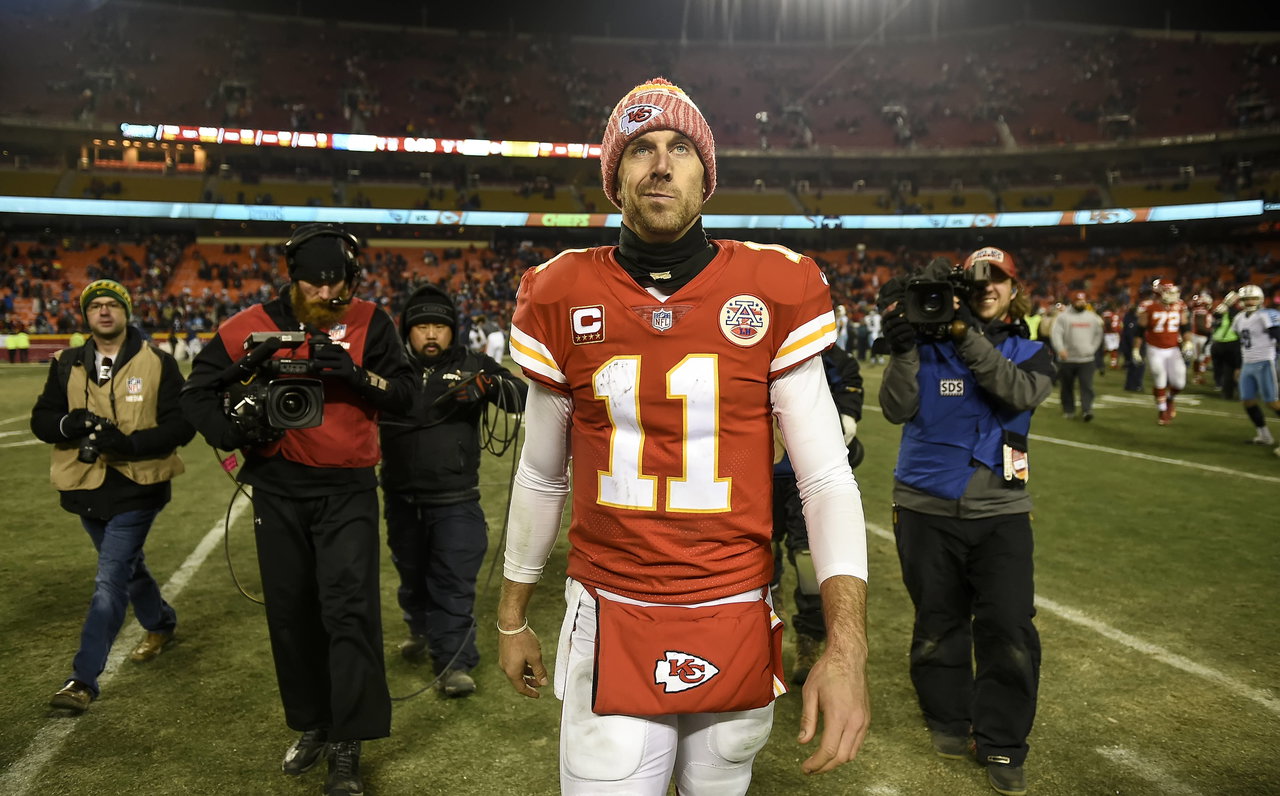
Former Washington Commanders quarterback Joe Thiesmann was attending a 2018 game against the Houston Texans. He watched then-QB1 Alex Smith try his best to turn around a game that was becoming difficult to win. In the third quarter, however, the Texans blitzed the Commanders offense, and defensive end J.J. Watt sacked Smith. Houston celebrated, but Smith lay on the ground, with hands on his face.
Watch What’s Trending Now!
Thiesmann, who was in this exact situation 33 years ago, feared the worst. The veteran’s career ended after he broke his leg all those years before, and it looked like Smith was in for the same. But it was far more than just a broken leg for him.
“I think back to all these surgeries as the doctors were trying to save my life and my leg,” Smith told Patrick Allen on Arrowhead Addict on June 5 this year. “[Incredibly] lucky that they did, first of all. I remember when I spit out of the hospital finally, and again, I was so lucky to do so much of my rehab at this military rehabilitation clinic called the Center for the Intrepid in San Antonio. As a civilian, getting access to this expert military care.”
Smith, who also played for the Kansas City Chiefs, underwent his first surgery to repair his broken tibia and fibula at the Inova Fairfax Hospital in Virginia and clean the wound. He came out of the operating room with three plates and 28 screws and pins holding his tibia together. But the battle was far from over for Smith, because he had developed necrotizing fasciitis.
His wife, in a personal piece written for ESPN, recalled that the condition, caused by flesh-eating bacteria, turned his leg black. And to make matters worse, it led to sepsis. The situation was concerning enough to have surgeons proposing that Smith amputate the leg, but he refused. Elizabeth tried hard not to panic.
“I’m obviously more worried about his life,” she said in an episode of 60 Minutes. “He is septic. And, you know, you hear all these staggering numbers on when people go septic.”

Imago
FOXBOROUGH, MA – OCTOBER 24: ESPNs Monday Night Countdowns Alex Smith before a game between the New England Patriots and the Chicago Bears on October 24, 2022, at Gillette Stadium in Foxborough, Massachusetts. Photo by Fred Kfoury III/Icon Sportswire NFL, American Football Herren, USA OCT 24 Bears at Patriots Icon482221024041
Per CBS, Smith underwent 17 surgeries on his leg, including eight operations in just ten days to carefully remove dead and infected tissue. He also had to wear an external fixator, often called a “cage,” on his leg for more than 10 months. His care involved a team of doctors that included orthopedic trauma surgeons Steve Malekzadeh and Michael Holtzman, plastic surgeon Vineet Mehan, Washington team physician Robin West, and Dr. Joe Alderete from the Center for the Intrepid.
The San Antonio facility, to which West reached out, is dedicated to rehabbing combat soldiers with similar injuries. Smith regards the center as the reason why his life changed. He said in an NFL that he used to keep his leg wrapped up until he began his rehab here. But seeing the others who were training to regain mobility, some with amputated limbs, gave him confidence.
Smith was initially confined to a wheelchair with his injured leg fixed straight, Elizabeth wrote. But at the center, he learned how to walk and run again. Less than two years later, all of that rehabilitation work had Smith thinking about football once more. Johnny Owens, the center’s chief physical therapist, still remembers the first time he tossed Smith a football.
“He almost broke my ribs because I didn’t catch the ball right,” he told CBS. “And second, there was that spark in his eye. It was so cool. I think it was like a light bulb went off.”
Considering how serious his injury was, many people thought Smith would never play football again, and he might as well announce his retirement. But Alex Smith was not done writing his story.
Alex Smith’s Biggest Comeback Story in NFL History
The QB remained on Washington’s physically unable to perform (PUP) list throughout the 2019 season. It was only in the next season, two years since he’d thrown a football, that doctors finally cleared him. Washington began by keeping him on the PUP list for training camp before activating him on August 16.
Smith made his long-awaited return in Week 5 against the Los Angeles Rams, where he threw for only 37 yards. Four weeks later, against the New York Giants, the quarterback looked like he had never left the field. He threw for 325 yards, with an accuracy of 75%, even though he lost that game. Smith topped this with a 390-yard record in the next game, against the Detroit Lions.
The quarterback finished his season 5-1 as a starter, completing 66.7% of his passes for 1,582 yards with six touchdowns. Smith also helped lead Washington to its first NFC East title and playoff appearance since 2015.
By the end of the season, there was no one more deserving of the AP NFL Comeback Player of the Year award. He won by an overwhelming majority of 49 out of 50 votes, and was the oldest winner of the award since Peyton Manning in 2012. After the announcement, several players congratulated him, including Dak Prescott.
“Watching you over the last couple of years with your leg has been an inspiration on the field, off the field, but just to show how to train your mind and do whatever it is that you want to do and come back from whatever it is that you’ve been dealt with,” the Dallas Cowboys QB said in an NFL video in February 2021.
Smith was waived by the Commanders in March 2021, and several teams lined up with interest. But the veteran QB chose to retire, ending a legacy that spanned 16 years. He’d achieved what he wanted with that last year, simply being able to run and throw the football again.