
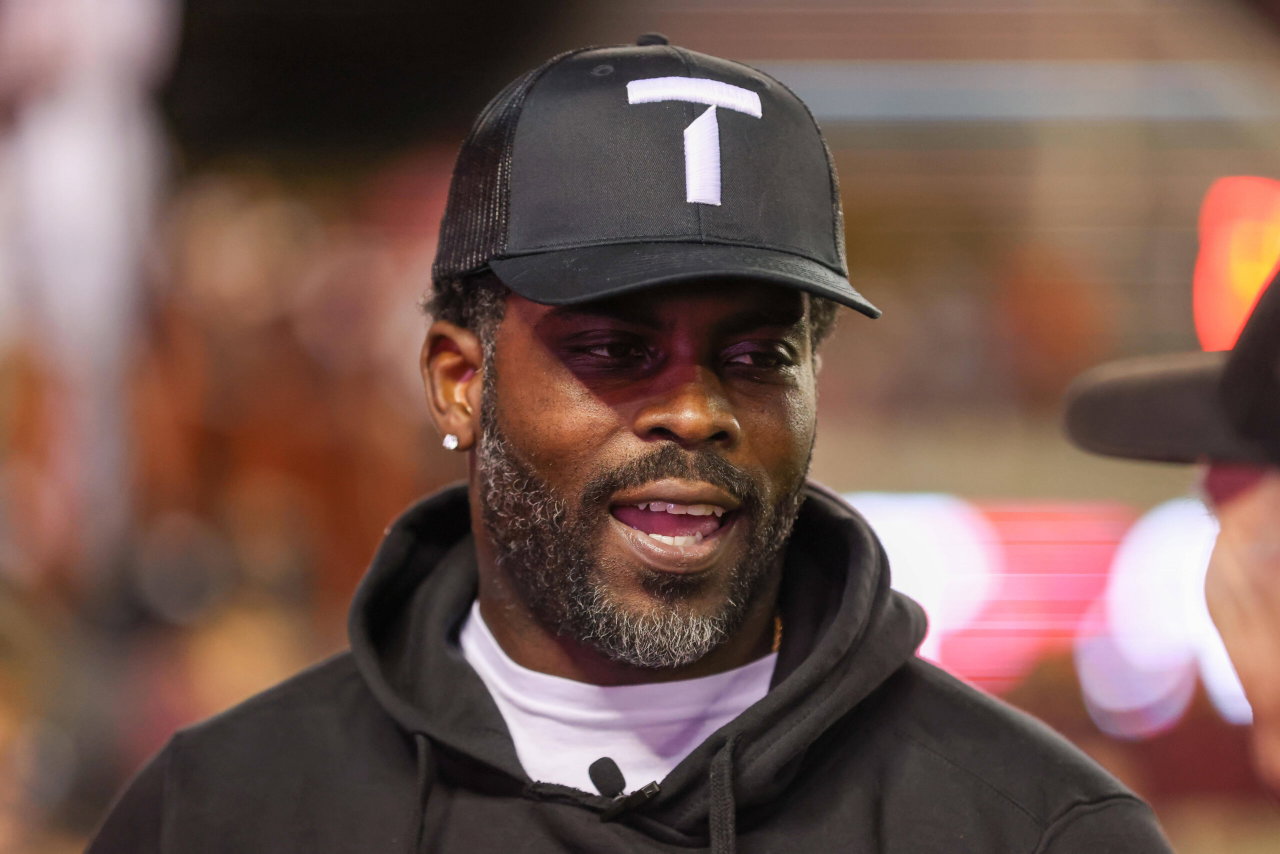
Back in April 2009, Michael Vick stood in a Newport News bankruptcy court, having survived a 12 cents-an-hour janitorial job at USP Leavenworth, and confessed, “I can’t live like the old Mike Vick.” During his Atlanta Falcons heyday, court papers showed, he was not only blowing his cash on cars given to friends as gifts but also had bank notes in an Indiana car rental business, a Georgia wine shop and a loose payroll of 30-odd people.
Watch What’s Trending Now!
Eighteen years later, with teenage college football players cashing in on six-figure NIL deals, the former Falcons quarterback is taking it upon himself to ensure history does not repeat itself. The star spoke to Beyond Ballin with Lawrencia Moten about young athletes facing astronomical sums for the first time in their lives and how they should approach the money.
“I think most importantly is to learn how to count what you have,” Michael Vick said on the podcast. “Addition and subtraction is really simple; we learned that very early in life. And from there, just make sure that you pay your taxes, make sure you don’t put yourself in debt and had the IRS chasing you, when that could have been avoided.”
“And I’m pretty sure these big schools, I would know, and I hope that they have people who come in and do financial literacy because it’s important, because for them it’s the money before the money. This is money for you to just kind of, like, get your life started with. It’s not gonna last your lifetime at all.”
According to the four-time Pro Bowl quarterback, young athletes make expensive mistakes by trusting the wrong people with their money, going into deals they do not fully understand.
“Unless you’re one of these quarterbacks making $10 million in a year, you make that for three years, you got 30 million, you’re good,” said Michael Vick, who was earning a reported $37.5 million at his financial peak in 2005. “You still got to manage it right, cuz I’ve seen people lose that type of money and lose a lot of money. Put it in the hands of the right people, most important. That’s what a lot of young men like myself, we failed. Trusting other people, putting money into the hands of other people, and they grow a brain, and they do what they want to do.”
The Falcons franchise signed him to a 10-year, $138 million contract extension with $37 million guaranteed in December 2004, making Michael Vick the highest-paid player in the history of the league. However, the former Falcons quarterback filed for Chapter 11 bankruptcy in July 2008 while in federal prison, owing more than $17.6 million.
Instead of liquidating his assets under Chapter 7, Vick went into his Chapter 11 plan to pay back his debts in full. Following his release, he joined the Philadelphia Eagles and remained a player under a court-approved spending plan, which left him with just a fraction of the money. He was able to pay back a total of $17.4 million of his $17.6 million debt by November 2017.