Imago
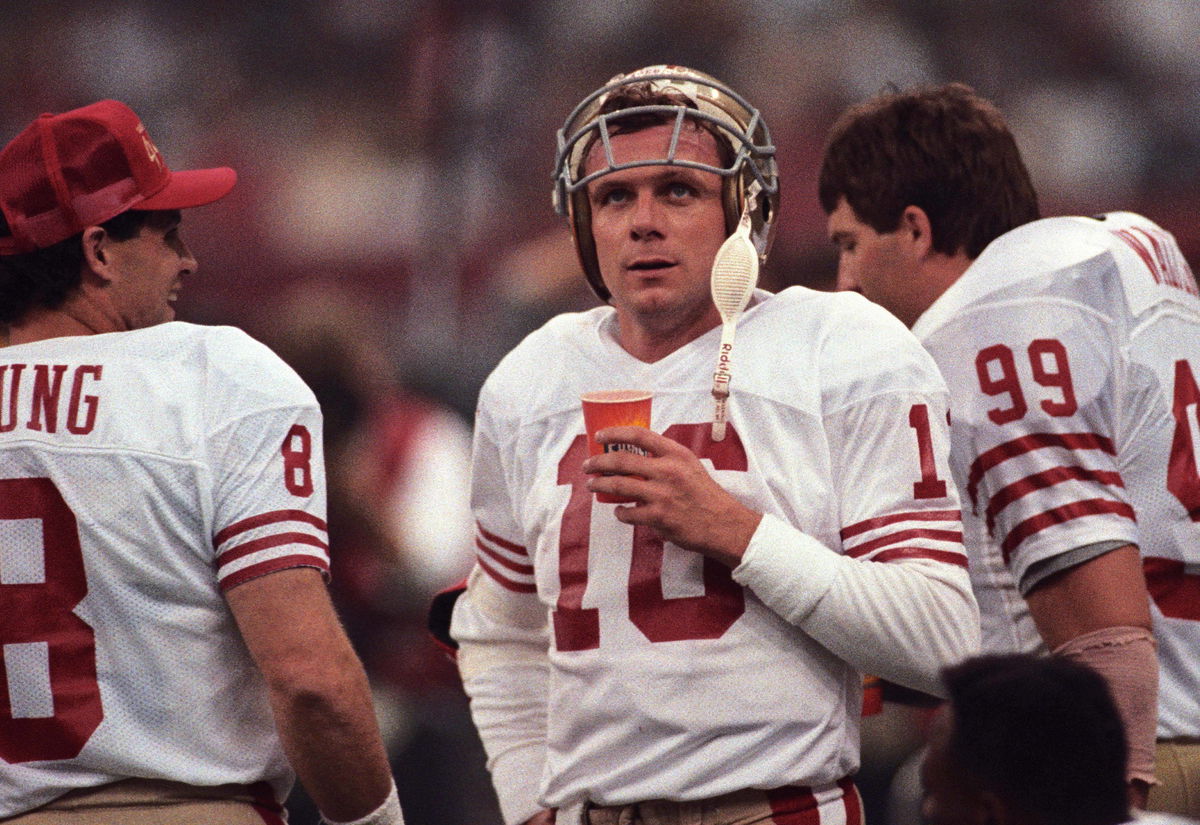
NFL, American Football Herren, USA Super Bowl XXIV Jan 28, 1990 New Orleans, LA, USA FILE PHOTO San Francisco 49ers quarterback Joe Montana 16 on the sidelines with quarterback Steve Young 8 against the Denver Broncos during Super Bowl XXIV at the Superdome. The 49ers defeated the Broncos 55-10. New Orleans Louisiana UNITED STATES, EDITORIAL USE ONLY PUBLICATIONxINxGERxSUIxAUTxONLY Copyright: xBobxDeutschx 8949027
Imago
NFL, American Football Herren, USA Super Bowl XXIV Jan 28, 1990 New Orleans, LA, USA FILE PHOTO San Francisco 49ers quarterback Joe Montana 16 on the sidelines with quarterback Steve Young 8 against the Denver Broncos during Super Bowl XXIV at the Superdome. The 49ers defeated the Broncos 55-10. New Orleans Louisiana UNITED STATES, EDITORIAL USE ONLY PUBLICATIONxINxGERxSUIxAUTxONLY Copyright: xBobxDeutschx 8949027
Essentials Inside The Story
- Joe Montana breaks his silence on a bitter organizational betrayal.
- Front office executives forced an unwanted succession plan despite consecutive championships.
- The legendary passer finally explains his sudden departure from national broadcasting.
Some exits are planned, while others are forced. And then there’s what happened to Joe Montana, the San Francisco 49ers’ legendary quarterback who was stripped of his throne while still believing he deserved it.
Watch What’s Trending Now!
In a recent interview with CNBC’s Alex Sherman, Montana revisited the Niners’ decision to move on from him in favor of Steve Young. Montana’s frustration remains raw even three decades later, revealing a wound that never fully healed.
“We had just won two Super Bowls in a row,” Montana said. “When I left the game, we were still winning. And we were headed to three in a row, and I had one of the best statistical years of my career. And he [head coach George Seifert] wouldn’t even let me compete for a job.”
“I know I can play; I know I’m better than he is,” Montana continued. “And I said, ‘Just let me compete.’ And he said, ‘No.’ So I said, ‘Well, I’m not going to sit here on the bench.’ That’s not how I pictured finishing my career.”

Tony's Top Prospects For QB For 49ERS
Montana’s exit traces back to the 1990 NFC Championship game against the New York Giants. Opposing defensive end Leonard Marshall drove Montana into the turf, leaving him with cracked ribs, a bruised sternum, and a broken hand. The Giants ended up winning that game 15-13, and that marked the final significant game of Montana’s 49ers career.
Joe Montana then sat out all of 1991 and most of 1992 while battling an elbow injury he suffered in the preseason. All the while, Steve Young was solidifying himself as the QB1 and gearing up for his first MVP title in the 1992 season.
Ahead of the 1993 season, George Seifert had made it official: Young would be the starter. The quarterback had made it known he would not be content being a backup, and the Niners told Montana he wouldn’t get a chance to compete in training camp. Montana understood the business rationale but couldn’t accept the execution.
View this post on Instagram
“Typically when you get hurt, you get your job back when you come back. Especially after you win two Super Bowls and you’re in the championship game again for the third year in a row,” Montana said. “I didn’t even ask for it back, because I understood what he was trying to do. And he thought that this is succession, right? But I wasn’t ready for succession.”
So in April 1993, Montana requested a trade. The Kansas City Chiefs landed him for a first-round pick, and he led KC to the AFC Championship game in his first season. Meanwhile, Steve Young led the Niners to yet another championship game and lost to the Dallas Cowboys. The following year (1994), Montana led the Chiefs to the playoffs once again, but Young got his second MVP title and won the Super Bowl with the Niners.
Montana’s refusal to accept an ending he didn’t choose defined his departure from San Francisco. It’s a weight he still carries to this day. And that same principle—walking away when things didn’t align with his standards—would surface again just a year after he hung up his cleats.
Why Joe Montana gave up his broadcasting gig
Montana’s post-playing career included an even shorter stint. After retiring in 1994, he joined NBC’s pregame show in 1995. He lasted just nine games, and once again, it was by choice.
The issue wasn’t talent; it was integrity. Montana couldn’t stomach making snap judgments without knowing every assignment.
“Coming from the other side as a player, so many times, people are making judgments on a player or on what happened on the field; they have no idea,” Montana told Alex Sherman. “It would be hard to judge our receivers, our quarterbacks that played under Bill [Walsh], because our receivers had so many adjustments they could make on a hook. It just depended on the defense.”
In Bill Walsh’s offense, routes changed based on coverage. Montana knew that complexity firsthand, having played under Walsh himself. But sitting in a booth pretending to have all the answers just felt dishonest.
“So, as someone sitting up in the box, you have no idea what those are, who misread who, and all that,” Montana continued. “I just didn’t like making those kinds of judgments on players. I was uncomfortable.”
So during the halftime of Super Bowl XXX, Montana called his wife and made his decision known. He finished the broadcast but never returned to the booth.
“I quit. I’m out of here. I can’t do this,” he told his wife.
Joe Montana won four Super Bowls as a player and cemented himself in Niners lore with the monikers ‘The Comeback Kid’ and ‘Joe Cool’ through his tenacity and ability to create comeback wins for his team. But being benched in favor of Steve Young and then the broadcasting booth disappointment? Those were two battles he couldn’t win on his own terms.
Written by

Edited by

Shrabana Sengupta