Imago
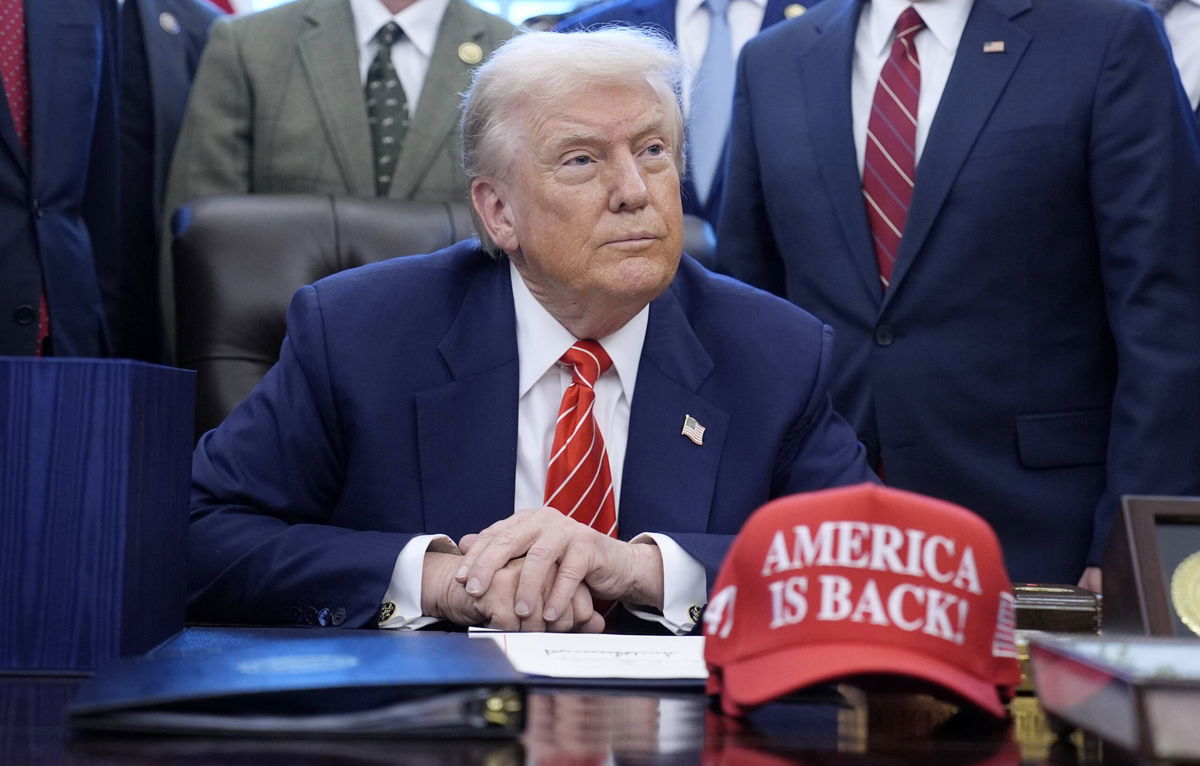
February 3, 2026, Washington, District Of Columbia, USA: United States President Donald J Trump answers questions after signing the bill ending the four-day partial government shutdown in the Oval Office of the White House in Washington, DC, USA, on February 3, 2026. A number of Republican lawmakers from both the US Senate and US House were present Washington USA – ZUMAs152 20260203_faa_s152_017 Copyright: xYurixGripasx-xPoolxviaxCNPx
Imago
February 3, 2026, Washington, District Of Columbia, USA: United States President Donald J Trump answers questions after signing the bill ending the four-day partial government shutdown in the Oval Office of the White House in Washington, DC, USA, on February 3, 2026. A number of Republican lawmakers from both the US Senate and US House were present Washington USA – ZUMAs152 20260203_faa_s152_017 Copyright: xYurixGripasx-xPoolxviaxCNPx
Essentials Inside The Story
- Donald Trump's Religious Liberty Commission is suddenly at the center of controversy
- A high profile exit sparked a debate about free speech, faith, and where the line is drawn
- The fallout didn't stop there, as internal fractures and a growing legal challenge hint that this story is far from over
Almost a year ago, President Donald Trump established the Religious Liberty Commission through Executive Order 14291. That created an advisory body meant to counsel the White House on matters of faith and religious freedom in America. But as tensions in the Middle East continued to shape political discourse at home, a former NFL quarterback’s wife received a final termination letter from the President himself, following a controversy that kept escalating.
Watch What’s Trending Now!
The chain of events that led to her removal began on February 9, during a commission hearing focused on antisemitism in America. That session quickly grew contentious, with Boller engaging in direct exchanges with witnesses and fellow participants over how antisemitism should be defined and where criticism of Israel fits within that framework. Commission leadership later pointed to those exchanges as the basis for disciplinary action.
“President Trump officially removes me from the Religious Liberty Commission for exercising my Religious Liberty,” Carrie Prejean Boller, wife of former Baltimore Ravens quarterback Kyle Boller, wrote on X on March 12. “The only Catholic woman who opposes Zionism was removed as a prelude to the Iran war.”
For Boller, the removal carries a deeper contradiction.
The entire purpose of the Religious Liberty Commission is to uphold First Amendment rights, the constitutional guarantee that every American can freely practice their faith without government interference or fear. In her view, her termination did not just end her role on the commission; it undermined the very principle the commission was created to defend.
🚨President Trump officially removes me from the Religious Liberty Commission for exercising my Religious Liberty.
The only Catholic woman who opposes Zionism was removed as a prelude to the Iran war.
This is the email I received from the White House informing me that my… pic.twitter.com/Fk2IOgqsEz
— Carrie Prejean Boller (@CarriePrejean1) March 12, 2026
The hearing itself had already turned tense before any action was taken. Several witnesses, including Jewish students, spoke about antisemitism they said they had experienced on college campuses, especially in the months following protests linked to the Israel–Hamas war. What followed wasn’t just a routine exchange of views — it quickly became a back-and-forth over where criticism of Israel ends, and antisemitism begins, with no clear agreement in the room.
Witnesses at the hearing shared personal accounts of antisemitic incidents they had experienced at universities across the country. Boller, a former Miss California USA, challenged those testimonies by questioning whether opposition to Zionism constituted antisemitism.
“Catholics do not embrace Zionism, just so you know. So are all Catholics antisemites?” she said during the hearing, drawing significant attention to her remarks.
She also defended conservative commentator Candace Owens, pushing back against claims that Owens had engaged in antisemitic rhetoric. “I haven’t heard one thing out of her mouth that I would say is antisemitic,” Boller said, a position that drew immediate pushback from other participants.
Seth Dillon, CEO of The Babylon Bee, who testified at the hearing, responded directly: “You should look up more of her statements,” citing examples he said crossed into antisemitic territory. He added that while criticism of Israel is not inherently antisemitic, “there are people who try to conceal their antisemitism under the guise of merely criticizing Israel.”
Boller’s remarks went further, at one point invoking a biblical reference tied to longstanding theological interpretations about the death of Jesus, an area widely regarded by modern religious scholarship, including official Catholic doctrine, as sensitive and historically misused in antisemitic narratives. That exchange intensified scrutiny of her comments beyond the immediate hearing room.
The combination of those and some other moments prompted Texas Lieutenant Governor Dan Patrick, who chairs the commission, to announce her removal publicly just two days later.
“No member of the commission has the right to hijack a hearing for their own personal and political agenda on any issue,” Patrick said in a statement on February 11. “This is clearly, without question, what happened Monday in our hearing on antisemitism in America. This was my decision.”
Despite Patrick’s statement, Boller remained on the commission’s official membership list and challenged his authority to remove her. She argued that a state lieutenant governor did not have the power to oust a presidential appointee. “As the name states, this is President Trump’s Religious Liberty Commission, not yours,” she wrote, calling the move “a gross overstepping” and suggesting it reflected “a Zionist political agenda.” That dispute left the matter unresolved for nearly a month. Now, the White House stepped in with a formal termination letter.
“Dear Mrs. Boller, On behalf of President Donald J. Trump, I am writing to inform you that your position as a member of the Religious Liberty Commission is terminated effective immediately. Thank you for your service. Mary Sprowls, Presidential Personnel Office, The White House,” read the letter Boller posted to her X account.
However, Boller’s removal did not stand alone for long as another member of the commission stepped down. And a lawsuit challenging the commission’s very existence is already making its way through the courts.
Another Commission member resigns in protest after Carrie Prejean Boller
Carrie Boller’s termination set off a chain reaction inside the commission. The day after her removal, another presidential appointee announced her resignation in protest.
“My name is Sameerah Munshi. I am a Presidential appointee serving as advisor to the White House Religious Liberty Commission. Today, I am resigning over the injustice and atrocities of this administration at home and abroad,” Sameerah Munshi wrote on X on March 13.
My name is Sameerah Munshi. I am a Presidential appointee serving as advisor to the White House Religious Liberty Commission.
Today, I am resigning over the injustice and atrocities of this administration at home and abroad.
Full statement below ⬇️
Also here:…— Sameerah Munshi (@SameerahMunshi) March 13, 2026
In a lengthy note accompanying her resignation, Munshi outlined multiple reasons for stepping down. Beyond Boller’s removal, Munshi wrote that fellow commission members had “mocked” and treated her “community with hostility.”
She also suggested that internal dynamics had shifted after she previously spoke about Palestine, saying she began to feel sidelined and excluded from key communications, including witness lists ahead of hearings. “If we are not free in America to abide by our religious beliefs… then in what country are we free to do so?” she wrote, framing her resignation as a broader concern about religious freedom within the commission itself.
The commission now faces scrutiny from outside its walls as well. In February, a coalition of religious groups filed a lawsuit in the United States District Court in New York. It directly challenges the legal basis for the commission’s establishment.
The lawsuit, brought by groups including the Interfaith Alliance along with Muslim, Hindu, and Sikh organizations, argues that the commission fails to meet federal requirements for ideological balance. It claims the body is composed “almost exclusively” of conservative Christian members and does not adequately represent diverse religious perspectives, raising questions about its legitimacy even before the February hearing controversy unfolded.
But all in all, for a body tasked with protecting religious freedom, the controversy has only deepened the conversation around who gets to define it, and at what cost.