
Last May, more than 4,000 people had already gathered inside the arena for a Life Surge event. Praise music opened the day before an entertainer took the stage, followed by a lineup of speakers who moved between faith, business, and wealth. The event’s pitch was wrapped in distinctly Christian language, with messages such as “Grow Your Faith to Grow Your Business” and “Build for Tomorrow & Eternity” putting financial ambition alongside religious purpose.
Watch What’s Trending Now!
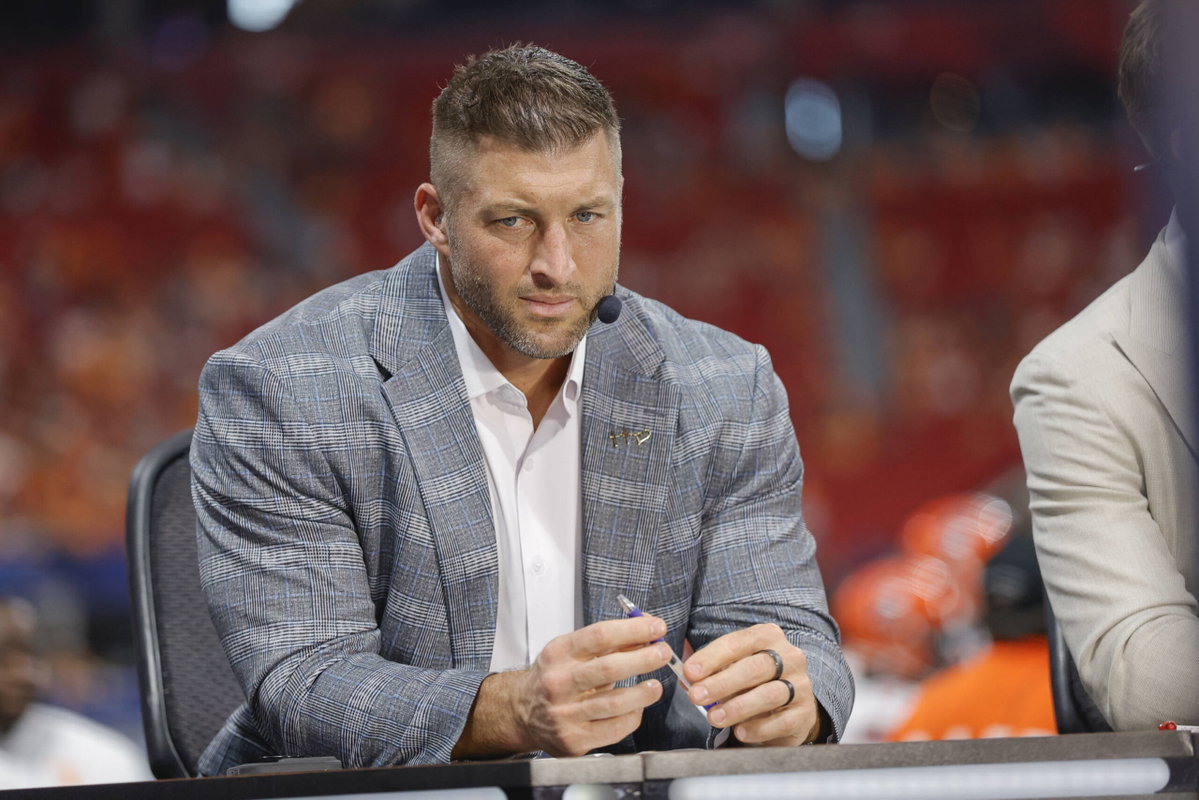
Tim Tebow was one of the names waiting later in the lineup, but his role extended beyond the stage. Life Surge has sold VIP packages that offered attendees perks including better seats, an after-party and, at some events, a photo with Tebow. By the time the former NFL quarterback took the stage, the audience had already spent hours inside an experience that blended Christian messaging, celebrity access and lessons on building financial resources for what Life Surge calls “Kingdom impact.”
However, that carefully constructed experience is now at the center of a new investigation by podcast host Pablo Torre and Mother Jones journalist Kiera Butler. They contacted the Federal Trade Commission for all the complaints filed against Life Surge, and out of the 49 complaints, one of them read as,
“I am so devastated that Christians like Tim Tebow made me trust in something that has taken so much money from me. This is evil, especially because I’m disabled on a limited income,” Butler shared the comment from an alleged victim on the Pablo Torre Finds Out podcast. But that complaint is only one part of a much larger trail of accounts that Butler and Torre say they found.
According to the investigation, the concern centers on what happens after attendees enter the door. Life Surge’s one-day events can cost as little as $20, while attendees are offered a $97 three-day “Impact Class” covering stock-market and real-estate investing. From there, the investigation found that some attendees were presented with SurgeU packages costing between $10,000 and $40,000, with some options reportedly reaching $50,000. Life Surge describes the programs as education and mentorship, while former customers interviewed by Mother Jones described the sales process as high-pressure.
The jump in price is where several former customers said the experience changed. Cathy Luebke, who attended a Life Surge event with her husband in Carmel, Indiana, in 2024, told Mother Jones that a stock-market demonstration made the strategy appear simple enough to try. The couple later bought a $20,000 package and, after speaking with an in-house financial counselor, borrowed roughly $40,000 through credit cards to put the strategy into practice. Luebke said they eventually had to take out a home-equity loan to pay off about $20,000 in credit-card debt after promotional interest rates expired.
Another former customer, Karen Neal, said she and her husband were encouraged to use the equity in their home to help pay for a $13,000 real-estate course. She told Mother Jones that they eventually received a partial refund of about $5,000 but never made money through real estate. “It was about a $15,000 mistake,” Neal said. Her concern was not only the money but how quickly she felt she had been pushed toward a decision without enough time to step back and reconsider.
The financing allegations are particularly significant because Mother Jones reported that Life Surge connected attendees with third-party brokers who could help them apply for credit cards with temporary 0% interest rates. Neal recalled being helped into an American Express card with a roughly $25,000 limit. Other accounts described being encouraged to consider home-equity borrowing or retirement funds to cover the cost of the programs.
The complaints are not confined to the Mother Jones interviews. The Better Business Bureau currently lists 35 complaints against Life Surge over the past three years, including complaints involving product issues, customer service, billing, and sales or advertising. One 2026 complaint described an attendee paying $97 for a three-day class before being presented with $20,000-to-$40,000 programs; Life Surge responded by saying it would issue a full refund. Another customer said they were offered trading and real-estate courses at a Life Surge event and later requested refunds.
The complaints also show that the experience has not been uniformly negative. The BBB lists hundreds of customer reviews, while Life Surge has promoted strong satisfaction figures of its own. Some attendees have described the events as inspiring and the educational programs as valuable. One 2026 reviewer, for example, praised the introductory training while criticizing what they considered heavy-handed marketing of the more expensive programs.
Life Surge disputes the characterization of its sales practices. In a written response to Mother Jones, spokesperson Richard Lorenzen said the company “does not train its representatives to pressure customers into borrowing or taking on debt they cannot afford.” He also said Life Surge does not use a person’s faith, fear or spiritual beliefs to pressure them into buying a product. The company says investing is a skill that takes time and that it does not promise customers that they will get rich.
There is also a visible disclaimer during the events. Mother Jones reported seeing warnings that investment results are not guaranteed and that customers could potentially lose money. Butler said the disclaimers appeared only briefly and were difficult to read from her seat. That distinction matters: Life Surge says it warns customers about investment risk, while former attendees and employees interviewed by Mother Jones argue that those warnings do not capture the pressure they experienced during the sales process.
Then there is Tebow’s own recorded involvement. Life Surge says it does not ask headline speakers to promote or endorse its Impact Classes or advanced training. But Mother Jones obtained a recording from a 2023 Life Surge event in which Tebow told attendees that many had probably already signed up for classes and encouraged them to “follow through on that commitment” and “finish strong.”
That recording does not, by itself, establish that Tebow knew about the alleged sales tactics or the financial difficulties described by former customers. But it does give the investigation a more direct connection to him than simply appearing on the same stage as Life Surge’s sales presentations.
Tebow has been one of Life Surge’s most frequent and highest-profile speakers. Mother Jones reported that he spoke at 10 Life Surge events in each of 2024 and 2025 and was on pace for 20 in 2026. Torre reported that his fee was between $50,000 and $100,000 per appearance, although Life Surge declined to confirm that figure. Based on those estimates, Mother Jones calculated that Tebow could have earned roughly $2 million to $4 million from Life Surge appearances.
He is not the only major sports figure who has appeared at Life Surge. The organization has featured names including Joe Montana and Magic Johnson, while other events have included sports and media personalities such as Sage Steele, Jeff Foxworthy and Russell Wilson. Tebow, however, has become one of its most regular headline speakers.
That celebrity component is central to the concerns raised by former customers. Karen Neal questioned why prominent Christian figures would attach their names to an organization if they were aware of customers taking on large debts. A Life Surge employee who spoke anonymously to Mother Jones raised a similar question, saying that hearing about customers cashing out 401(k)s or taking on credit-card debt “just doesn’t seem like something a good Christian motivational speaker or pastor would want to be a part of.”
The investigation also uncovered a broader business history behind Life Surge. The company was founded in 2020 by entrepreneur Joe Johnson, who had previously been involved with Get Motivated, a motivational seminar company that also combined celebrity speakers, Christian messaging and expensive financial education programs. Mother Jones reported that Johnson later bought Get Motivated with a $12 million loan from a former student, Amy Wolfe, which he ultimately defaulted on. Life Surge spokesperson Lorenzen disputed the comparison, saying Life Surge was developed later by a broader team around a distinctly Christian mission and was not a rebrand of Get Motivated.
Johnson has also faced legal scrutiny over another venture, Welfont Group. The Justice Department sued over what it called “abusive” bargain-sale transactions involving real estate and charitable tax deductions. Johnson denied the allegations, and the matter ended in a settlement that imposed an injunction but no monetary damages or civil penalties and included no admission of wrongdoing.
Another piece of the company’s history involves Online Trading Academy. Mother Jones reported that three senior Life Surge executives previously worked there. The FTC sued Online Trading Academy in 2020, alleging that it falsely promised consumers they could quickly become proficient traders and earn substantial income. The resulting settlement required the company and its executives to pay millions and forgive debt owed by thousands of consumers. The Life Surge executives identified by Mother Jones were not named as defendants in that FTC case.
For Life Surge, the connection between faith and financial education remains central to its pitch. The company describes the idea as “Kingdom impact”: building financial resources that can then be used to support Christian work, rather than simply pursuing wealth for its own sake. That framing is also what makes the allegations particularly sensitive for former attendees who say their faith helped them trust the people onstage.
Tebow’s broader public record adds another layer to that contrast. His Tim Tebow Foundation, founded in 2010, works across areas including orphan care, special needs and anti-trafficking and child-exploitation efforts. The foundation has partnered with Homeland Security Investigations on Operation Renewed Hope, which has helped identify and protect hundreds of previously unidentified child victims across multiple operations. In 2026, the foundation said more than 1,100 victims had been tentatively identified through the first three operations and more than 400 children had been protected.
That record is separate from Tebow’s relationship with Life Surge, and the new investigation does not establish that his charitable work has any connection to the company’s business practices. What it does raise is a narrower question: how much did Tebow know about the sales operation attached to events where he was a headline speaker?
Tebow declined to comment when Pablo Torre reached out to him through multiple avenues. Life Surge has defended its practices and rejected the claim that it trains representatives to pressure customers into unaffordable debt. For now, the allegations against the company remain just allegations.