Troy Aikman Reveals He Was Headed for NFL Bust Status Until One Cowboys Figure Saved His Career

Add us on Google
Troy Aikman Reveals He Was Headed for NFL Bust Status Until One Cowboys Figure Saved His Career
Add us on Google
Imago
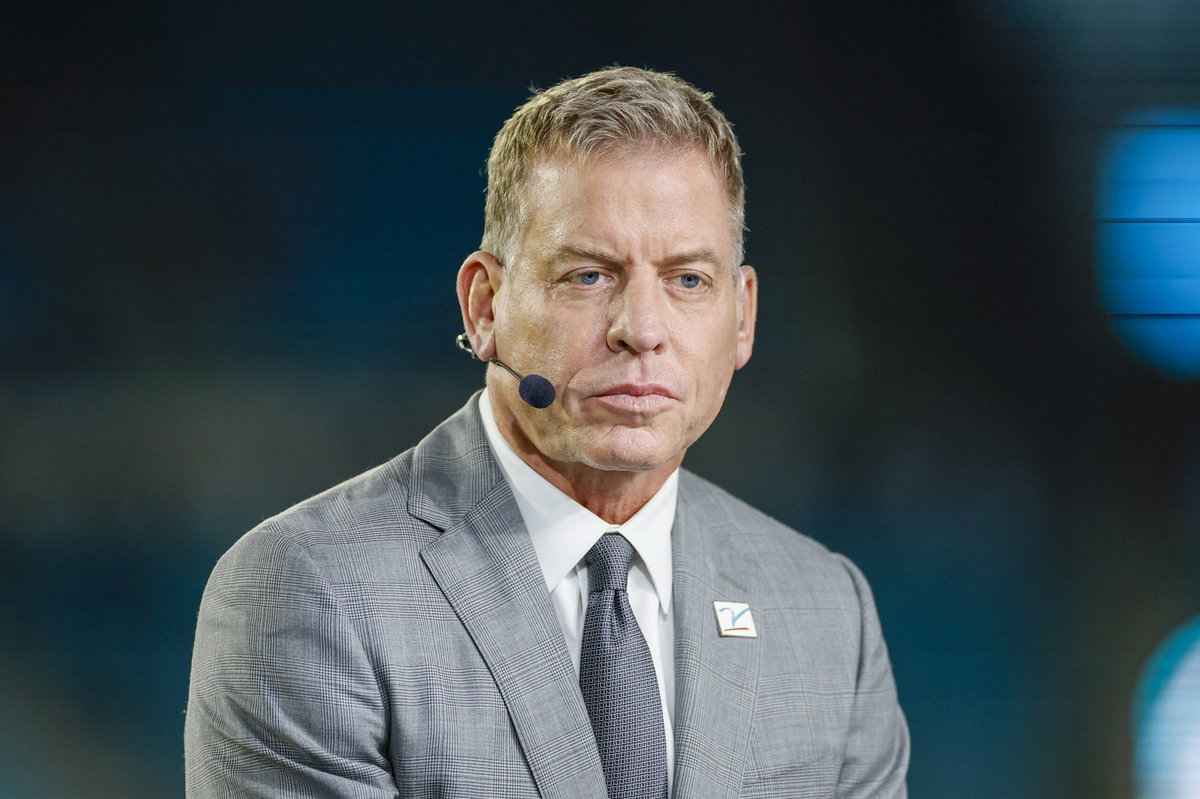
JACKSONVILLE, FL – DECEMBER 04: Former NFL, American Football Herren, USA quarterback and TV commentator Troy Aikman looks on before the game between the Jacksonville Jaguars and the Cincinnati Bengals on December 4, 2023 at EverBank Stadium in Jacksonville, Fl. Photo by David Rosenblum/Icon Sportswire NFL: DEC 04 Bengals at Jaguars EDITORIAL USE ONLY Icon231204457579
Imago
JACKSONVILLE, FL – DECEMBER 04: Former NFL, American Football Herren, USA quarterback and TV commentator Troy Aikman looks on before the game between the Jacksonville Jaguars and the Cincinnati Bengals on December 4, 2023 at EverBank Stadium in Jacksonville, Fl. Photo by David Rosenblum/Icon Sportswire NFL: DEC 04 Bengals at Jaguars EDITORIAL USE ONLY Icon231204457579
Essentials Inside The Story
- Troy Aikman gives flowers to the coach who was once the least favorite to be the Cowboys' offensive coordinator.
- Jerry Jones' habit to stick with his players helped him create Dallas' dynasty in the '90s.
- Aikman has always believed that it's the teams that fails a quarterback and not the other way around. Here's how:
Jerry Jones has one habit: he rarely wants to move on from his players. While Troy Aikman doesn’t agree with his former general manager on most things, he knows this one habit once saved his career and turned him into the Dallas Cowboys’ legend we know today. But he credits the coach who almost didn’t make it to Dallas for the turnaround.
Watch What’s Trending Now!
Back then, the franchise was undergoing an overhaul. Aikman’s 7-19 record in his first two seasons, including zero wins as a rookie, did not help win the crowd. But Jones and Jimmy Johnson knew the problem was not with him. In Aikman’s third season, the aggressive OC in Norv Turner replaced David Shula. To date, Aikman believes that move and the promise to create a team around a quarterback saved him.
“There’s so many quarterbacks that have come into this game that came in as high draft picks with high expectations, and then it just never quite happens for them. My first two years in Dallas, I was on the path of being a bust,” Aikman said on the latest episode of the New Heights podcast.
After his two seasons in the NFL, Johnson was under pressure to prove something. Under Shula, the Cowboys ranked 28th and 26th in the 1989 and 1990 seasons, respectively. This was despite having players like Aikman, RB Emmitt Smith, WR Michael Irvin, and TE Jay Novacek. However, instead of moving on from them, Johnson and Jones replaced the OC.
What’s funny is that Turner almost never made it to Dallas. He was with the Rams at the time, and Johnson had three other names in his mind. But failing to secure them, he turned to Turner. The very next year, Dallas ranked ninth in total yards and seventh in points scored, went 11-5, and made the playoffs.
They had the same skill players but went on to win two back-to-back Super Bowls in 1992 and 1993. And the biggest catalyst in this rebuild was offensive coordinator Norv Turner, who ran Dallas’ offense for three glorious seasons.
“Even in today’s game, there’s not a lot of great offensive minds,” Aikman said on the podcast. “And if you’re one of these quarterbacks who’s fortunate enough to play for one, you got a chance to be really successful.”
Turner’s impact on Aikman’s career was so great that Aikman even chose him as his presenter at his Pro Football Hall of Fame induction in 2006. The credit would also go to Johnson and Jones.
Despite the public scrutiny, the two pulled off the Herschel Walker trade, stockpiled the picks, and built the roster around Aikman. That foundation and fulfillment of the promise helped Aikman become a legend of the game.
Imago
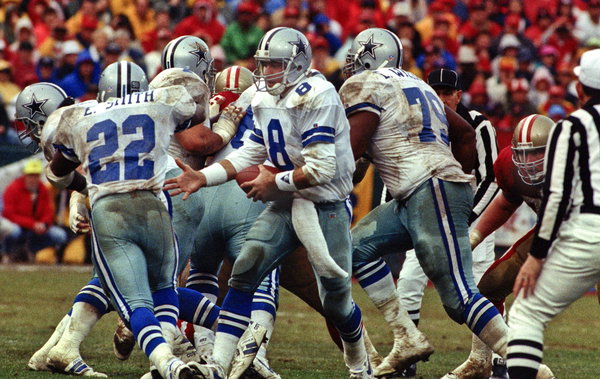
January 17, 1993 – San Francisco, California, U.S – San Francisco 49ers vs. Dallas Cowboys at Candlestick Park Sunday, January 17,1993. Cowboys beat 49ers 30-20. Dallas Cowboys quarterback Troy Aikman (8) fakes hand off to running back Emmitt Smith NFL American Football Herren USA 1992: 49ers 20:30 Cowboys – ZUMAg52_ 19930117_zap_g52_030 Copyright: xAlxGolubx
This is a lesson the NFL seems to keep learning the hard way: quarterbacks don’t succeed or fail on their own. Many who get labeled as busts aren’t lacking talent—they’re stuck in systems that don’t work. Take Sam Darnold, for example.
Drafted third overall in 2018 and written off after stops with multiple teams, Darnold finally found the right situation with the Minnesota Vikings in 2024. With Kevin O’Connell running a stable, well-structured offense, he put together the best season of his career, throwing for 4,319 yards and 35 touchdowns. He then moved to Seattle in 2025 to face his fate.
Darnold had once thrown four picks and lost a fumble in a 33-0 shutout against the New England Patriots. He admitted to “seeing ghosts” in that game. That stumble came full circle last season with the Seattle Seahawks when he defeated the Patriots to win Super Bowl LIX.
“Everyone points to Sam Darnold and what he’s gone through and where he’s been the last two years. And that’s a great example of it,” Aikman said. “He’s been around really great coaching. He’s excelled, and we’ve seen his talents come out, and that’s what happened to me.”
Norv Turner transformed Troy Aikman into the face of the 90s dynasty, and that had a ripple effect. Aikman wrapped his career with 90 wins in the 1990s, then the most by any quarterback in a single decade. That number exists only because one coordinator fixed the system around him, something the former quarterback has always confessed to.
“I’ve said it many times, my career would not have been the same had Norv Turner not have come in, and Norv was the fourth choice for offensive coordinator,” Aikman said earlier in February.
Turner didn’t just elevate Aikman. He helped structure an offense that maximized Michael Irvin and Emmitt Smith as well. Smith captured three consecutive rushing titles, Irvin produced two of the best receiving seasons in franchise history, and Aikman became the highest-rated playoff quarterback in league history.
But once that system was stripped from him, he found himself thinking about the bench again.
Troy Aikman has thought of being benched more than once
Two years after Jimmy Johnson and Jerry Jones fell out, Aikman was thinking about his first two seasons again. His father always told him how everything had to be done a certain way, and that’s what he found in Johnson’s guidance, too. But once he left, Aikman was craving that drive again.
In 1996, they led the division. But their offense struggled, ranking 25th in points scored, which finally translated into them losing the divisional round to the Carolina Panthers. Everything the coach had built — everything Aikman had bought into — was slowly unraveling. Aikman bounced back in 1998 but knew the team had lost its way, and he finally retired after two more seasons. But that wasn’t the only time Aikman thought that he would be a bust.
Fast forward to today, and Aikman is an analyst with ESPN’s Monday Night Football. He is one of the analysts who isn’t afraid to say something. But that’s the very thing that makes him think that he wouldn’t be able to be the quarterback he was in the ’90s.
“When I started out, there weren’t some talking heads ripping me on TV 24/7,” Aikman said. “Now you’ve got it all day on every sports channel, and the owners are listening to this, the GMs are listening to this, and the coaches are seeing it, too. There’s just so much more these guys have to learn how to handle.
“It doesn’t matter how much money you’re making, and it doesn’t matter how much success you had in college. For the real competitors, if you’re struggling and the offense is a mess and the team is losing, you’re absolutely miserable.”
And that’s the thread connecting what happened in Dallas in 1991 to what Aikman sees happening for quarterbacks across the league now.
Troy Aikman on the current state of NFL QB play
On the same podcast, before Aikman dove into his tribute for Norv Turner, Jason Kelce asked Aikman where he stands on today’s quarterbacks. Aikman offered a simple answer before going in-depth with his explanation: “Well, I like it.”
He remembered a period near the end of his career when people were asking who would replace legendary quarterbacks like John Elway, Dan Marino, Warren Moon, Jim Kelly, Steve Young, Boomer Esiason, and many more. Aikman’s answer? It’s always the next man up.
“What you find is somebody always fills those shoes,” Aikman said. “There are always more superstars that are coming along, and I think the league is in great hands.”
Aikman then cited Patriots quarterback Drake Maye, who was the runner-up in the MVP battle last season. Kansas City Chiefs’ Patrick Mahomes (Travis’ quarterback) and Buffalo Bills quarterback Josh Allen also came to Aikman’s mind. He also noted that Cincinnati Bengals’ Joe Burrow “has always been one of my favorites.”
Aikman admitted that he’d have liked to get more air yards during his playing years. But if given the chance, he wouldn’t really change anything.
The run-game and play-action-heavy Dallas Cowboys remain Aikman’s blueprint if he ever coaches a franchise. And the best part is Aikman’s already seen that shift in the San Francisco 49ers, the Los Angeles Rams, and the Chicago Bears.
All of these teams have won consistently without needing a 4-yard touchdown passer in every game. A functional run game creates the same conditions Turner manufactured in Dallas: defenders in conflict, play action with teeth, and a quarterback who doesn’t have to carry the offense alone. That formula made Aikman, and he still thinks it works.
The whole conversation circles back to the same thing. Talent at quarterback matters, but the structure around it is what determines whether that talent actually shows up. The best living proof of that is Troy Aikman himself, who has always believed in one thing:
“If you have to say who fails who the most, it’s the team failing the quarterback.”
Written by

Edited by

Kinjal Talreja