
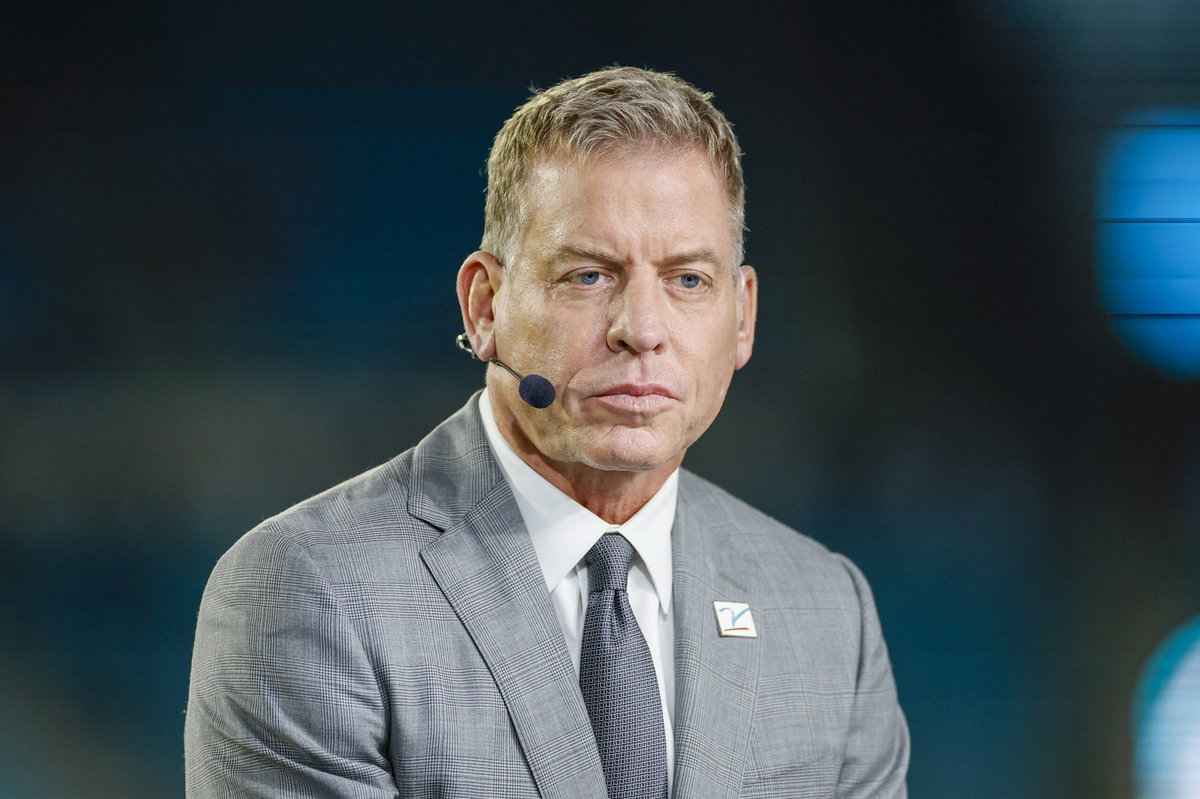
Conventional beliefs in the NFL state that Troy Aikman was one of the best quarterbacks in history. He was not a ‘bus driver’ QB, though many make the mistake of considering him just that, as his stats were underwhelming. In some cases, however, quantity and quality simply do not equate, and that was the same with Aikman.
Watch What’s Trending Now!
So, when FOX’s Craig Carton discussed Aikman’s legacy, he made the same mistake of assuming Aikman was simply an average quarterback.
“I think Troy Aikman was an average quarterback,” Craig Carton said on WFAN on SNY. “He had a pop-gun arm, but he played behind the best offensive line in football, had the best running back in football at the time, arguably the best wide receiver in football, the best tight end in football, and a top-10 defense.
“Troy Aikman is thought of as one of the great quarterbacks of his generation because he won three Super Bowls. He did not have a strong arm.”
The numbers tell a certain story. Aikman’s career averages, 7.0 yards per attempt and 11.4 yards per completion, just aren’t elite numbers. They’re well below what you’d expect from a quarterback known for a big arm. However, it’s a stat Aikman himself would like to see gone, because to him, it doesn’t tell the whole tale.
Aikman was good at precision, not power. He completed 61.5% of his passes and threw very few interceptions, just 3.0% of his attempts over 12 seasons. That kind of consistency shows how careful and in control he was as a passer.
Even his longest completion ever was only 90 yards. So, many of Aikman’s teammates may not agree with Carton’s comment. Take Emmitt Smith as an example.
Much before Carton’s comment, running back Emmitt Smith once told the Associated Press:
“That strong arm, the blond hair and blue eyes – his legacy is part of the Dallas Cowboys’. Any time you saw us winning, you saw him throwing.”
One cannot take away what the man accomplished. Aikman walked into Dallas as the first overall pick in 1989, and by 1992, just 54 games into his career, he’d already crossed 10,000 passing yards. The 1992 season also marked a turning point for the franchise: Dallas went from the bottom of the league to the top, riding a dominant offense and defense.
That was followed by as many as three Super Bowl wins for Aikman and Dallas.
The early 90s had an offense built around Aikman, Michael Irvin, and Emmitt Smith, the famous ‘Triplets.’ With Michael Irvin stretching defenses and Emmitt Smith wearing them down on the ground, Aikman had everything he needed to make that offense nearly unstoppable.
Together they took Dallas from a one-win team in Aikman’s rookie year to champions just three seasons later, and eventually to three rings overall. Sure, Aikman doesn’t have the numbers, but he had such a powerful offense rallying behind him that he didn’t need to throw dimes. He’d said it himself.
“Those years of our success, we would lead the league in yards per pass,” he told Bob Sturm of The Athletic a couple of years ago. “It wasn’t like I couldn’t throw it. We threw the ball better than anybody. We just didn’t throw it as much.”
Whatever people say about his arm, his accuracy and leadership were never in question. As broadcaster Pat Summerall once put it.
“When he was good, and the offense was clicking, and he had it humming, he was as good as I’ve ever seen,” Summerall said. “If I had to define him in a word, I’d say accuracy.”
Troy Aikman eventually retired because of chronic back pain, for which he is still training. However, 15 years after he retired, he said he still had “enough arm strength to go play in the National Football League.”
Call him average if you want. By nearly every measure that matters, Troy Aikman was one of the best.
Troy Aikman was simply elite!
The numbers around Dallas’ passing game tell a story that Aikman’s touchdown totals alone never could. The Cowboys’ offense was consistently among the NFL’s elite, piling up points while their passing attack never slipped out of the league’s upper tier.
So, looking at Aikman as a’bus driver’ QB misses what those Cowboys were actually built to do. Dallas didn’t need to lean just on one dimension because the offense could hurt defenses on the ground or through the air.
The narrative that the passing offense was lacking doesn’t match the reality of how effective the Cowboys were.