
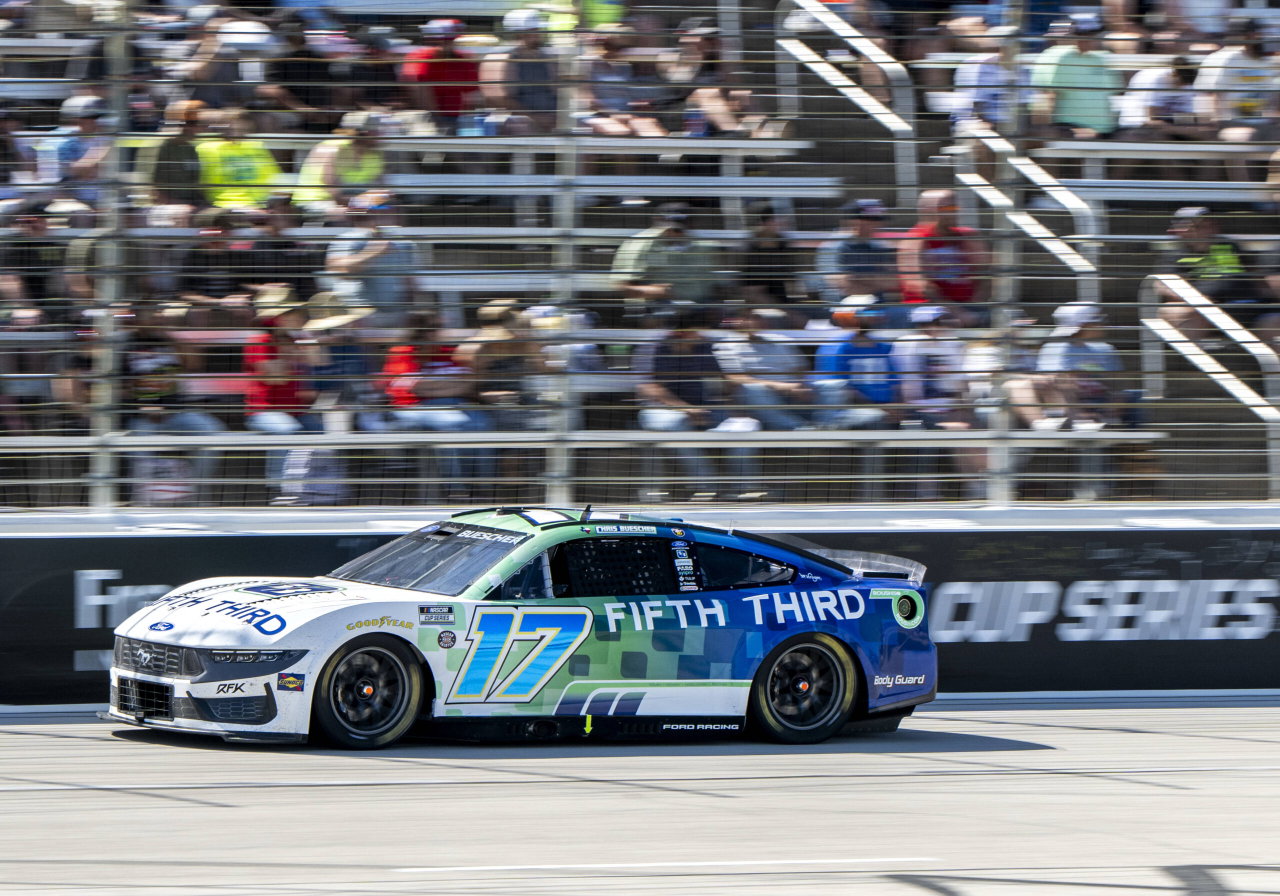
Brad Keselowski, Chris Buescher and Ryan Preece left the Talladega field trailing by more than 40 seconds after their three-car RFK Racing draft seized control of the opening stage. The move unfolded within minutes, turning a developing opportunity into one of the race’s biggest strategic surprises. But while the breakaway looked like the work of a carefully laid plan, competition director Josh Sell offered a different perspective on how the team pulled it off.
Watch What’s Trending Now!
“I’ll be honest. I’ve told a few people this as a competition director, the spot that I’m in, I prefer for it to be a group effort, right? Like, yeah, the outside world wants to point to one person, but I’m probably more proud that it was, you know, our entire group of people and not just one person,” RFK Racing competition director Josh Sell explained on SiriusXM NASCAR via X.
The opening stage ran for 98 laps, encouraging much of the field to save fuel and manage its pace. Keselowski spotted an opportunity to attack while other drivers were still conserving fuel. His teammates joined him, forming a three-car drafting line that could maintain speed without relying on the larger pack.
Why strategy matters at Talladega is closely tied to the track’s drafting-dependent racing. Cars running together can benefit from the aerodynamic assistance of the pack, while fuel conservation can determine when drivers need to pit and how aggressively they can race.
Breaking away carries risks, but a coordinated group can maintain momentum and build an advantage while rivals remain focused on saving fuel. That makes timing, communication and cooperation particularly important when a team spots an opportunity to change the race’s direction.
As the Fords pulled away, their advantage grew beyond 40 seconds. The gap became so substantial that the trio threatened to put much of the field a lap down before the stage ended. Their approach also forced competitors to reconsider a strategy built around saving fuel and positioning themselves for the next pit cycle.
How RFK Racing created its Talladega breakaway
The move paid off in the stage results. Buescher led the RFK sweep, followed by Preece and Keselowski. The team ultimately combined to lead 88 laps during the race, although a late crash would later undo much of the advantage they had established.
Sell revealed that the decision was not a detailed plan developed well before the race. Instead, the group responded to what was unfolding on track and settled on its approach within minutes.
“I would love to tell you it was planned in advance, but it was pretty much spur of the moment. We were kind of building the plane as we were flying it, if that makes sense. You know, really credit to our crew chiefs, our strategy group, our spotters, drivers, pickers, you name it.”
“We, you know, we kind of adapted and saw what was going on and decided to make kind of a bold move there in the span of, I don’t know, it was probably eight or ten minutes of communication while the race was happening. And we decided to just try to go get it.”
That short decision window illustrates the demands of superspeedway strategy. A team must evaluate the developing race, communicate across the organization and decide whether a potential advantage is worth the risk.
RFK’s drivers then had to execute the plan together, maintaining their draft while the rest of the field worked through its fuel calculations.
Talladega has seen similar examples of teams using coordination to challenge the prevailing strategy. In April 2024, Toyota took a related approach during its Cup Series race at the track.
NASCAR‘s race analysis reported that seven remaining Toyota cars made their final fuel stop together with 36 laps remaining before abandoning fuel-saving and preparing to push toward the finish.
The circumstances differed from RFK’s 2026 move: Toyota’s strategy came late in the race, while RFK Racing‘s breakaway developed during Stage 1. Nevertheless, both examples highlighted the potential advantage of teammates working together when the timing is right.
RFK’s early success did not guarantee a strong final result. With five laps remaining, the team co-owner Brad Keselowski and Buescher were caught in a multi-car crash. Keselowski finished 24th and Buescher 32nd, while Preece, who had also dealt with damage earlier, brought his car home in 13th.
The late crash changed the outcome, but not the significance of RFK Racing’s Stage 1 performance. The strategy grew from a quick assessment, communication and coordinated execution rather than a single pre-planned masterstroke. At Talladega, the team found an opening and committed to it and the result showed what a collective decision could achieve.