
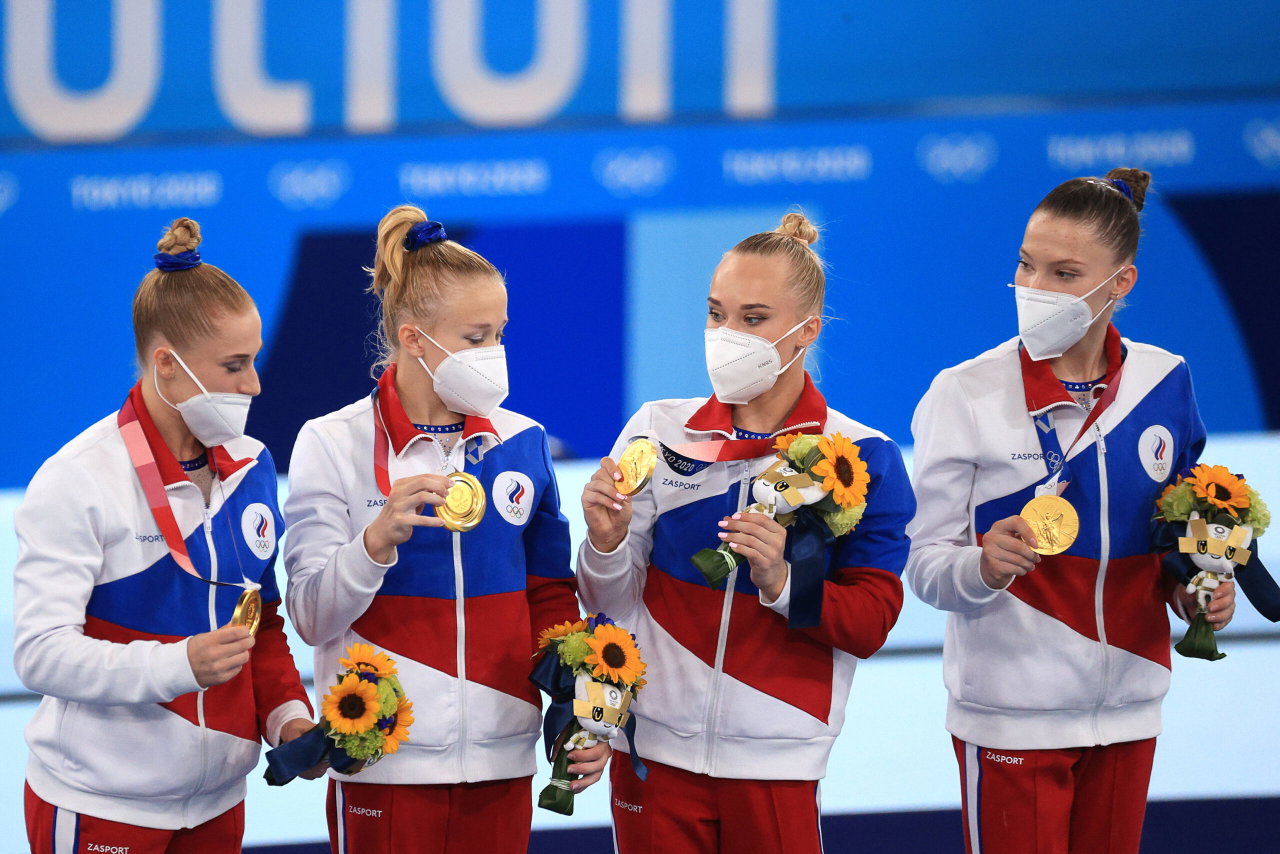
A tenth of a point was all that separated Angelina Melnikova from another world title. Four years after she had last stood on a World Championships floor, the Russian gymnast had returned to the biggest stage she could reach as an individual neutral athlete. There had been a fall on beam in Jakarta, but she recovered on her final rotation, producing a Cheng vault that helped push her past Leanne Wong by 0.100 points for the all-around gold.
Watch What’s Trending Now!
It was more than another medal for Melnikova. After spending years competing only inside Russia while her country remained shut out of international gymnastics, she had proved that the gap had not erased her place among the world’s best. By the summer of 2026, that comeback was supposed to lead somewhere else. World Gymnastics had lifted its restrictions. European Gymnastics had followed. And when the European Championships arrived in Zagreb, Melnikova, as one of the headline stars, expected to return not as a neutral athlete, but as part of Russia’s national team. Then came the visa decision.
The Russian Gymnastics Federation (FGR) officially stated that Croatia did not grant visas to nine gymnasts. The list includes Olympic gold medalists Angelina Melnikova and Viktoria Listunova, as well as reigning national champion Anna Kalmykova. In a statement via Gymnastics Now, the FGR shed light on the matter:
“The Russian Gymnastics Federation considers the visa refusal as a de facto deprivation of the leading Russian athletes of the opportunity to perform at the qualifying tournament,
“Such a practice creates a dangerous precedent in which administrative decisions can directly affect the composition of participants and the course of qualification selection. According to the federation, this calls into question the equal conditions for participation in qualifying competitions for athletes of all national federations.”
Due to the ongoing Russian conflict in Ukraine, federations had banned Russian and Belarusian athletes. That began to change in 2024, as officials allowed neutral athletes to compete as Individual Neutral Athletes (AIN).
Both Melnikova and Kalmykova returned to international action in 2025 after being granted AIN status. Melnikova made her official return at the 2025 Paris World Challenge Cup while Kalmykova competed at the 2025 World Gymnastics Championships. That trend has continued before World Aquatics and several other organisations lifted the ban.
That was followed by World Gymnastics in May 2026, although without national flags, anthems, or symbols. In fact, the 2026 European Artistic Gymnastics Championships would be the first time that gymnasts could represent Russia at an international competition in four years.
However, Listunova did not receive AIN status, unlike Melnikova and Kalmykova. So, the European Championships would have been her return to the international stage. According to Gymnastics Now, the Russian delegation, totaling 65, had nine members refused visas. That includes team doctor Sergey Gulevsky and coach Yuly Kuksenkov alongside the trio, as per TASS.
The visa dispute comes at a particularly significant moment for Russian gymnastics. For FGR president Oleg Belozerov, World Gymnastics’ decision marked a major step forward. That made the latest developments all the more significant.
FGR’s Oleg Belozerov reflects on World Gymnastics’ landmark decision
Since the beginning of Russia’s conflict with Ukraine in 2022, Russian and Belarusian athletes haven’t been able to fully compete internationally. It was an initial blanket ban across all sports and competitions. However, the situation changed after an Authorized Neutral Athlete (AIN) system was created.
That allowed athletes who remained neutral to go through a process that would allow them to compete internationally again, but only under the AIN banner with no flags, national anthem and/or symbols of their country. It saw the reintroduction of Russian athletes in World Gymnastics-sanctioned competitions for the first time in three years.
The 2026 Winter Olympics also followed suit. Then, at the 2026 Winter Paralympics, Russian and Belarusian athletes competed under their own flag. Then, World Gymnastics announced in May 2026 that the ban had been lifted, which followed suit with the decision World Aquatics and United World Wrestling made in the months prior. The decision went down well with President of the Russian Gymnastics Federation Oleg Belozerov.
“The Russian Gymnastics Federation welcomes the decision of World Gymnastics to fully restore the rights of Russian athletes, returning them the opportunity to perform under the national flag and with the national anthem,” Belozerov said in a statement (via Gymnastics Now).
“This is an important step towards strengthening the unity of the world gymnastic community and protecting the interests of athletes. I would like to personally thank the president of the organization Morinari Watanabe for his consistent position, constructive approach, and support for the principles of open international sports.”
The absence of several of its biggest names has instead complicated the return that was supposed to mark a new chapter for Russian gymnastics. Belozerov’s praise for restored international rights now sits in contrast to a tough reality.