
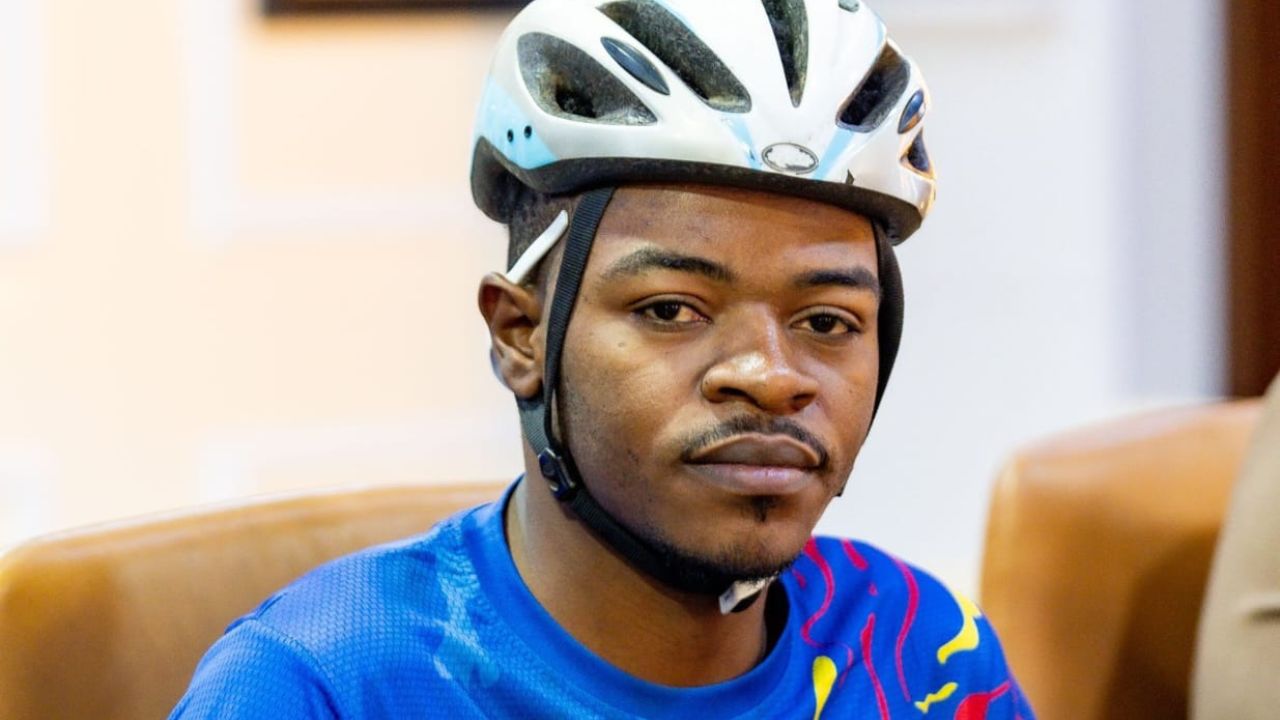
For Miguel Masaisai, the bicycle was his voice. From Goma to the far reaches of Africa, every turn of the pedals carried the same message – peace, unity and hope. Now, that journey has come to a heartbreaking end.
Watch What’s Trending Now!
The 23-year-old Congolese cyclist has died in a road accident while continuing his ambitious “Pedals for Peace” journey from Goma in the Democratic Republic of Congo to Rabat, Morocco. The DRC sports ministry confirmed his death on Saturday, September 19, following the fatal crash in the Republic of Congo.
According to information shared by the Goma Cycling Club, Masaisai was travelling through northern Congo-Brazzaville when his bicycle suffered a mechanical problem. He accepted a lift in a taxi so he could reach a location where the bike could be repaired, and he could continue the journey.
The vehicle, carrying Masaisai, the driver and two other passengers, was later involved in a fatal accident near the border with Cameroon. All four occupants died. The precise cause of the crash has not yet been established.
It was a devastating ending to a journey that had already taken Masaisai thousands of kilometres from home.
He had left Goma on May 1 with an enormous target ahead of him: roughly 14,000km through Africa before reaching Rabat. Along the way, he crossed the Democratic Republic of Congo and eventually reached Kinshasa after covering more than 6,500km. His arrival in the capital was met by cyclists, young people and supporters who joined him in celebrating the message behind his ride.
The journey later continued toward Brazzaville. On September 6, Masaisai crossed the Congo River and entered the Republic of Congo, announcing that his mission was moving forward toward Rabat.
But the significance of his journey went far beyond the distance on his GPS tracker.
The purpose behind Miguel Masaisai’s ride
Masaisai had already completed a major endurance ride from Goma toward South Africa in 2025. His new challenge was designed to take that message even farther, using cycling to speak to young Africans about peace, education, unity and the rejection of violence.
“I want to do something for my country because I cannot go to the war to fight with a gun. I cannot. The only thing that I have is my bike,” Masaisai had said.
That philosophy shaped everything he did on the road.
His journey attracted a growing audience online, where he regularly documented the challenges of life on the road. Mechanical failures, difficult terrain and long stretches of riding alone became part of the story. Yet the support waiting for him in different communities repeatedly pushed him forward.
Radio Okapi reported that his passage through cities such as Mbuji-Mayi drew strong interest from young people, while his arrival in Kinshasa became another major moment for his peace campaign.
And there was history behind the athlete himself.
Masaisai began as a triathlete and developed through the Goma Cycling Club. Club president Charles-Guy Makongo described him as a gifted and determined athlete who represented the club at competitions, including the 2019 Sprint Triathlon African Cup in Gisenyi, where he finished sixth among 30 competitors from 16 countries.
He eventually became known as “The Unstoppable Masai,” turning his endurance into a platform for something much bigger than sport.
His earlier ride from Goma to Cape Town had already demonstrated what he could endure. The new journey was supposed to be even more ambitious, stretching across multiple African countries and taking his message beyond the borders of the DRC.
Now, the cycling community is left mourning a young athlete whose journey was cut short on the road.
“He was far more than an athlete to us,” Makongo said, describing Masaisai’s contribution to the Goma Cycling Club and his evolution into a peace advocate.
The grief has spread far beyond the club. Tributes have poured in from supporters, athletes and young people who followed his progress online. His family has been left devastated, while members of the Goma Cycling Club gathered at his parents’ home following the news.
Masaisai once believed that sport could give young people another direction, even in a region shaped by years of conflict.
He did not have a political platform or a convoy surrounding him. He had a bicycle, a message, and the determination to keep moving.
Now, the wheels have stopped.
But the message he carried across thousands of kilometres does not have to stop with him.