
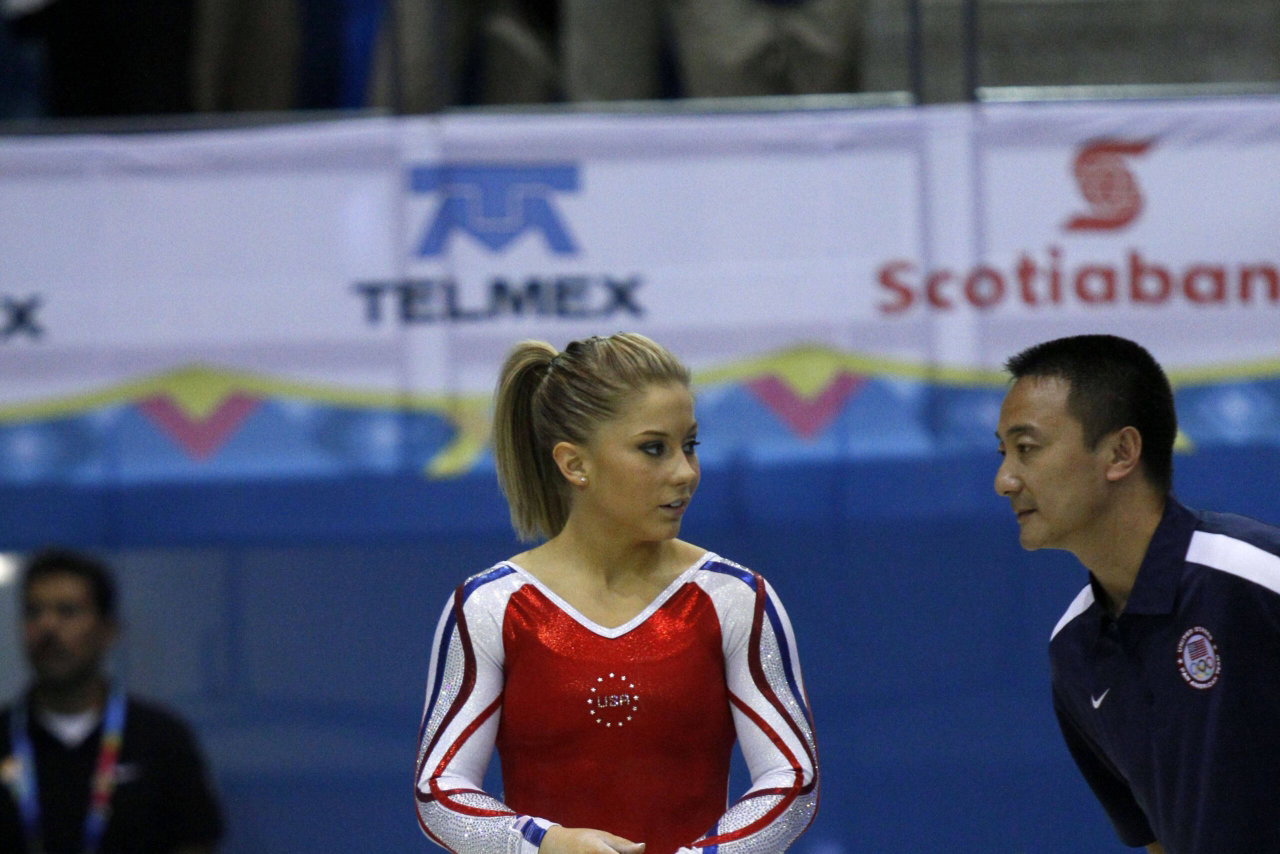
America has produced some of the greatest Olympic champions. However, for many children, the journey to becoming an Olympic athlete now starts at a very young age. They face more training sessions, year-round competitions, and pressure to focus on just one sport. Parents and coaches often believe this will help them become future stars.
Watch What’s Trending Now!
However, former Olympic gymnast Shawn Johnson believes this approach can cause more harm than good.
“Kids’ sports are crazy right now. Crazy. And I, I so strongly disagree with all of it, especially like here. When you start hearing coaches say, They need to be going four days a week, and they need to be doing all this stuff, I’m like, No, they don’t. Mm. They need to be doing… They need to be kids. Yeah. And they need to play,” Johnson said on the Rideout podcast.
“They need to try everything, and they need to have fun. If you don’t protect that early on, they won’t make it far. Yeah. They’ll be really good. You can teach a kid to be really good at a sport really fast, but if you want them to have longevity with a career, emphasizing specialization and mastery at such a young age doesn’t get you anywhere.”
Her words carry extra weight because she knows what it takes to reach the highest level in sports. Johnson became the all-around world champion in 2007 at just 15. She then won four medals at the 2008 Beijing Olympics, including gold on the balance beam. She also won silver in the team, all-around, and floor exercise events.
However, her journey also shows why young athletes need more than early success. They also need time to enjoy their childhood. Johnson’s childhood was not like the strict training culture she now speaks against. In an August 2008 interview with Woman’s Day, she said, “Most Elite athletes train about 45 hours a week, but my parents want me to have a ‘normal life,’ so they limit my training to 25 hours a week.”
It’s something her parents made sure of; as in a 2024 interview with ELLE, she said, “We had Dairy Queen after practice. We just kind of proved the [old] system wrong.”
Johnson even explained, in 2018, ”I had this unique story of blue-collar family, all American, Midwest just kind of parents that wanted me to be normal. And they pushed me to be in so many sports and so many activities and tried the oboe and clarinet and piano practice and mock trial and all these things that kind of distracted me from this Olympic dream that I had.”
Gymnastics eventually became her favourite sport, but she first got the chance to explore other interests. However, the pressure grew as she closed in on Olympic success. Shawn Johnson began to see herself only as a gymnast and put more pressure on herself. Now a mother, she wishes she had enjoyed her childhood more.
That’s because before the 2012 London Olympics, Shawn Johnson felt mentally and physically exhausted. A left knee injury and the pressure of her comeback made things worse, and she eventually withdrew from the Olympic trials, weeks before the event.
“I wanted out of this system that just pushed and pushed and pushed overtraining and undereating. I protected myself by leaving the sport,” she told ELLE.
Her experience shows that helping a child become a good athlete is different from putting too much pressure on them at a young age.
Experts and athletes also warn against too much pressure on young sports stars
Shawn Johnson is not the only one raising concerns about this issue. The American Academy of Pediatrics (AAP) has also warned about the risks of too much training and early sports specialization.
The AAP’s 2024 report on young athletes found that around 70% of children stop playing organized sports by the age of 13. Injuries and burnout may be among the reasons. The report also warned that too much training without enough rest can cause injuries, affect performance, and lead to physical and mental exhaustion.
The AAP recommends at least one or two days off from sport-specific training every week. It also suggests taking a two- to three-month break from one sport each year.
An earlier AAP report from 2016 also supported playing multiple sports until puberty. It suggested that children should try different sports before focusing on one. This could help them enjoy sports for longer and improve their chances of reaching the top level.
The Aspen Institute’s 2025 survey included 3,827 American children aged 10 to 17. It found that bad coaching was the biggest complaint among children playing organized sports, with 22.9% saying it was something they disliked.
In a 2021 report by The Washington Post, Simone Biles’ coach Laurent Landi also raised concerns.
“This is why the sport is somewhat in trouble, sadly. There is so much pressure, too much pressure, on the kids. Kids need to be kids,” Landi said.
American runner Mary Cain’s experience also shows what can happen when young athletes face too much pressure. At 17, Cain became the youngest American athlete to qualify for a World Championships track and field team. She later joined Nike’s Oregon Project, coached by Alberto Salazar.
In a 2019 video published by The New York Times, Cain said, “Alberto was constantly trying to get me to lose weight. He created an arbitrary number of 114 pounds, and he would usually weigh me in front of my teammates and publicly shame me if I wasn’t hitting weight. He wanted to give me birth control pills and diuretics to lose weight— the latter of which isn’t allowed in track and field.”
That kind of pressure to lose weight could easily affect any athlete’s mental health. The pressure affected her physical and mental health. She said she broke five bones and lost her menstrual cycle for three years while training with the programme.
Later, Salazar denied many of her allegations, according to a Sports Illustrated report in November 2019.
“To be clear, I never encouraged her, or worse yet, shamed her, to maintain an unhealthy weight,” Salazar wrote to The Oregonian. “Mary at times struggled to find and maintain her ideal performance and training weight,” he added.
Her experience showed how pressure to perform can harm young athletes when people do not prioritise their health and well-being. It’s why Shawn Johnson believes children should try different activities, have fun, and choose the sport they love. And more than anything, her journey shows that athletes can win Olympic gold without giving up their childhoods.