
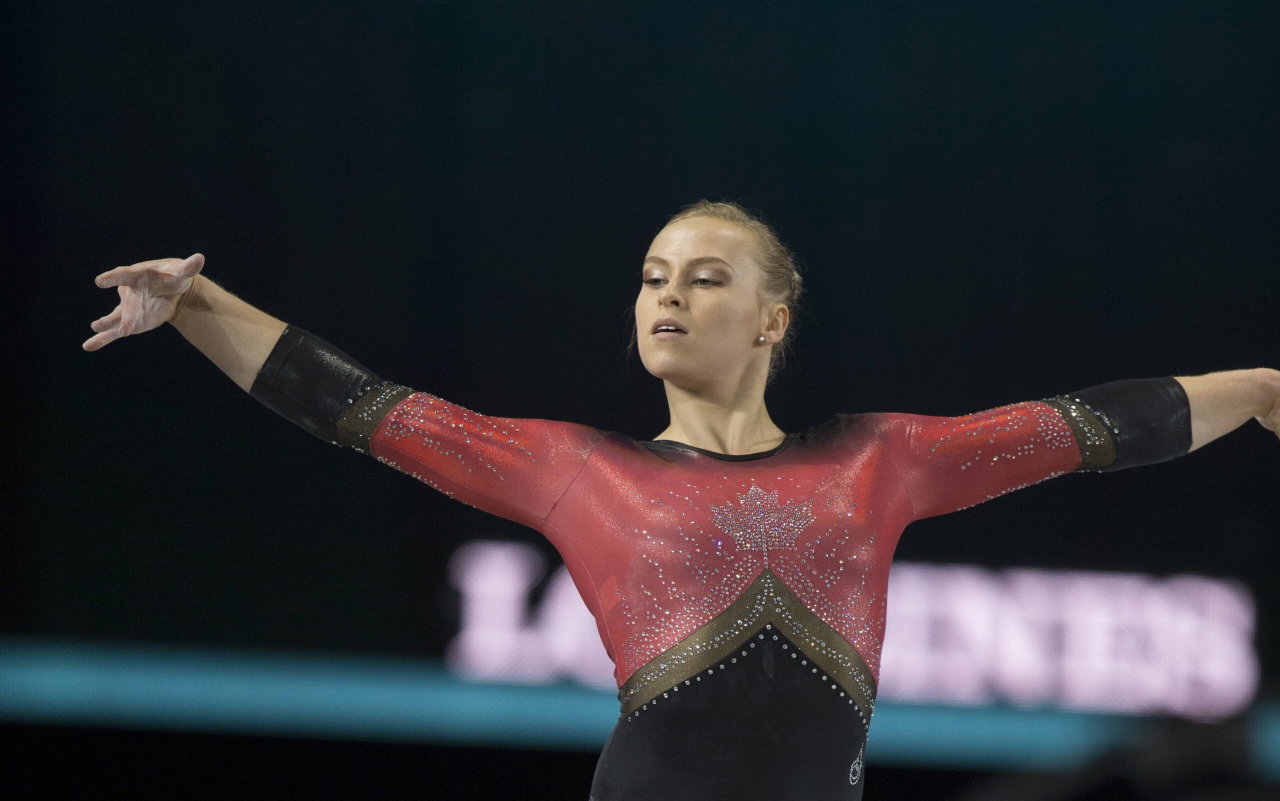
Ellie Black had plenty to be proud of, but one judging call left her frustrated at the 2026 World Artistic Gymnastics Championships. Judges downgraded her front handspring layout full twist to a pike, costing her 0.6 points in both qualification and the vault final. That score hit also had the potential to shake up the medal standings.
Watch What’s Trending Now!
Now, the 10-time Canadian world team member questioned the decision and revealed she could work on a Rudi vault to change her game plan.
I was really happy with my performance. I think I delivered two really nice vaults. I was frustrated, for sure, with the downgrade of the front full,” Black said, as video was shared by Gymnastics Now on X.
“That’s been frustrating all week for me. I’ve been trying super hard. It’s so close, and it’s frustrating to have that downgraded, especially when the positions across all the different vaults aren’t scored the same way.”
In gymnastics, the start value depends on the difficulty of the skill that judges recognise. A downgrade lowers this value, which can reduce the final score even before judges take off points for mistakes. Judges gave her vault a lower start value, and the decision could affect any athlete.
“So I think that was really frustrating for me today, just knowing that, you know, it’s a really big hit to the start value. So it affects the score a lot. But I really did try and hit that layout position, and I was really proud of the vaults that I did today,” she explained.
Black had tried to keep her body in a layout position and wanted the judges to recognise it. The same downgrade affected her in both qualification and the final, making it a repeated problem during the competition.
The 31-year-old also performed her front handspring full-twist vault at the 2024 Paris Olympics, where she scored 14.100 in the final. Ellie Black averaged 13.933 across her two vaults and finished sixth in the women’s vault final. She later compared footage of her Olympic vaults with her performances at the 2026 World Championships.
“Yeah, so, well, actually, I was, like, looking online literally yesterday at my vaults from the Olympics, and my vault, I think, today and from all around yesterday were better than the ones at the Olympics, and that counted as a layout,” the Canadian revealed.
Her comparison raised questions about how judges were checking the skill under the current Code of Points. The judges were using technology to measure the angle of a gymnast’s hips.
“But they have changed a little bit of how they’re judging the layouts in this code, and I know that they’re using the Fujitsu to measure the angle and the angle of the hips,” Black admitted.
“To me, it’s a little bit backwards in the sense of it should be a layout and you should be taking a deduction for form, because I don’t think that’s a pike.”.
For context, a downgrade lowers the start value, while an execution deduction takes points off the score for mistakes during the performance. Her concern goes beyond the score she received at the championships. When a gymnast attempts a difficult vault, the reward depends on both the difficulty credited by the judges and the execution.
The judging controversy could now influence Ellie Black’s training plans. This is especially true because South Korean gymnast Yeo Seo-jeong performed a Rudi in the vault final at the 2026 World Championships. She received 14.600 for her first vault, so working on the Rudi could give Black another option.
Despite her disappointment, Black remains motivated to return to training and work towards improving the vault. The six-tenths deduction has left her questioning the judging approach, while the potential impact on the medal standings has added to her frustration.
Coaches debate AI judging as Ellie Black’s medal hopes take a hit
Ellie Black qualified for the 2026 World Championships vault final in sixth place with a score of 13.933. She also advanced to the all-around final, finishing 15th with 53.466. However, the vault final on October 24 brought further frustration for the Canadian gymnast. Judges once again downgraded her front handspring layout full twist to a pike.
The gymnastics commentator at Balance Beam Situation noted a slight hip angle throughout the vault, which led the judges to classify it as piked. In the end, Ellie Black finished fifth with an average score of 13.966, while Brazil’s Rebeca Andrade won gold with 14.466, and Americans Claire Pease and Skye Blakely claimed silver and bronze, respectively.
Her frustration has also drawn attention to technology in gymnastics judging. Gymnastics coach Rick Mc discussed the issue in his October 20 report on the World Championships qualification rounds.
“Unpopular opinion — I’m thrilled Fujitsu video analysis is available to the D-panel now. It’s new and making mistakes, even hallucinations. But using machine analysis as part of the final score works really well in Trampoline,” the report reads.
“It could already be part of Vault scoring ➙ height & distance relative to gymnast height, alignment on landing. Think of the cost savings by having fewer humans involved in scoring. Humans make mistakes, as well.”
Mc’s comments raise an important question: can technology make judging more accurate while still producing decisions that athletes and coaches find difficult to accept? American coach Patrick Kiens also discussed AI judging during an interview with Gymnastics Now on October 19.
“Then if they look back on AI, I think AI doesn’t lie. AI doesn’t lie,” Kiens said.
The two perspectives reveal the challenge facing gymnastics. Technology can provide measurements, but officials must still use the rules to determine a skill’s difficulty value. Kiens made this comment while discussing elements, connections and body positions in gymnastics. He did not make the statement specifically about Black’s vault.
The downgrade was a major source of frustration for Black because she believed her vault deserved a higher difficulty value.
However, the available results do not establish that the downgrade alone cost her a medal. The other finalists’ scores also mattered. Whether she continues refining her layout full twist or develops the Rudi as an alternative, the decision could shape her next steps.