
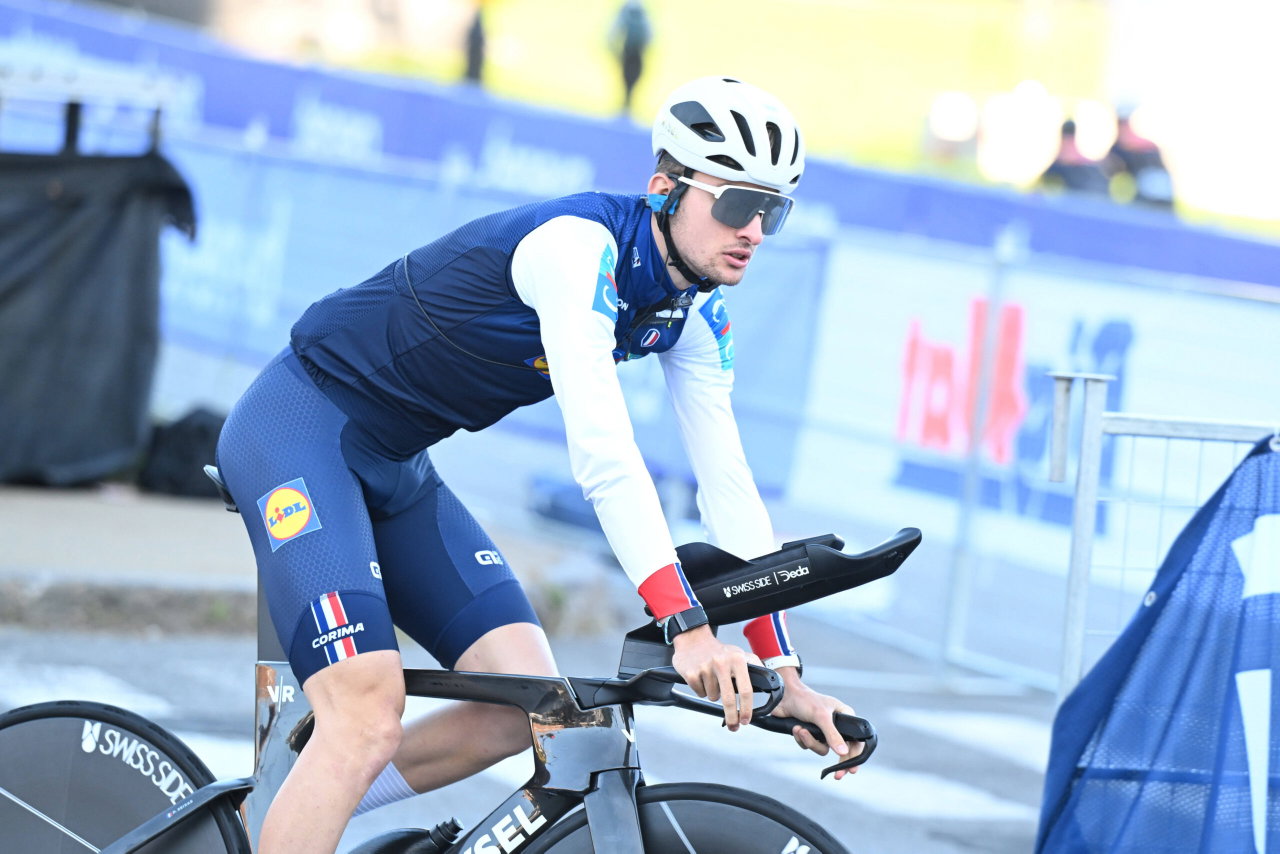
A champion rider’s rise usually draws attention to his victories, but Paul Seixas has shifted the spotlight to a far more troubling side of cycling. The 20-year-old French star has raised serious concerns about race safety after British teenager Finlay Tarling died in a crash during the Volta a Portugal in August. Seixas now wants the sport to review its safety standards more closely.
Watch What’s Trending Now!
Seixas discussed the incident in an interview on Canal+’s Clique show.
“Honestly, it’s terrible. Frankly, I think the problem is that he’s not the only one. And what’s more, I raced with him, and it really affects me. It really touched me at the time because what’s terrible is we tell ourselves it’s one more cyclist this year who has lost their life in a race, and I think it really affected everyone, all cyclists,” Paul Seixas said in an interview with Canal+’s Clique show.
This tragedy is about more than losing another cyclist. It has also raised serious questions about race safety and what organisers can do to prevent such incidents in the future.
“That’s when you realize that sometimes there are real organizational issues, and the organizers are doing their best. That’s not what we mean; it’s just that sometimes there should be more standards,” Seixas explained.
For the unversed, the accident involving Finlay Tarling occurred in August earlier this year during the eighth stage of the Volta a Portugal. The 19-year-old British cyclist was riding for the NSN Development Team when he suffered a fatal accident during the 166.8-kilometre stage between Melgaço and Fafe.
According to Portuguese broadcaster RTP, Tarling collided with a car that was not part of the official race. Tarling was riding behind the main group of cyclists when the accident happened. There have been other issues as well, with another example is when cyclists delayed the start by five minutes to raise safety concerns during professional races.
“We protested about that around Lombardy at the start of the race for 5 minutes. But here, what happened is extremely serious. And the problem is we tell ourselves that families are being affected. It’s very serious that this happens in a race, a professional organization like this, riders losing their lives; it’s scary,” Seixas added.
Remco Evenepoel spoke on behalf of the riders at the starting line.
“Unfortunately, we lost the life of a brother and of a colleague, so we want to make this statement to show the world that we cannot keep accepting the fact that guys are getting injured or literally dying in what we like the most to do,” Evenepoel said.
However, the protest was not only about Tarling’s death. Other incidents involving vehicles on race routes had also raised concerns among cyclists. These incidents showed that even professional races with safety arrangements can face serious problems.
Cycling has already lost riders in other tragic incidents
Unfortunately, Finlay Tarling’s death was not the first tragedy to raise questions about safety in professional cycling. In 2011, Belgian cyclist Wouter Weylandt died after crashing during the third stage of the Giro d’Italia.
The Leopard-Trek rider crashed while descending at high speed, about 25km (15.5 miles) before the stage finished, between Reggio Emilia and Rapallo.
“Despite immediate treatment there was nothing we could do,” doctor Giovanni Tredici told Italian television. “He died from a fracture to the front of his skull. We arrived at the scene 30 seconds after the crash. We tried for 40 minutes to resuscitate him.”
Five years later, another Belgian rider, Antoine Demoitie, died after a crash at Gent-Wevelgem in 2016. He fell during the race. With 115 kilometres to go, Demoitié and four other cyclists crashed in Sainte-Marie-Cappel during the race’s short crossing into France.
“The entire team is in disbelief, shock, angry and sad because of the loss of Antoine,” the team said in a press release.
More recently, Colombian cyclist Cristian Camilo Munoz died in April 2026. His death followed medical complications linked to an injury he suffered in a crash at the Tour du Jura in France. The 30-year-old first received treatment for a knee injury. However, doctors later found complications linked to an infection.
“[His] death occurred as a result of medical complications arising from the accident he suffered last Saturday,” the cyclist’s team said after the incident.
These accidents show how dangerous professional cycling can be.
At just 20, Paul Seixas is already one of the sport’s brightest young talents. However, his comments show that rider safety matters as much as success. He and other cyclists now want better safety rules to prevent such tragedies and ensure that no other family suffers a loss like the Tarling family.