
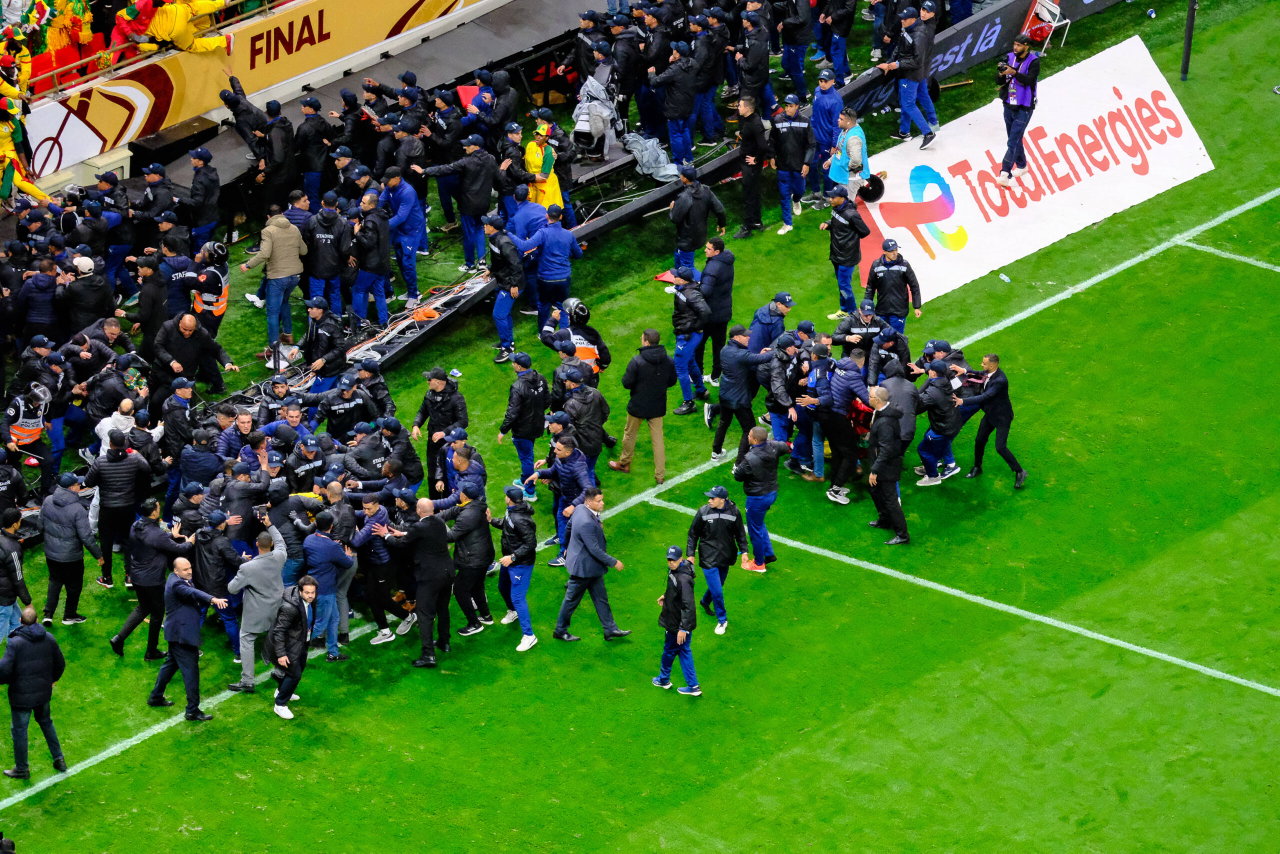
Morocco’s hopes of keeping the Africa Cup of Nations (AFCON) title have taken another hit. However, the Royal Moroccan Football Federation (FRMF) is not ready to accept defeat. After the Court of Arbitration for Sport (CAS) restored Senegal as the 2025 champions, Morocco has decided to continue its legal fight.
Watch What’s Trending Now!
The federation has questioned the fairness of the CAS process and raised concerns about an alleged contact involving one of its arbitrators. It has also challenged the court’s view on Senegal’s players walking off the pitch. Now, Morocco could take the battle to Switzerland’s highest court.
The controversy began during the 2025 AFCON final between Senegal and Morocco on January 18, 2026.
Neither team scored in normal time. However, the match took a dramatic turn when referee Jean-Jacques Ndala awarded Morocco a penalty after a VAR review in stoppage time.
Senegal’s players strongly protested the decision. Head coach Pape Thiaw also joined the protest, and several players walked off the pitch. The match remained stopped for over 15 minutes before Senegal’s players returned.
Morocco then had a chance to take the lead, but Brahim Diaz missed the penalty. Senegal goalkeeper Edouard Mendy made the save. The game went into extra time, where Pape Gueye scored the winning goal.
Senegal secured a 1-0 victory and lifted its second AFCON trophy. However, the celebrations soon turned into a legal battle.
The Royal Moroccan Football Federation challenged Senegal’s walk-off. CAF’s Disciplinary Board rejected Morocco’s protest on January 28. But Morocco continued its fight, and the CAF Appeal Board changed the result on March 17.
The Appeal Board declared Senegal the loser and awarded Morocco a 3-0 victory. It used Articles 82 and 84 of the AFCON regulations, which cover teams leaving the pitch without the referee’s permission or refusing to play.
Senegal refused to accept this decision and appealed to CAS on March 24. The fight over the AFCON title had now moved to the international sports court.
The legal battle took another major turn on November 24, 2026.
CAS unanimously accepted the appeal filed by the Senegalese Football Federation (FSF). It overturned the CAF Appeal Board’s decision and brought back the original disciplinary ruling.
This meant Senegal’s 1-0 win in the final became official again. Morocco also lost the title it had received after CAF’s appeal decision.
The main issue was whether Senegal’s temporary walk-off meant an automatic defeat. CAS ruled that referee Ndala had the authority to restart the match. Senegal’s players eventually returned, and the referee allowed the game to continue.
Since the match was not permanently abandoned, the panel found that CAF’s Appeal Board was wrong to declare Senegal the loser.
CAS also considered the separate punishments CAF had already given to the Senegalese federation, head coach Pape Thiaw, and some players.
CAS Director General Matthieu Reeb explained the importance of the ruling, saying, “This is a huge decision because it is the first time that we have had to rule on the fate of a continental final.”
Senegal regained its title, but Morocco is now preparing another legal challenge.
Morocco raises concerns over CAS ruling and eyes Swiss court appeal
One of the biggest concerns raised by the FRMF involves German arbitrator Ulrich Haas, who was part of the three-member CAS panel.
Morocco claims Haas communicated with Senegalese Football Federation President Abdoulaye Fall 48 hours before CAS announced its decision.
The Moroccan federation believes this alleged contact raises serious questions about the fairness of the arbitration process. It has also questioned CAS for not properly considering its concerns about the communication.
However, the allegation remains disputed.
According to Reuters, both Haas and the Senegalese federation denied that the alleged contact took place. Reuters also said it could not independently confirm whether the call happened or what the two sides discussed.
Morocco has also criticized CAS for overlooking FIFA and IFAB rules on players leaving the pitch without the referee’s permission.
The FRMF believes the court should have given more attention to the disciplinary rules and possible punishments for such actions. These concerns now form another major part of Morocco’s fight against the ruling.
Following the CAS ruling, the Royal Moroccan Football Federation released an official statement explaining its position and plans for further legal action.
“The Royal Moroccan Football Federation has taken note of the Court of Arbitration for Sport’s decision, issued on Tuesday, November 24, 2026, in Lausanne, Switzerland, concerning the appeal filed by the Senegalese Football Federation against the decision of the CAF Appeals Committee regarding the 2025 Africa Cup of Nations final.
In this context, the Royal Moroccan Football Federation expresses its surprise and protest at the failure to consider its request to take into account the necessary legal consequences for practices that could compromise the integrity and credibility of the arbitration process, particularly the confirmed communication between German arbitrator Ulrich Haas and the President of the Senegalese Football Federation 48 hours before the decision was issued.
The Royal Moroccan Football Federation also notes that the decision failed to consider the recent trend established by both the International Football Association Board (IFAB) and FIFA regarding players leaving the field of play without the referee’s permission, and the resulting disciplinary responsibilities and sanctions.
Accordingly, the Royal Moroccan Football Federation confirms its intention to pursue all available legal avenues to appeal the Court of Arbitration for Sport’s decision.”
Morocco does not intend to accept the CAS decision without exploring its remaining legal options.
The Swiss Federal Supreme Court could become Morocco’s next destination in this legal battle. CAS is based in Lausanne, Switzerland, and its decisions can be challenged before the country’s highest court, also known as the Swiss Federal Tribunal.
However, Morocco cannot simply ask the court to review the entire case or change the result because it disagrees with CAS. The rules for challenging an arbitration decision are very strict.
Under Article 190 of Switzerland’s Private International Law Act, a party can challenge a ruling only on specific legal grounds. These include an improperly formed panel, lack of jurisdiction, violation of the right to be heard, or a decision that goes against public policy.
Morocco’s concerns about the alleged communication involving Ulrich Haas could become important if it can prove that the panel’s independence or fairness was affected.
Morocco’s latest statement makes its intentions clear. The FRMF wants to use every available legal option to challenge the CAS ruling.
For now, Senegal remains the official 2025 AFCON champion after CAS restored its 1-0 victory. Morocco’s plans for further legal action do not automatically change the result.
The next step will depend on whether the FRMF approaches the Swiss Federal Supreme Court and what arguments it presents.
Meanwhile, Senegal has welcomed the decision. Federation President Abdoulaye Fall called it justice for sport and highlighted the friendly ties between the two countries.
What started with a disputed penalty and a walk-off has become a major legal battle. Senegal has its trophy back, but Morocco is not ready to end the fight. The AFCON controversy could still have another chapter.