
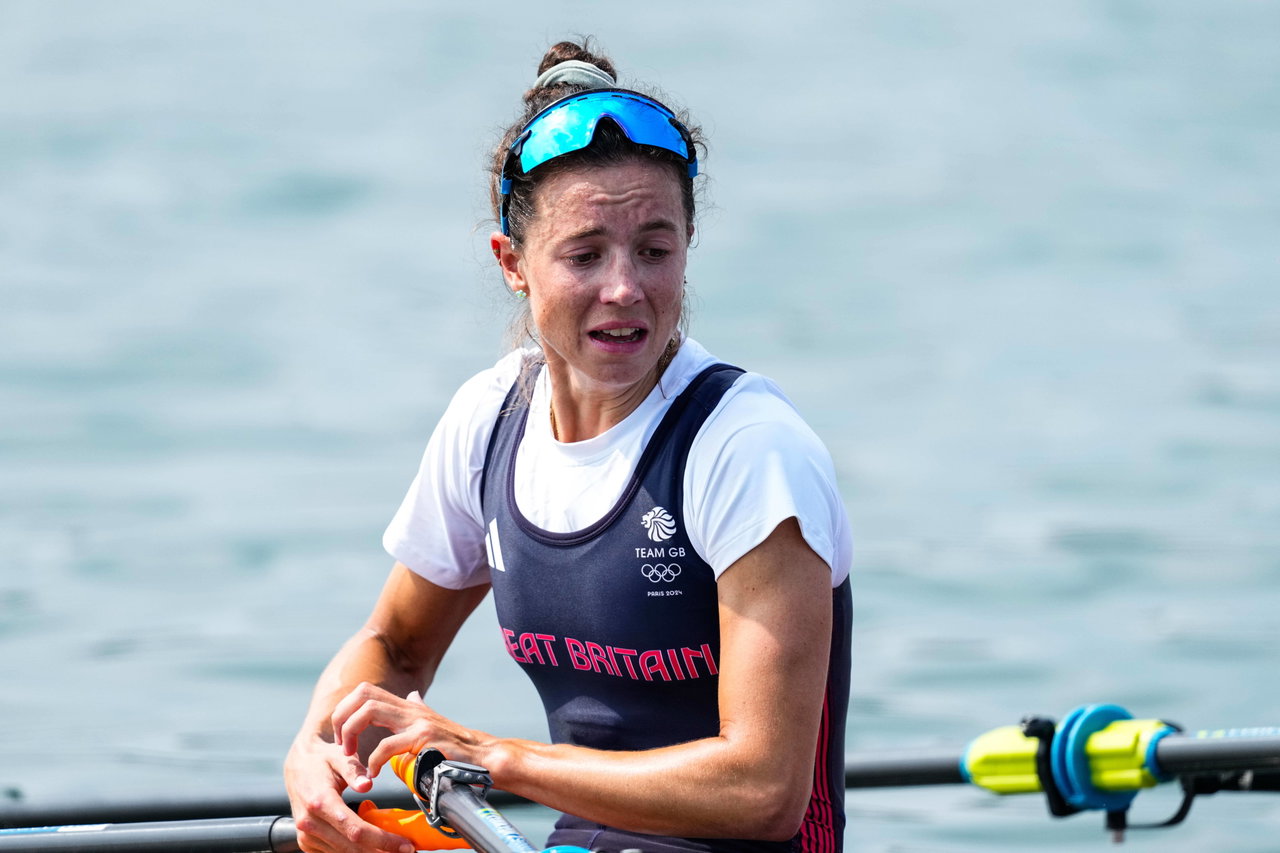
For Imogen Grant, Olympic gold was supposed to be the finish line. Instead, has now become the beginning of an entirely new challenge.
Watch What’s Trending Now!
The British rower reached the top in Paris alongside Emily Craig, winning gold in the lightweight double sculls. But with lightweight rowing removed from the Los Angeles 2028 programme, Grant suddenly had a choice to make: walk away or rebuild herself for a different kind of rowing.
After her gold-medal race in Paris, Grant finally had the chance to experience the Games without the pressure of competing. Somewhere along the way, that experience changed her mind about what should come next.

Reuters
Tokyo 2020 Olympics – Rowing Training – Sea Forest Waterway, Tokyo, Japan – July 21, 2021 A rower during training REUTERS/Leah Millis
“It’s so special. I just have to try and do it again,” she remembers thinking, as per Katie Gornall, a BBC Sport correspondent.
But getting back to the Olympics would require Grant to become a very different athlete.
At 5 ft 6 in, she is considerably smaller than many of the open-weight rowers she could face. Lightweight rowing required her and Craig to maintain an average pre-race weight of no more than 57 kg. Open-weight rowing has no such restriction.
Instead of trying to stay light, Grant now has to become bigger, stronger and powerful enough to compete for a place in Britain’s women’s quadruple sculls.
“It was definitely a bit daunting thinking about just like physically whether I’d be competitive,” she told BBC Sport. “I’m never going to be the strongest person in the boat.” But strength is not everything that moves a rowing boat.
Grant spent years developing the technical precision and efficiency that helped make her one of the world’s best lightweight rowers. Now she is hoping those qualities can compensate for what she lacks in size.
“It’s not just about the raw power in a rowing boat,” she explains. “It’s about all of those other things, how well you can row with each other, how well you can move the boat.”
That philosophy has also changed what happens away from the water.
Imogen Grant’s biggest transformation goes beyond rowing
For years, food was closely tied to making weight. Now, Grant has the freedom to eat more as she attempts to add muscle while handling the demands of elite endurance training.
“Now, I don’t have that restriction,” she says. The change has been gradual, but Grant can already feel the difference. “I’m heavier now, I’m bigger now, I’m stronger now and I think all of those things are really positive,” she says.
There is another challenge attached to that transformation. Grant is vegan, a choice connected to her climate activism and commitment to environmental sustainability.
Her training requires around 3,500 to 4,000 calories a day, with carbohydrates playing a major role. Tofu, chickpeas, beans, and vegan protein shakes help provide the protein she needs as she builds muscle.
“We’re an endurance sport, so carbs are king,” she says.
Still, Grant does not want her diet to become the center of her sporting story.
“I never want it to be a really big part of kind of how I perform, because I don’t think that’s really how you convince people that being plant-based or reducing meat and dairy is the way to go forward,” she says. “But just consistently showing up and showing that it is possible is really important to me.”
After Paris, Grant spent much of her time balancing rowing with her work as a resident doctor in Britain’s NHS. She traveled to the 2025 World Championships in Shanghai as a reserve but returned to full-time rowing this year.
In June, she helped Britain’s women’s quad win World Cup gold in Lucerne. She has since been selected alongside Paris champions Lola Anderson and Hannah Scott, plus Finnola Stratton, for the World Championships in Amsterdam.
Grant admits the transition has not happened overnight.
“It’s been going well,” she says. “I think it was a slow and steady start, trying to understand how to fuel and how to gain a bit of weight and gain a bit of muscle. I feel like the momentum has been really building.”
Her Olympic ambition is even more remarkable considering everything else she has managed alongside rowing.
Grant completed her medical training at Cambridge and began working as a doctor just two days after winning Olympic gold in Paris. She has described medicine as a source of balance and perspective while also helping her better understand her body as an athlete.
Now, she is putting that knowledge to another test. Grant knows there are no guarantees that she will make Britain’s LA 2028 team. But the challenge itself has become part of the motivation.