
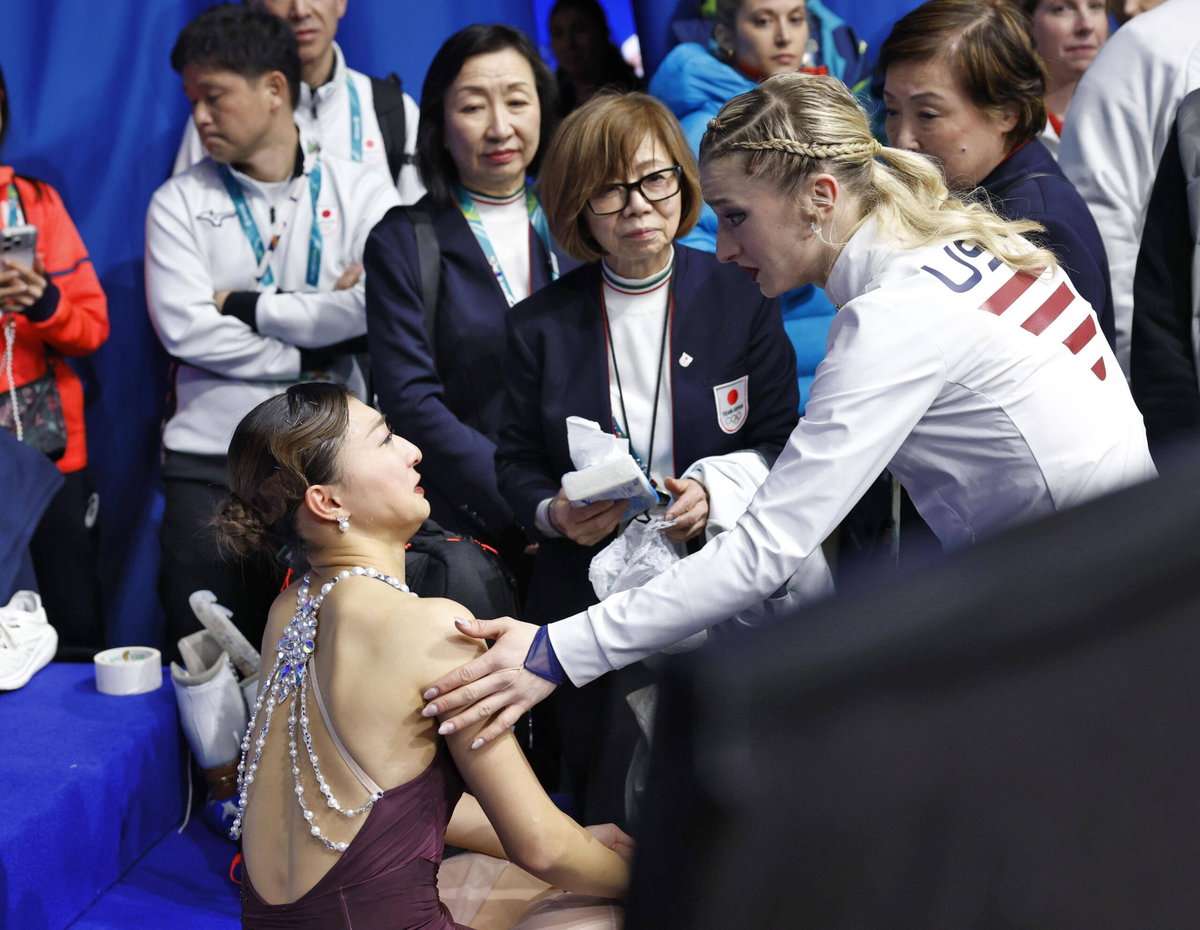
Kaori Sakamoto’s skating career includes major titles, Olympic medals, and unforgettable performances. But behind her success on the ice, the Japanese star faced a serious health battle she kept secret for years. After winning silver at Milan-Cortina 2026, the four-time world champion revealed that she underwent heart surgery in July 2017 to treat an irregular heartbeat.
Watch What’s Trending Now!
In an interview with Kyodo News in Kobe, published on October 23, 2026, the four-time world champion revealed that she underwent catheter ablation after experiencing worrying symptoms during training. She recovered fully, but the experience also made her fear death.
“I was having really bad palpitations. It wasn’t just a ‘thump, thump’, but more like a ‘thud, thud, thud, thud, thud,’” Sakamoto recalled in the interview, as reported by Daily Sports.
Sakamoto first noticed the symptoms in 2016, when she was still competing at the junior level, and over time, they became harder to ignore.
At first, she felt better when she leaned against the fence around the skating rink. However, the episodes became more frequent. They increased from once a month to two or three times a month. Later, she had to lie down and raise her legs to feel better.
Her regular health checkups found no problems, even though the symptoms continued. In May 2017, an electrocardiogram finally showed that she had an irregular heartbeat, which led to surgery two months later. The timing made the situation more difficult for Sakamoto. She was preparing for the 2018 PyeongChang Winter Olympics season.
Unfortunately, it only got worse as Sakamoto underwent catheter ablation in July 2017. In the procedure, doctors use a catheter to find and treat areas of the heart that cause an abnormal rhythm. The treatment worked, and Sakamoto fully recovered.
“The surgery gave me this ‘strong heart’ (which makes me strong on big stages). Now I have no problems, and I’m super healthy,” Sakamoto explained.
For a figure skater like Sakamoto, repeated heart palpitations could make training difficult. A 2024 expert statement from the Heart Rhythm Society and other medical organisations explains how doctors assess and treat athletes with heart rhythm problems.
“The document offers practical recommendations on diagnostic evaluation, including ECG interpretation, imaging, and exercise testing, as well as guidance on medical therapy, catheter ablation, and device considerations in this population,” HRS Online report reads.
“A central focus of the document is shared decision-making around return to play, balancing athlete safety with quality of life and performance goals,” a part of report reads.
Doctors must check each athlete’s condition and decide when it is safe to return to competition.
Her post-surgery achievements show how her career continued to grow. She won three straight World Championship titles from 2022 to 2024. She also won an Olympic bronze in Beijing 2022 and silver in Milan-Cortina 2026.
In March 2026, she claimed her fourth World Championship title before ending her competitive career. Sakamoto’s experience highlights how heart rhythm problems can affect even elite athletes at the peak of their careers. She is not alone, as other athletes have also faced similar health challenges while pursuing their sporting goals.
Other athletes have also faced heart rhythm problems
Kaori Sakamoto is not the only athlete to face heart rhythm problems during their career. Atlanta Falcons offensive tackle Kaleb McGary also underwent catheter ablation after developing an arrhythmia.
“It was an incredible feeling of accomplishment to finally reach my dream of playing in the NFL. A real shock-and-awe experience after years of blood, sweat and tears,” Kaleb said, reported by Emory Healthcare.
According to Emory Healthcare, he experienced another heart rhythm problem in 2015 and needed a second procedure before continuing his journey towards an NFL career.
“Of course, the heart stuff came up,” says Kaleb. “Everybody said other than that, I might have been the healthiest person in the draft.”
Football has also provided a recent example. In October 2026, Napoli confirmed that midfielder Scott McTominay could return to competitive football after receiving treatment for a mild, benign heart rhythm problem. He completed further medical tests before doctors cleared him to return to full team training.
“Scott McTominay underwent further diagnostic tests, which showed that he is fit to play. The Napoli player therefore resumed training with the rest of the team after the period spent training separately,” the club said in a statement.
These cases show that an arrhythmia diagnosis does not always end an athlete’s career. The outcome depends on the type of condition, the treatment, and the doctor’s assessment. However, the three cases are not necessarily the same, as the available reports do not confirm that all three athletes had the same heart condition.
For Sakamoto, the most striking part of this revelation is how long she kept it private. Her four world titles and four Olympic medals already make her career special. Kaori Sakamoto competed for the last time at the 2026 ISU World Figure Skating Championships in Prague, Czechia. By sharing this experience, she has revealed a part of her journey that fans could never see when she stepped onto the ice.