
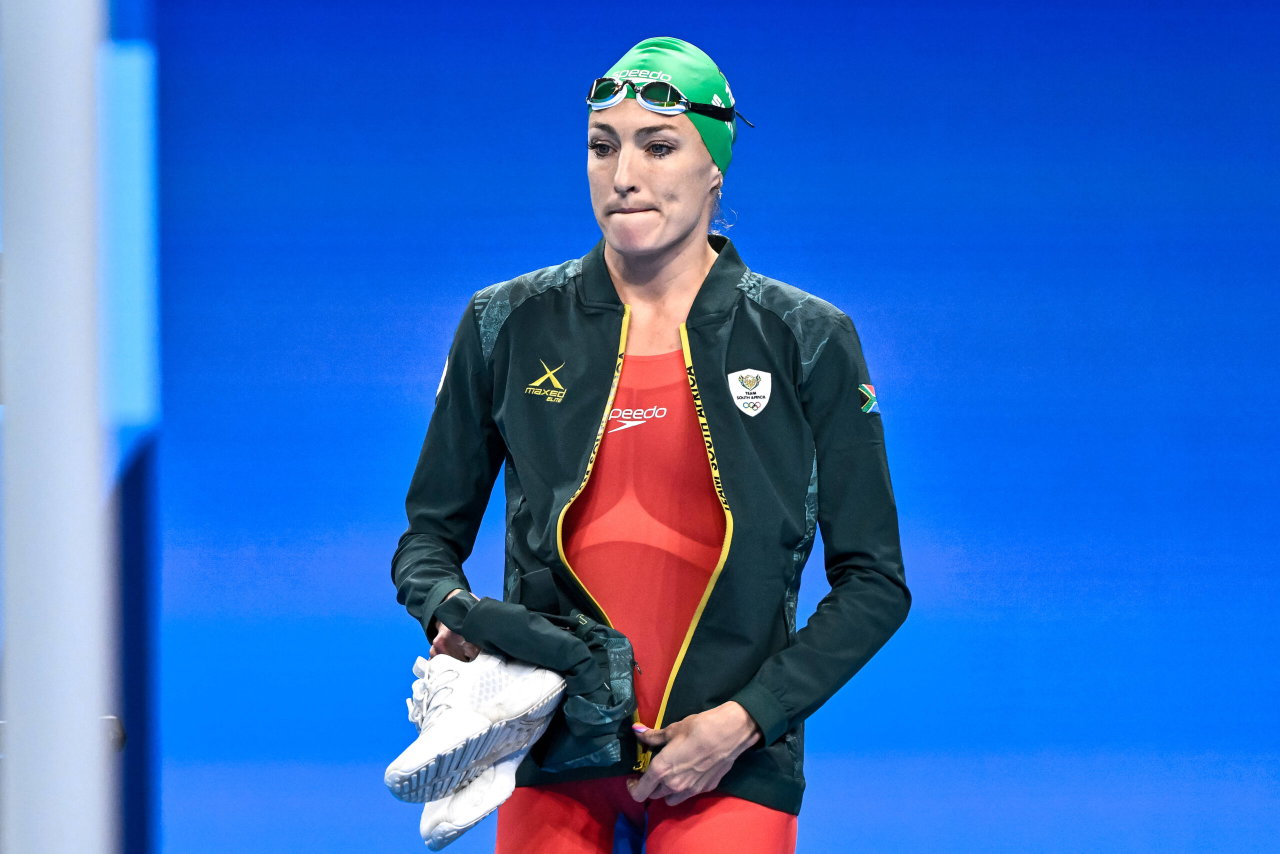
Tatjana Smith thought she had already said goodbye to swimming. Two years after walking away from the sport following the Paris Olympics, the South African Olympic champion has changed her mind. At 29, Smith is back – and this time, she is chasing a very different challenge.
Watch What’s Trending Now!
The two-time Olympic champion has ended her retirement and is setting her sights on the 50m breaststroke at the 2028 Los Angeles Games. Her return begins at the South African Short Course Championships in Pietermaritzburg from September 24 to 27, where she is entered in the 50 m, 100 m, and 200 m breaststroke.
“Never say never…” Smith wrote on Instagram while announcing her comeback. “I genuinely thought my swimming career was over. But somewhere along the way, I started missing the water. The training. The nerves. The racing.”
It was an unexpected turn for an athlete who had seemingly closed one of the most successful chapters in South African swimming history.
Smith retired after Paris with four Olympic medals to her name. She won the 200m breaststroke in Tokyo under her maiden name, Tatjana Schoenmaker, before adding 100m breaststroke gold in Paris. She also claimed silver in both Games, putting her alongside Chad le Clos as South Africa’s most decorated Olympians by total Olympic medals.
Yet the medals failed to mask the exhaustion that had accumulated beneath them.
Smith’s retirement stemmed from multiple pressures: burnout, financial disputes, and systemic frustrations. For years, Smith’s life revolved around the pool. The relentless training, travel, and expectations eventually left her questioning whether she still wanted the sport that had defined her since childhood.
“I think probably everyone would think that the timing [of retirement] was the worst. But I absolutely 100% believe it was the best decision at that time,” she told the BBC World Service.
The break gave Smith something she had rarely experienced: distance. She spent time away from swimming, explored life outside elite sport, and even tried an Olympic-distance triathlon. But whenever she returned to the pool simply to stay fit, something familiar began to surface.
“Every time I went back to the swimming pool and I dived in, I was like, wow, I really miss that quietness,” she said.
Slowly, the idea of racing again stopped sounding impossible.
There were other factors behind her original retirement, too. Smith has spoken openly about financial pressure in swimming and her frustrations with aspects of the system surrounding athletes. A dispute over prize money from her 2023 World Championships campaign also became a major issue.
Smith and her husband and manager, Joel Smith, have pursued the matter legally, seeking interest connected to prize money that was delayed after the federation imposed a penalty that was later withdrawn. The dispute has added another layer to Smith’s complicated relationship with the sport she once walked away from.
But her comeback is not about settling old scores. It is about choosing swimming again.
Tatjana Smith opens up about her LA28 goal
“I’ve learned that I don’t have to choose between being an athlete and having a fulfilling life outside of sports. I can have both,” Smith said. That philosophy is also shaping the way she intends to race.
The 50m breaststroke gives Smith a new target.
Smith is not returning simply to recreate the career she had before. Her biggest change will come in the event she wants to pursue.
The 50m breaststroke is set to make its Olympic debut at LA28, giving Smith an opportunity to build something completely new rather than chase the same races that defined her first career.
“I thought, ‘Why don’t I try? Why don’t I give myself that challenge? Reinvent myself,'” she said.
The difference is significant. Smith has spent much of her career as an elite 100m and 200m breaststroker, events demanding a blend of endurance, efficiency and speed. The 50m is almost entirely about explosiveness, with little room for mistakes.
“One length, no turn, no room to settle, almost no time to recover if the start, pull-out, breakout, or touch goes wrong,” Smith explained. “Everything happens now. It scares me, but it also excites me.”
Her training has already changed dramatically. Instead of the enormous workload she once carried, Smith is now training around three swimming sessions a week, compared with as many as eight previously.
She will also begin this chapter with a new coach, new training environment and new city. Smith is working with Karin Hugo at Lane Leader in Stellenbosch after previously training with Tuks Swimming Academy in Pretoria.
“I’m not returning as the same athlete, nor as the same person,” Smith said. “It’s a new chapter, a new challenge, a new race, a new training group, a new city, and a new coach.”
The first test comes this week in Pietermaritzburg. It will be Smith’s first official competition since the Paris Olympics.
And while LA28 is firmly in her sights, she is refusing to treat the destination as a guarantee.
“LA 2028 is the goal. It is not a promise,” Smith said. “I still have to build a race, qualify and earn my place back on those blocks.”
That distinction says plenty about why this comeback feels different.
Smith already has the Olympic medals. She has broken world records, won world titles and reached the summit of her sport. There is little left to prove.
Now, for the first time, she says the decision belongs entirely to her. “I’m choosing swimming,” Smith said. “I’ve achieved way more than I ever dreamed in my whole life, so I have nothing to prove.”
The blocks are waiting again. This time, Tatjana Smith is diving in because she wants to find out what happens next.