
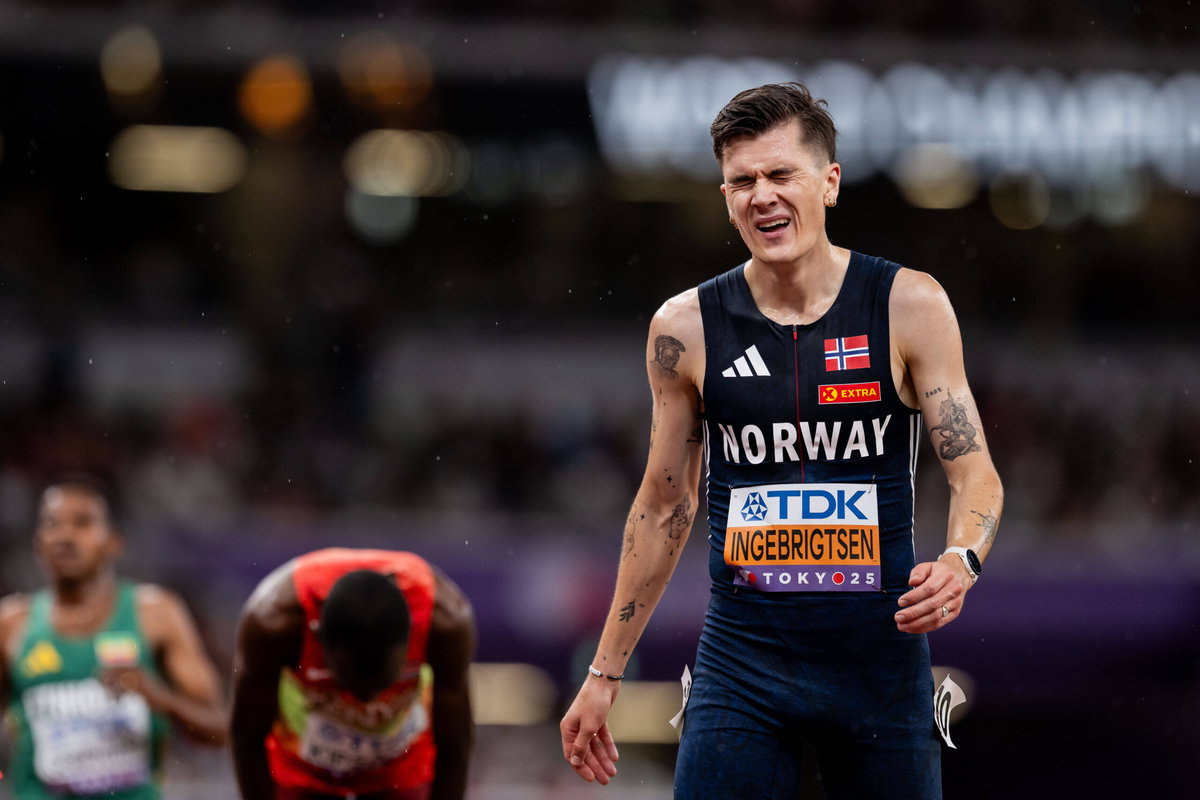
The finish looked like it belonged to Jakob Ingebrigtsen. The Norwegian had made his move, opened the gap, and appeared ready to add another global title to his résumé. Then, in the final 100 meters, Eritrea’s Dawit Seare found another gear.
Watch What’s Trending Now!
Seare surged past the two-time Olympic champion to win the men’s 5K at the World Athletics Road Running Championships in Copenhagen on Saturday, September 19. His 12:56 not only earned him gold but also set a new Eritrean national record.
Ingebrigtsen, who won the men’s 5K at Paris 2024 ( and the 1500m at Tokyo 2020 before that) had to settle for silver in 12:59, which became a Norwegian national record. Saymon Amanuel completed a remarkable day for Eritrea by taking bronze in 13:00, leaving the country with two athletes on the podium.
For much of the race, the battle was difficult to predict. France’s Jimmy Gressier helped set the early pace, while Ethiopia’s Mezgebu Sime later threatened to break away from the pack. Seare stayed close to the action, conserving enough for the moment when the race would truly begin.
That moment arrived inside the final kilometer.
Ingebrigtsen, racing just eight days after winning the 5,000m at the World Athletics Ultimate Championship in Budapest, produced the familiar acceleration that has delivered so many major victories. With roughly 200 meters remaining, he moved ahead of Seare and looked to have done enough.
But Seare refused to let him disappear.
What did Dawit Seare say after outclassing Jakob Ingebrigtsen?
The Eritrean stayed on his shoulder, drew level in the final 100 meters and then pushed clear. By the time the clock stopped, Seare had three seconds between himself and one of the sport’s biggest stars.
“I am very, very happy because I have been preparing very well for the last two months for this championship,” Seare said in Copenhagen.
“I am African Champion in five kilometres, which was part of my preparation. So this is the result of my effort. I know Jakob (Ingebringsten) is a very strong athlete, especially in the last kilometre. It was difficult to compete with him, but at the end I won, and I am very pleased about that.”
The victory capped a remarkable rise for the 21-year-old. Seare had already won the 5,000m at the 2026 African Championships and now owns a global road title to match it. His 12:56 was also faster than his track personal best of 13:07.77.
There was another piece of history for Eritrea. Amanuel, just 19, crossed the line in 13:00 to take bronze and improve his personal best by one second. Eritrea had previously enjoyed its biggest road-running successes through Zersenay Tadese, a five-time world road champion, and marathon world champion Ghirmay Ghebreslassie.
For Ingebrigtsen, meanwhile, the silver represented another significant milestone in a season defined as much by resilience as racing.
The Norwegian had spent much of the year recovering from surgery on the sheath around his left Achilles, an issue that kept him away from competition for roughly 11 months. His return eventually brought a European 5,000m title, and he followed that with another 5,000m victory in Budapest.
Copenhagen was only his sixth race since returning on August 10 and his third consecutive weekend of competition. His season has therefore been anything but straightforward, making the 12:59 national record another positive marker in his comeback.
“I felt that it was so far to the finish line and I hoped that the others would maybe freeze a little bit and they did,” Ingebrigtsen said.
The timing of the result made the occasion even more notable. Ingebrigtsen turned 26 on the same day, but instead of another gold medal to celebrate his birthday, he had to watch Seare raise his hand in victory.
Still, the silver added another medal to an already crowded global résumé. Ingebrigtsen entered Copenhagen as a two-time Olympic champion and one of the defining distance runners of his generation. With his first global road medal, his collection now includes two Olympic medals, four World Outdoor medals, three World Indoor medals and the World Ultimate Championship title he claimed just a week earlier.
Seare, though, had the final word.
Two years after finishing fourth at the inaugural edition of these championships in Riga, the Eritrean returned to the podium in Copenhagen. This time, he did not merely contend with the favorites.
He waited for Ingebrigtsen’s trademark surge, answered it, and produced the decisive move himself.
For a race that seemed destined to end with another Ingebrigtsen victory, the final 100 meters changed everything.