
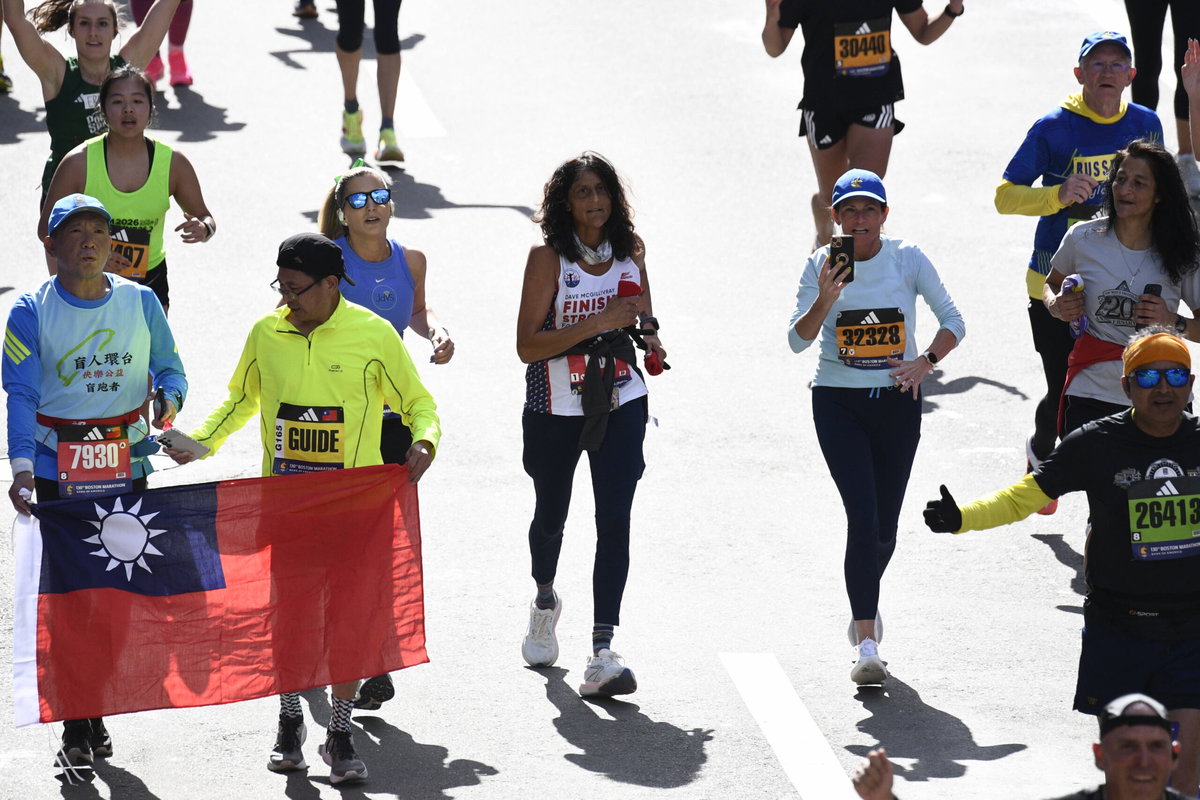
During the 1983 Boston Marathon, a shoeless 17-year-old just about made it across the line. Now, 43 years later, the same runner, retired astronaut Sunita Williams, also known as Suni Williams, crossed the line for the fifth time, this time with her shoes. It was a remarkable achievement and marked a full-circle moment for Williams, who recently endured a grueling nine-month stay in space amid trouble with an experimental spacecraft. Living in zero gravity for nine months changes the body. Coming back meant she had to relearn how to run.
Watch What’s Trending Now!
“So it’s been a little tough,” Williams said in an interview on Instagram.
“So just picking up my legs using my hip flexors, I think that’s one of those things that sort of went away in space ’cause you don’t have to fight against gravity, so just sort of shuffling. I felt like I was doing for a while. Finally, I can run, so that’s okay.”
Williams and Butch Wilmore’s mission in 2024 was only supposed to last a week. Instead, due to issues in their spacecraft’s thrusters, they stayed in orbit for 286 days. They returned to Earth in March 2025. Later that year, she retired after 27 years of service, marking the end of an incredible career with NASA.
However, even in space, Williams kept on running.
In 2007, Williams became the first person to run a marathon in space on a treadmill after her Boston Marathon plan went haywire due to her return time.
Williams had originally planned to run on Earth. But after qualifying for the 2007 Boston Marathon, she realized she wasn’t going to make it back in time. So after a chat with the Boston Athletic Association (BAA), they allowed her to run the distance in space.
View this post on Instagram
“I qualified in Houston for the 2007 run, but that was when I was going to space,” Williams told Runner’s World. “My sister and I sort of look alike, (we were thinking) maybe she could run in it, but she was very resourceful and found the people who organized the race and got me a number for being in space.
“And we ran it simultaneously, which was pretty cool,” she says. “It’s just been part of our lives, you know, it’s just always out there.”
That’s exactly what Williams did, running her second-ever Boston Marathon in space. She returned to Earth in time for her third and fourth in 2008 and 2009. She finished the 2008 race in 4:20:42. A year later, she improved her time to 3:49:49, despite having stomach issues.
Now in her fifth edition of the marathon, Williams clocked in at 5:52:49. Earlier, the BAA honored her with the prestigious Patriot Award. However, Williams admitted she has moments of self-doubt when she starts running, despite all her achievements.
Sunita Williams reflects on her moments of self-doubt when running
That does come as a surprise, given that Williams is a retired Navy captain and a NASA astronaut. She served as a flight engineer on several missions and commanded NASA’s Expeditions 33 and 72. That’s aside from the other impressive accolades that Suni Williams has collected over her career.
However, Williams notes that going into the 2026 Boston Marathon, she hadn’t run in a marathon in more than a decade. That, combined with the effects of her nine-month space stay, meant that Williams wasn’t in perfect condition going into the race. Yet, she knows she’s done harder things.
“I don’t think that’s uncommon, to have those moments of doubt…I think this goes back and forth a little bit because, yes, there is in the back of my mind I’ve done hard things,” Williams added. “I think to myself sometimes when I’m doing something, I’ve been colder, I’ve been hotter, I’ve been more hungry in my life, and I’ve gone through it and I’m fine.”
As for her time, Williams knew exactly what to expect, prophesying, “I’m a little bit older, a little slower, but that’s okay.”
In the end, it wasn’t just another finish line for Suni Williams, but proof that she had overcome the physical toll of space to get there. And despite the doubts along the way, the astronaut-turned-runner once again showed that resilience, more than anything else, defines her journey.