
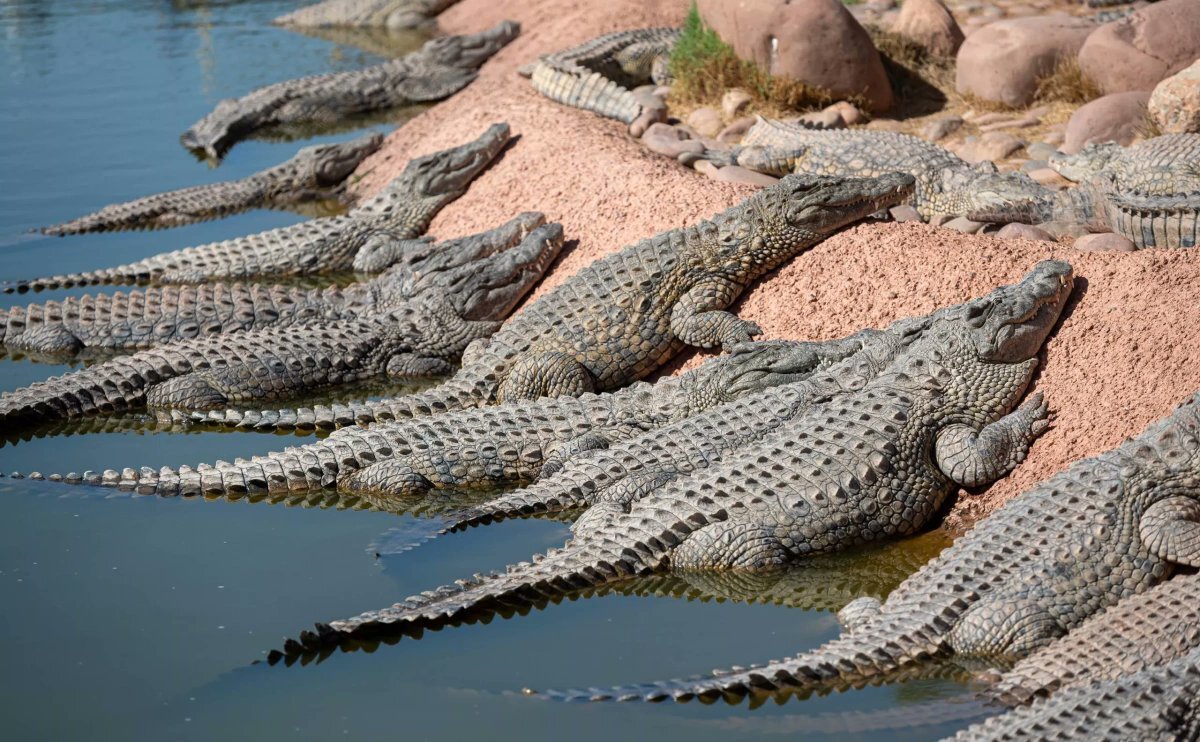
The first Olympic Games held in 1896 didn’t feature rowing because of stormy seas and high winds. Nearly 130 years later, the 2032 Olympic Games will not be hosting the sport again, but for a different reason. No, it’s not because of the Greek seas that threaten to scupper the iconic sport in Australia. Rather, it’s a river infested with crocodiles the size of an average large SUV.
Watch What’s Trending Now!
According to Australian.com.au, the IOC’s headquarters in Lausanne had a rather serious discussion about crocodiles.
“But the crocodiles will be behind a fence, won’t they?” An official asked, and when told no, he added, “If an athlete was to get bitten, this would be the end of the Games.”
The infestation has been a genuine concern for over eighteen months now. Early rumours suggested that rowing and canoeing at the 2032 Brisbane Olympics would be on the Fitzroy River. Officials confirmed the speculation in March, and things have taken a turn for the worse since. For context, the river runs through Rockhampton and is prone to flooding and currents that can create uneven conditions.
However, the bigger issue is that it’s home to saltwater crocodiles. In fact, the banks along the Fitzroy have a variety of signs warning of “death or injury” from nearly 4-metre-long crocodiles. The Guardian has reported no officially recorded crocodile attacks on humans in the river. There have been several sightings, with a canoe club member reporting a 4.5-metre-long “saltie” in 2024.
Officials captured and removed the crocodile several weeks later. In fact, the same canoe club has been paddling the river since the 1970s without any incidents. Despite the canoe club’s 50-year safety record, the IOC and rowers remain unconvinced, as shown by a petition signed by over 6,000 people. The petition, created in April 2026, asked the organizers to move the event to Lawnton Lakes.
“The Queensland government plans to spend hundreds of millions on a flood-prone river course 600km from Brisbane, serving just 200 local rowers, while ignoring more than 5000 rowers across southeast Queensland. This isn’t a legacy. It’s a costly mistake. Help us fix this now.”
Built for rowing and canoeing, the lake is located north of Brisbane and has been used for training since its construction. Further, given the river’s uncertainty, the petition even argued that the lake would make for a fairer race. That’s largely because nature doesn’t control rivers in the way it does purpose-built venues, so the currents can change.
It does make for uneven conditions during the Olympic event, which doesn’t make for a fair race, according to several critics. That includes Australian rowing icon Drew Ginn, who called the decision “embarrassing”.

Australia plans to hold Olympic rowing events in a river full of crocodiles The Brisbane 2032 Olympic Committee has approved the Fitzroy River in Queensland as the venue for canoe and kayak competitions — despite the fact that it’s home to crocodiles. The decision has already Show more

“I think it’s just embarrassing that we’re doing it,” Ginn said, according to 7news.au. “Imagine the 100m sprint having a (runner) in lane six going forward, and on lane one going backwards and thinking that’s fair for athletes.”
“Rivers flow, rivers flood, we know the course up there has real issues around this – that’s ok for a local regatta … but it’s not ok for the Olympic Games.”
Olympians, coaches and even rowing officials have signed it, all hoping organisers move the event. World Rowing and the International Canoe Federation have taken that seriously and are conducting studies of the river.
Officials toured the location in February and were reportedly told that the ratio of “salties” was around 0.2 per km. It does significantly reduce the threat, although their studies are reportedly ongoing.
Even as concerns continue to dominate the conversation, local officials have remained adamant that the venue is safe. Queensland politician Deb Frecklington has been among the strongest voices pushing back, supporting the Fitzroy for the 2032 Olympics.
Deb Frecklington dismisses crocodile concerns on the Fitzroy
Despite the visit, Rowing Australia’s Sarah Cook admitted she wasn’t sure whether the Fitzroy would be a “viable option or not”. However, the push to designate the river as an official venue for the 2032 Olympics continues. That ranges from rowers using the Fitzroy to train to a catalogue of politicians.
In fact, Rowing Australia (RA) has used the river as a training venue and has never had an incident. Andrew Miller, a regular canoeist on the Fitzroy, and John Mackenzie, the secretary of the Fitzroy Canoe Club, have also attested to the lack of “salties” on the river. Both men also told The Guardian that the lack of “salties” is largely thanks to park rangers.
They’re reportedly tasked with removing any “large crocodiles” or any “displaying dangerous behaviour” and relocating them. Even Queensland’s attorney-general, Deb Frecklington, attests that she’s confident of rowing on the river, per nine.com.au.
“I’m not a great rower, I’ll give you that, my husband will attest that I probably would need an Olympian with me to make sure that I don’t turn it over, but I would row on the Fitzroy, absolutely. I, for one, can’t wait for rowing to be in Rocky.”
Whether that confidence is enough to convince the IOC, World Rowing, and the athletes themselves, only time will tell. Until officials make a final decision, people will continue to judge the Fitzroy as much for its crocodiles as for its ability to host an Olympic regatta.