
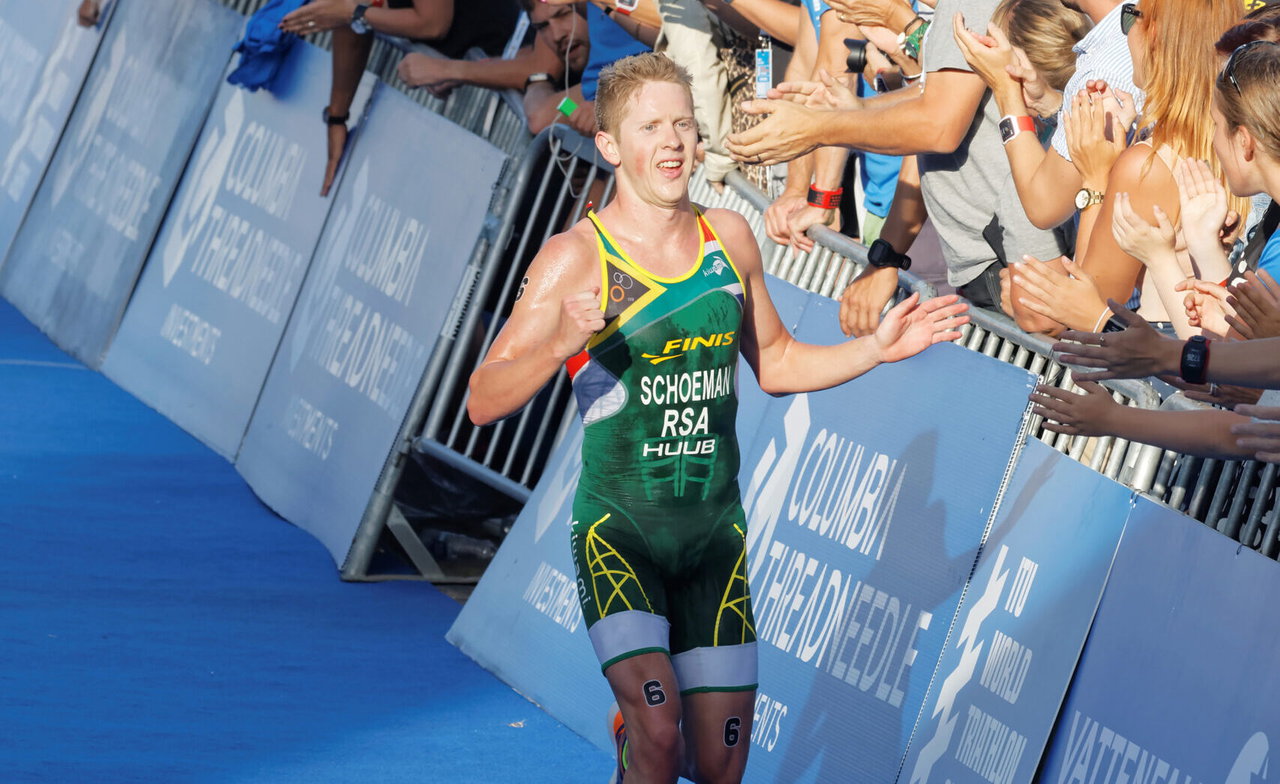
Few moments in triathlon history have been replayed as often as the 2016 World Triathlon Grand Final. With less than a kilometre to go, Britain’s Jonathan Brownlee collapsed after struggling in the heat. His brother, Alistair Brownlee, rushed to his side and helped him towards the finish line. Meanwhile, South Africa’s Henri Schoeman continued running and crossed the line first in 1:46:50 to claim the men’s title. Yet, the scenes surrounding the Brownlee brothers overshadowed his victory, with some fans questioning the circumstances of his win. Now, 10 years later, Schoeman has broken his silence, speaking about the controversy and years of criticism directed at him and his family.
Watch What’s Trending Now!
On October 20, Schoeman shared a video on X revisiting the dramatic finish and explaining why the race, despite being one of the biggest victories of his career, had become a source of pain. He revealed that whenever footage of the race goes viral, he continues to receive abusive messages, with some targeting his family. “Attacking me and sometimes even attacking my family,” he said.
The video also showed several abusive comments he had received, including “You are not the real winner,” “You’re a f**kin douche bag,” “Your mom getting filled up then I dispose her body in a pond,” a f**kin douche bag,” and “You don’t deserve to be a sportsman, shame on you.” After years of staying silent, Schoeman said he wanted to share his side of the story.
Schoeman was 24 years old when he won the Cozumel race. At the time, he was coming off a bronze medal at the 2016 Rio Olympics and was determined to prove himself among the world’s best. Looking back, he said, “I was young, and I was hungry, and I was determined to prove a point.” He recalled that some people had labelled him a “one-hit wonder” after his Olympic success, making the race another opportunity to show that he belonged at the top of the sport.
Explaining what happened during the final stages, Schoeman said he and Jonathan Brownlee had been pushing each other throughout the race. He described Brownlee as having an “incredible” performance and said both athletes had been working hard to maintain their positions. However, when Brownlee collapsed with less than a kilometre remaining, Schoeman said he was focused on reaching the finish line and was not fully aware of what was happening behind him.
Schoeman pointed out that athletes can collapse in the final stages of endurance races, even after competing for hours. For him, the outcome of the Cozumel race came down to a simple principle: competitors must cross the finish line to complete the race. “The finish line is where the winners are made, and in Cozumel, I crossed that finish line first,” Schoeman said.
He also addressed Alistair Brownlee’s decision to help his younger brother, making it clear that he had no resentment towards him for what happened. “But in that moment, he was a brother first. I think most brothers would have done the same,” he said. Schoeman added that the emotional moment should not take away from what he achieved that day.
Beyond the race itself, Schoeman spoke about the personal cost of the criticism he has faced over the past decade. “What people don’t see is the impact the last 10 years of hate and abuse have had on me and my family,” he said. “My mental health over that period is a whole other story in itself.” After keeping those feelings to himself for so long, Schoeman said he was ready to let go of the burden.
“I know what happened that day. I know what it took to win and I have absolutely no regrets on how I raced,” he said. For Schoeman, the Cozumel victory remains one of the proudest moments of his career, even if the public conversation has often focused on the Brownlee brothers instead. In the years that followed, he added many more victories, proving there was much more to his story than one race in 2016.
Henri Schoeman’s triathlon triumphs after 2016 controversy
At the 2016 Rio Olympics, Henri Schoeman won bronze in the men’s triathlon, finishing behind Britain’s Alistair Brownlee, who took gold, and Jonathan Brownlee, who claimed silver. The result made him the first South African to win an Olympic medal in triathlon. Yet even after the historic achievement, Schoeman felt overshadowed by the British brothers.
In a 2018 interview with TimesLIVE, he recalled how photographers focused on the Brownlees rather than celebrating his own achievement. “I had photographers saying ‘out the way, I want a picture of the Brownlees’,” he said. Months later, Schoeman got another chance to prove himself against the brothers at the 2016 World Triathlon Grand Final in Cozumel, Mexico. But that victory came up with controversy.
Schoeman continued to build his record in the years that followed. In 2017, he earned two World Triathlon Series silver medals and finished among the top 10 in the overall standings. He then won the Abu Dhabi race in March 2018, claiming his second World Triathlon Series victory, before taking gold in the men’s triathlon at the 2018 Commonwealth Games on the Gold Coast. His career continued beyond those early successes.
Then he won the Arena Games Triathlon world title in 2023 and claimed his first Ironman 70.3 victory in the Philippines in 2024. He also competed at the Tokyo 2020 and Paris 2024 Olympic Games, remaining active at the highest level of the sport. Despite those achievements, the Cozumel race remains closely tied to the controversy surrounding the Brownlee brothers.