
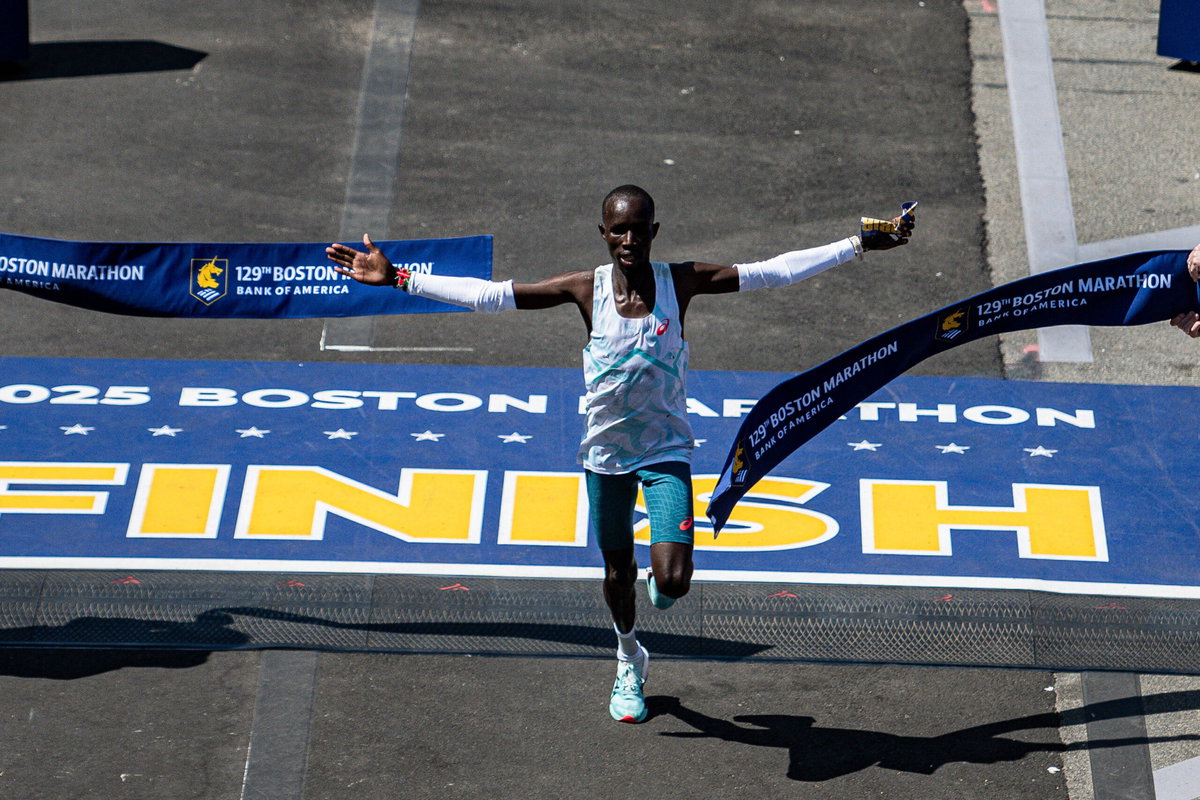
John Korir just ran 2:01:52 at the 2026 Boston Marathon, shattering Geoffrey Mutai’s 15-year-old course record by over a minute. Sharon Lokedi defended her women’s title in 2:18:51. Both performances would rank among the fastest marathon times ever recorded. But neither will count as a world record or an American record. On one of the oldest marathon courses in the world, first run in 1897, the clock doesn’t carry the same official weight. So, why don’t these times count?
Watch What’s Trending Now!
The main reason lies in how the Boston course is built. Unlike most modern marathons, Boston is a point-to-point route that begins in Hopkinton and ends in Boston. Along the way, the course drops more than 130 meters in elevation. This long downhill lets the runners gain early speed, in some cases, at a pace that would be more difficult to sustain on flatter courses.
Subsequently in the race, there are hills rolling over, such as the well-known Heartbreak Hill at around the 20-mile mark, when exhaustion has already set in. This combination of rapid downhill running and late climbs alters the whole race pattern.
Another factor is the wind. Due to the distance between the start and finish, the runners can experience long periods of tailwinds. When these conditions coincide with the downhill profile, it can allow finishing times to be shorter than would otherwise be possible in more balanced courses. Consequently, World Athletics in 1990 came up with rules of record-eligible marathons.

Imago
X@bostonmarathon
Two key standards matter most: the course cannot drop more than one meter per kilometer, and the start and finish must not be too far apart. Boston does not meet either requirement. As a result, performances there are officially recorded as course results, not world or American record-eligible times. So the question becomes, has anyone tried to change that status for Boston?
Did the 2011 Boston Marathon Champion try to make the Boston world record eligible?
In 2011, Geoffrey Mutai ran 2:03:02 at Boston. At that time, it was faster than the official marathon world record of 2:03:59 set in Berlin. However, the performance raised questions because of how well the time was on a course known to be tough.
Later, World Athletics confirmed the result was valid, but not eligible for world record status. The reason was the same: the course profile gave what they consider “assisted conditions.” Even though the time was legitimate and measured correctly, it could not be compared fairly with performances on record-eligible courses.
Following the race, Boston officials, led by race director Dave McGillivray, filed paperwork with World Athletics to have the mark recognized, but despite public discussion about reviewing the rule, the request was ultimately denied.
Reports at the time also noted that accepting Mutai’s time would have forced governing bodies to recognize a performance under conditions they classify as non standard for record purposes even on one of the sport’s most prestigious stages. Sure, while Mutai’s performance remains one of the fastest marathons of all time, it isn’t listed in the official world record books.