
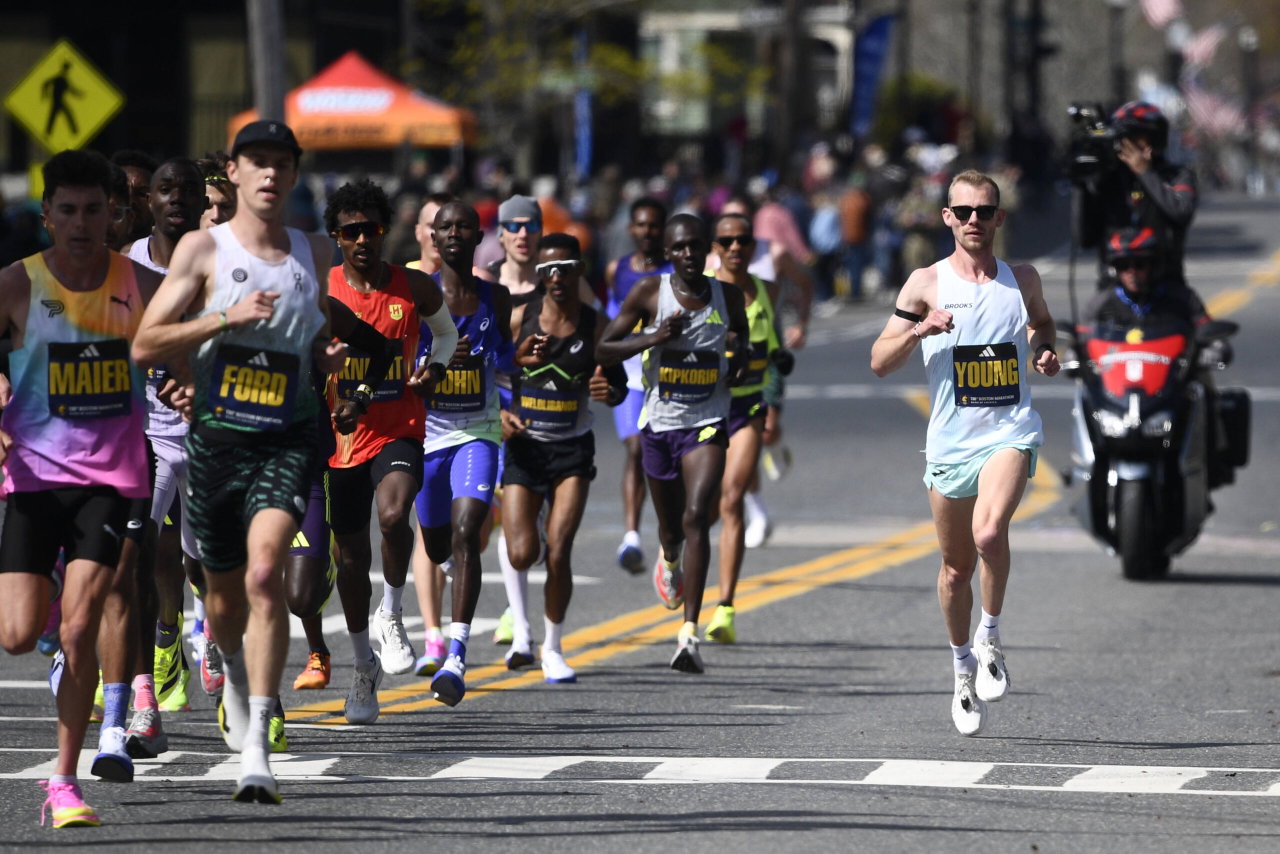
American distance runner Clayton Young had more than a personal best on the line at the 2026 Chicago Marathon. After an MRI revealed a 12-centimeter tear in his hamstring tendon, his plans for the race were thrown into doubt, and his first doctor recommended four weeks of rest. Yet, on October 11, Young took his place at the starting line and finished in 2:05:23, setting a personal best and becoming the top American man. Now, Young has opened up about the difficult weeks behind that performance, revealing how his faith and the support of his wife, Ashley, helped him face a decision that could have affected his running future.
Watch What’s Trending Now!
In a conversation with CITIUS MAG host Chris Chavez on October 15, Young explained that he remained determined to give himself every opportunity to race, even as concerns about his injury mounted. When Chavez asked whether he believed the American record was within reach on race day, Young replied, “Yeah. Yeah, I mean, or at least I believe that I would do everything I could until I was told not to.”
For Young, the previous four weeks had been about maintaining his belief, trusting the people around him and continuing one step at a time until he had a clear reason to stop. Young’s injury had become a serious concern following the Great North Run half-marathon in England on September 13. With around 250 metres remaining, his hamstring tightened up, forcing him to ease off rather than continue pushing at full speed.
He still finished seventh in 1:02:04, but the problem persisted. After attempting to run in the following days, he cut a speed workout short and underwent an MRI on September 17. The scan revealed a 12-centimeter longitudinal split tear in an upper hamstring tendon near its attachment to the pelvis. The diagnosis put his Chicago Marathon ambitions at risk.
His first doctor recommended a platelet-rich plasma injection and four weeks away from running, which would have ruled him out of the October 11 race. Young had hoped to challenge the American record of 2:04:43, but the injury forced him to reconsider his plans. He sought further medical input and worked with his team to assess how his hamstring responded to training, knowing that continuing to run could aggravate the injury.
Under coach Ed Eyestone’s guidance, Young adjusted his preparation and monitored his condition rather than following his original training schedule. He managed to complete a 22-mile run and later returned to faster sessions, although his workload was modified to account for the injury. While the physical side of his preparation required careful monitoring, Young revealed that his faith had become just as important to him during the four weeks before Chicago.
“These last four weeks from a faith standpoint have never… I want to be respectful of everybody in their faith. But I’m going to look back on these last four weeks with more faith building experience than I’ve ever seen,” Young said. The couple also drew strength from the prayers of those around them. Young explained that even when the circumstances pointed toward withdrawing from the race, he and Ashley continued to find reassurance through their faith.
“When everything said, don’t run this race, it was so interesting to see how so many of the answers that we were receiving were just like, keep moving forward, take the next step, and trust in God and the plan that he has for you, even though it doesn’t make sense,” he said.
However, throughout the difficult buildup, Ashley remained a source of support as the couple faced the possibility that Young might not make it to the starting line. He described how the experience brought them closer together and strengthened their faith. “Yeah, Ashley and I grew stronger together. Our faith grew stronger together. And yeah, I’m going to look back at this as a miracle,” Young said.
Young also acknowledged that his hamstring had not been completely healed by race day. Rather than suggesting the injury had disappeared, he expressed gratitude that it had held up well enough for him to finish the marathon. “My hamstring held up. No, it wasn’t made perfect, but we got through this,” he explained. While the Chicago Marathon marked an important milestone in his career, Young has his sights set on a bigger goal in 2028: returning to the Olympic stage in Los Angeles.
Clayton Young sets sights on LA 2028 Olympics after Chicago Marathon breakthrough
Speaking to Men’s Health, Young made clear that preparing for the Games is a major priority. “My biggest goals right now are to do everything I can to prepare for the LA 2028 Olympic Games,” he said. “Right now, it’s all about getting as much confidence and preparation for all of the world’s major marathons, where I get to compete against some of my biggest competitors.”
Young already knows what it takes to reach the Olympics. He finished second at the 2024 U.S. Olympic Marathon Trials before placing ninth in the marathon at the Paris Games. His personal-best 2:05:23 in Chicago, where he was the leading American, gives him another strong result to build on as he works toward Los Angeles. However, he will first need to earn his place on the U.S. team through the 2028 Olympic Marathon Trials.
For now, Young’s immediate focus will be recovering from the hamstring injury and building toward his next races. With LA28 as his long-term target, his performance in Chicago could prove an important step in his preparation for another Olympic campaign.