
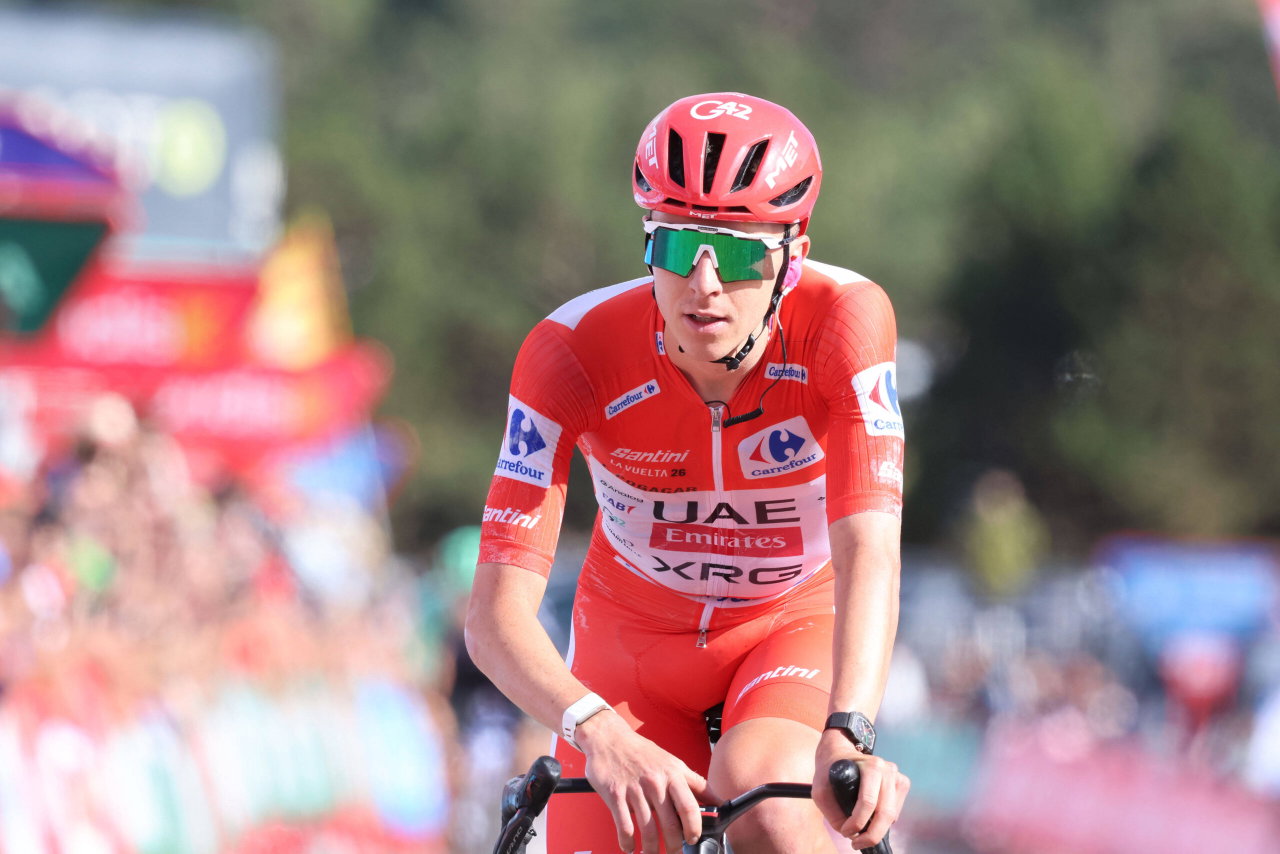
Tadej Pogačar has spent years making the impossible look routine on a bicycle. But his latest crash reminded him just how fragile even the strongest riders can be. Two months after the terrifying incident at the Vuelta a España, the Slovenian has revealed the frightening extent of his injuries.
Watch What’s Trending Now!
The accident happened on August 29, during Stage 8 of the Spanish Grand Tour. Wearing the leader’s red jersey, Pogačar hit an object on the road and went down at high speed, suffering a concussion and a fractured collarbone. Initially, doctors had identified a C7 fracture in his neck. However, a follow-up scan in Slovenia revealed two more broken vertebrae.
Speaking to The Athletic, Pogačar recalled the moment he discovered the full extent of the damage. “There’s actually a funny story,” he said. “Two weeks ago, I was in Slovenia, and I went to do another CT scan. I knew I had a C7 fracture, but then we saw I had two more broken vertebrae, the T1 and T2.” The discovery changed his perspective immediately. “At that moment, I was happy I didn’t do the European Championships, which had been my initial goal. When I saw I had three broken vertebrae? I’m just happy to be alive, actually, or just to be standing.”
For a rider who had just tied the record with his fifth Tour de France title, the crash brought an abrupt end to a remarkable season. Pogačar had also enjoyed an extraordinary spring campaign, winning major races before turning his attention to the Vuelta. Suddenly, his biggest concern was not another victory but whether his body would recover fully.
The first two weeks proved particularly difficult. After spending four days in a Barcelona hospital, he returned to Monaco, where even a short walk for ice cream became an exhausting challenge. His concussion had affected the inner-ear crystals responsible for balance, leaving him nauseous and dizzy. Standing up or lowering his head could trigger discomfort, making everyday tasks difficult.
Surgery did little to lift his spirits immediately. Unlike his previous wrist injury in 2023, when he joked around after an operation, this time the Slovenian struggled mentally. He had to wait two days for surgery and needed assistance even to shower. The procedure lasted around an hour and 40 minutes, but the toughest part came afterwards.
“For the first two weeks, I was really mentally not OK. I was really down. I was not a fun person to be around,” he admitted, acknowledging that his partner, fellow professional cyclist Urška Žigart, had to deal with his difficult mood. Things began to change only when he could return to the home trainer, attend daily physiotherapy sessions, and gradually rebuild his routine.
Recovery, however, was never a straight line. Some days he felt ready to complete physiotherapy sessions, attend gym sessions, and take long walks. On others, he barely wanted to leave the sofa. His neck injury also carried a seriousness that was not immediately obvious. While the collarbone fracture drew attention, the broken vertebrae made him think about what another crash could mean.
Pogačar explained that the injury did not cause much pain in the affected area, which made it easy to overlook. But conversations with others and reading about the condition helped him understand the risks. “If I crash again on the bike now, it can be very problematic,” he said. “It’s a bit scary, to be honest, to think about it.”
As his physical condition gradually improved, Pogačar began looking beyond rehabilitation. He still had unfinished business in 2026, and one race in particular carried a special meaning for him. The European Championships were set to take place on home soil, giving him another reason to fight his way back.
A missed home championship and bigger goals ahead
The European Championships were scheduled for October 4 in Slovenia, close to his parents’ home. He had hoped to compete in front of his family and on roads he knew almost perfectly. The prospect of wearing the European champion’s jersey also gave him an extra reason to push through rehabilitation.
But another scan showed that his collarbone had not healed enough after three weeks. His medical team was not convinced that racing was a safe option, and the dream of competing on home roads faded. Instead, he watched the World Championships from home, cheering on UAE Team Emirates-XRG teammates Brandon McNulty and Isaac del Toro. McNulty’s victory left him particularly emotional, as he followed the closing stages on television.
His recovery also involved a careful return to physical activity. The team monitored his concussion symptoms, used inner-ear exercises to improve coordination and assessed his response to exertion before allowing him to increase training. Pogačar gradually returned to outdoor rides, running and swimming, with the focus firmly on rebuilding his fitness rather than rushing towards competition.
That cautious approach reflects the bigger lesson he has taken from the accident. Pogačar has long spoken about rider safety, and the crash has only strengthened his concerns. He pointed to inadequate road protection at smaller races, dangerous surfaces, speed bumps, and increasingly high racing speeds as issues that need attention. For him, improving safety requires more than regulating equipment; organizers must also make courses safer.
His 2026 season is over, and UAE Team Emirates-XRG has made it clear that he will not return to racing until 2027. Yet Pogačar still has plenty to chase, including Paris-Roubaix, another world title, and the dream of becoming Olympic champion at LA 28. For now, though, the five-time Tour winner has a more immediate priority: getting completely healthy. After discovering that his crash had left him with three broken vertebrae, simply being able to stand and ride again is a victory he does not take for granted.