
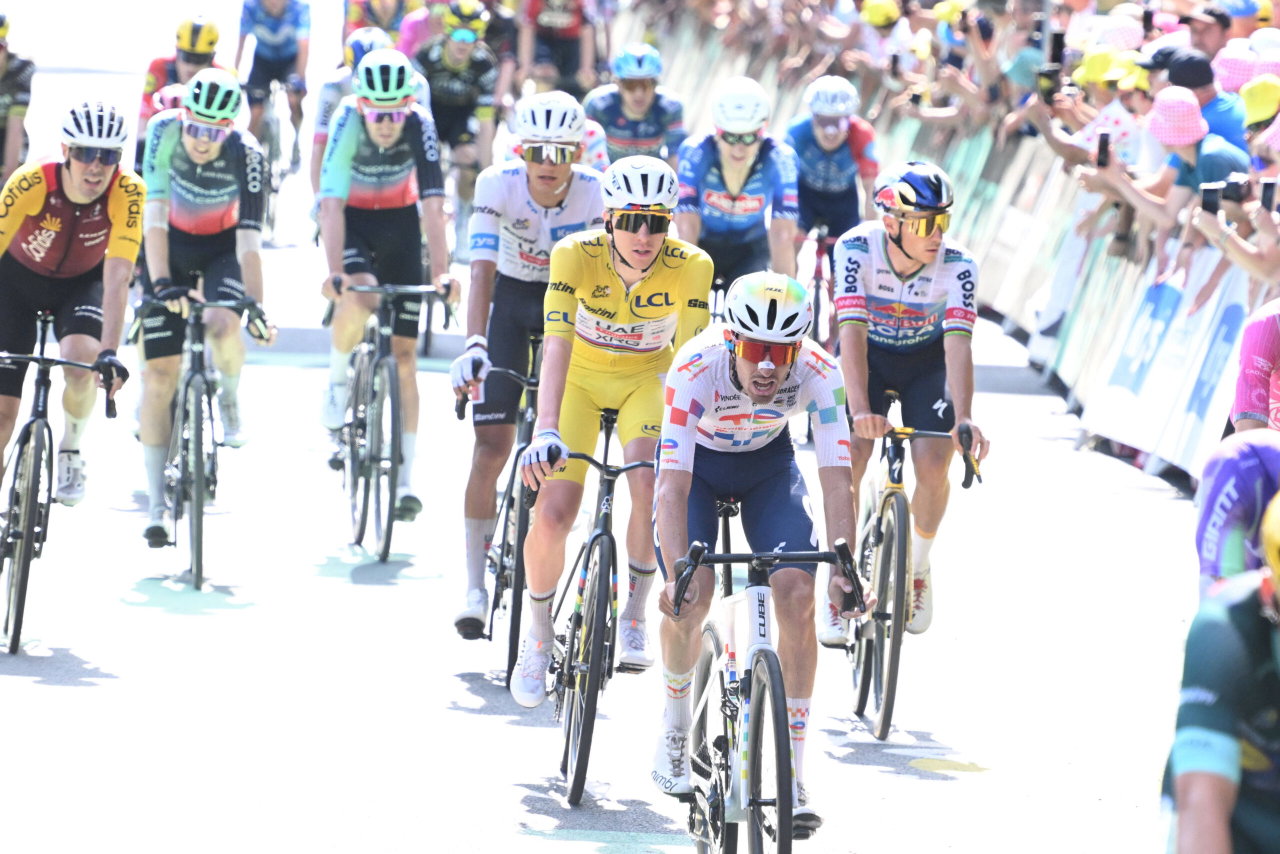
Just hours after Tadej Pogačar got his fourth victory in the Tour de France and Jonas Vingegaard held on to second place in the general classification, an unexpected knock on the door shifted attention away from the race. In the early hours following Stage 14, anti-doping officials woke Vingegaard at 2 a.m and Pogačar at 5 a.m. for surprise tests. And those overnight wake-up calls have become a talking point in the cycling community.
Watch What’s Trending Now!
Discussing the incident during TNT Sports’ coverage on July 19, former professional cyclist Robbie McEwen, who’s now an analyst, expressed disbelief at the decision to carry out the tests during the night. “That’s borderline a violation of human rights. It’s just ridiculous.”
The former sprint star, while acknowledging the need for anti-doping rules, said, “Being woken at 2 am, that’s borderline a violation of human rights. It’s just ridiculous. Two weeks into a stage race, it is not normal. It’s ridiculous.” Former pro cyclist and TNT Sports analyst Adam Blythe concurred, saying that the tests could have an immediate effect on how riders recover and perform.
“It’s utterly disrespectful and like you said, they’ve got a very important job to do, but the times you can do it, to wake a rider who needs that sort of sleep. You could see Jonas. I’m surprised Jonas wasn’t a bit more forthright because you could read between the lines. He’s probably too tired. It’s like that could have a massive impact on the way he rides today. It’s utterly disrespectful.”
The criticism came as both riders revealed the extent to which the overnight visits disrupted their recovery. Since 2016, anti-doping authorities have been allowed to conduct tests between 11 p.m. and 6 a.m., though such checks remain relatively uncommon. Even Pogačar admitted the early-morning visit left him running on very little sleep. “I got four hours of sleep today,” he said.
The Slovenian added that he was unable to return to sleep after the test. “I had a cool, long morning because I couldn’t fall back to sleep. I was chilling, listening to some old Eminem hits, and making coffees, so I’m overcaffeinated and ready to start the day. It was definitely not nice to be woken up in the middle of sweet dreams.”
Vingegaard echoed those frustrations after revealing he had been tested even earlier. “Of course it’s good that they test, but when it’s affecting performance and your sleep, I don’t think it’s so good. Hopefully, I’m not the only one. It has to be equal for everybody, I think. It’s not the nicest at 2 am.” He added that the interruption kept him awake for nearly an hour.
While the ITA has defended surprise testing as an important part of keeping the sport clean, the incident has reignited debate over whether overnight controls should be conducted during the most physically demanding stages of cycling’s biggest race. But it seemed Pogačar also felt the effects of the unexpected disruption, as the lack of sleep from the overnight anti-doping test affected his recovery before the next stage.
Pogačar raises concerns after Vingegaard’s tour exit following sleep disruption
Before the anti-doping test, Tadej Pogačar was enjoying another outstanding Tour de France campaign. The Slovenian entered the race as the defending champion. By Stage 14, he had already built a strong advantage in the fight for the Yellow Jersey.
On Stage 14 from Mulhouse to Le Markstein Fellering, Pogačar delivered one of the most impressive performances of the race. He attacked alone on the final climb and rode away from his rivals to claim victory. It was his fourth stage win of the 2026 Tour de France and his 25th career Tour stage victory. The win further strengthened his position at the top of the general classification. After the stage, Pogačar held a lead of around 4 minutes 30 seconds over Jonas Vingegaard, who remained his closest challenger in second place overall.
The results of the overnight controls were even more controversial, though after the athlete was involved in a crash during Stage 15 Tour de France Stage. The Dane’s collarbone was broken and he had to give up the Tour. After the crash, Pogačar was asked if the lack of proper rest could have played a small role in Vingegaard’s concentration.
“I was just thinking about it: we had a doping control today. I thought maybe that disturbed your sleep and you are a bit less concentrated because of it. I don’t blame it, but there could be a connection,” Pogačar said.
Pogačar was quite clear that the test should not be to blame for Vingegaard’s crash, but his comments made it clear that even race leader Pogačar knew how much a bad night could matter during the toughest part of the Tour de France.