
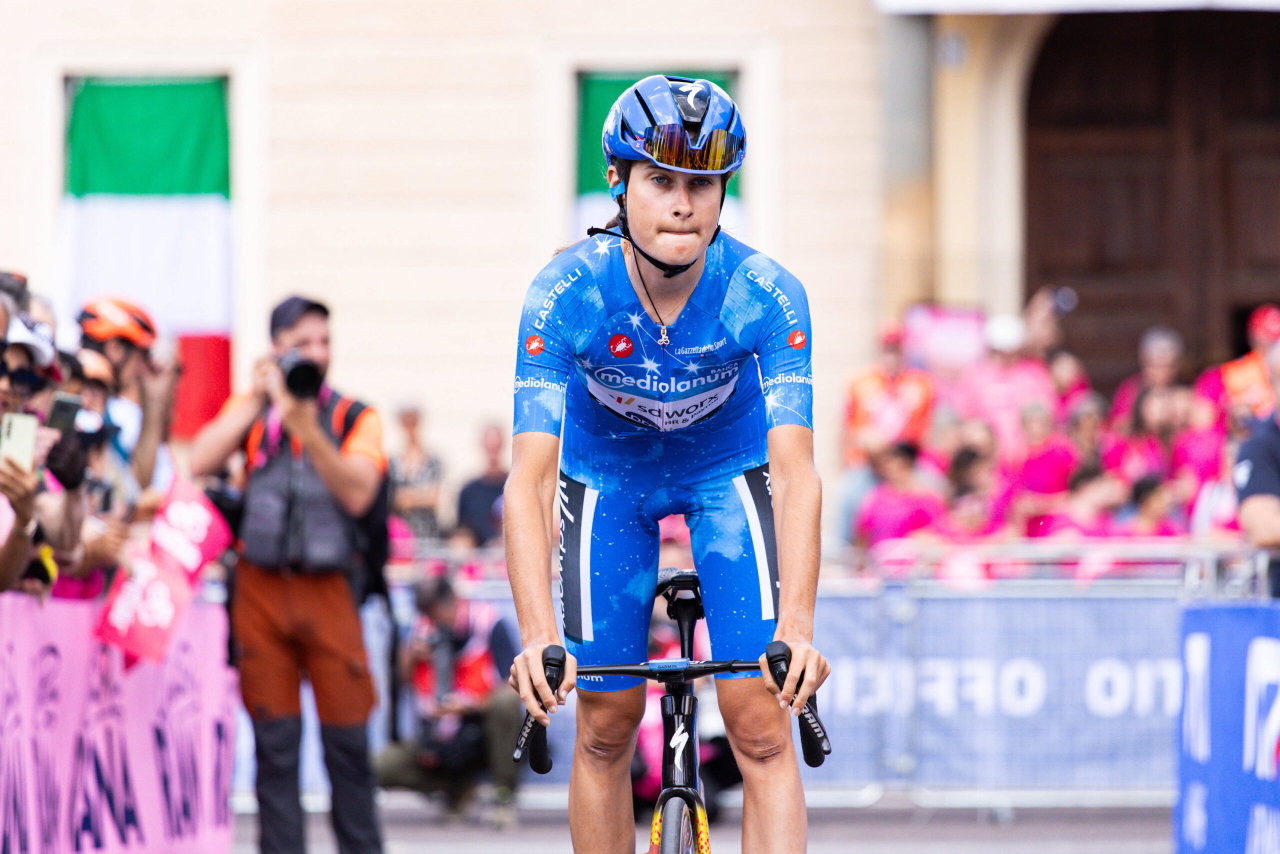
Valentina Cavallar was enjoying a strong 2026 season, finishing ninth overall at the Giro d’Italia Women. However, she was forced to withdraw from the Tour de France Femmes before the final stage in August due to personal reasons. A few weeks later, on 5 September, her mother passed away. Just hours later, an anti-doping officer arrived at Cavallar’s home to carry out a doping test, while her mother’s body lay in a neighbouring room. Days later, the Austrian cyclist spoke out about the incident, describing the test as “Disrespectful towards my family.” Following her criticism, ITA has now apologised to Cavallar.
Watch What’s Trending Now!
In a statement provided to Velo on 14 October, the ITA confirmed that it had contacted Cavallar directly to apologise. “Neither the ITA nor the Doping Control Officer (DCO) were aware of the rider’s personal situation prior to arriving at her home,” the agency said. “The DCO was informed of her mother’s passing upon arrival.”
The ITA added that, according to the information it gathered after Cavallar’s Instagram post, the rider and her family cooperated with the procedure and did not request that the test be postponed or stopped at the time or afterwards. “Faced with an exceptionally sensitive situation, the DCO, with the rider and her family’s support, endeavoured to pursue the procedure as discreetly, respectfully and swiftly as possible,” the agency said.
However, Cavallar’s account of the incident revealed the personal toll of undergoing a doping control during such a painful moment. In an Instagram post, the Austrian climber explained that the test took place just hours after her mother’s death. “I had to undergo a doping control at home, in the room next to where she lay,” Cavallar wrote.
The Austrian climber acknowledged that anti-doping testing is part of professional cycling and that athletes are expected to meet their obligations. “But in that moment, I was clearly not thinking about cycling, competition or my responsibilities as an athlete. I was a daughter who had just lost her mum,” she wrote.
The ITA acknowledged the distress caused by the test and said it regretted the experience Cavallar had endured. “We fully recognise that undergoing a doping control in these circumstances has added to her distress experienced at an extraordinarily painful time,” the agency said. At the same time, ITA also stressed that protecting clean sport must go hand in hand with treating athletes with respect and compassion.
In its statement, the agency said: “The ITA remains committed to ensuring that the protection of clean sport goes hand in hand with respect, compassion and care for athletes.” It added that athletes would continue to be encouraged to report concerns during or after doping controls so that the agency could respond appropriately and consider their personal circumstances.
Despite the apology, questions remain about whether the test could have been postponed once the officer learned about Cavallar’s circumstances. The ITA stated that no request to delay or discontinue the procedure had been made, but its response did not establish whether postponement was possible under the applicable rules.
But this was not the first time a doping control had caught a professional cyclist off guard during an important personal occasion.
John Degenkolb got tested during teammate’s wedding ceremony
In August 2015, German cyclist John Degenkolb was attending the wedding of his teammate Koen de Kort in Girona, Spain, when a doping-control officer unexpectedly turned up during the celebrations. The Paris-Roubaix winner recalled the unusual experience in an interview with Velo published in July 2026.
“Probably the most iconic one was when I attended the wedding of my teammate Koen de Kort in Girona,” Degenkolb said. He explained that the test took place at a particularly awkward moment, adding, “During the ceremony basically, the chaperone turned up and did a doping control with me.”
Recalling how the officer appeared while he was enjoying the wedding festivities, Degenkolb said the encounter came as a surprise. He also acknowledged that he had not included the wedding in his whereabouts information, accepting some responsibility for the situation. “In the end, it was also a bit my fault not filling in that there was a wedding that day,” he admitted.
Despite the unexpected interruption, Degenkolb did not criticise the testing process. Instead, he recognised that unannounced doping controls are part of professional cycling and serve the interests of clean athletes. However, Degenkolb’s experience differs from Valentina Cavallar’s recent case.