
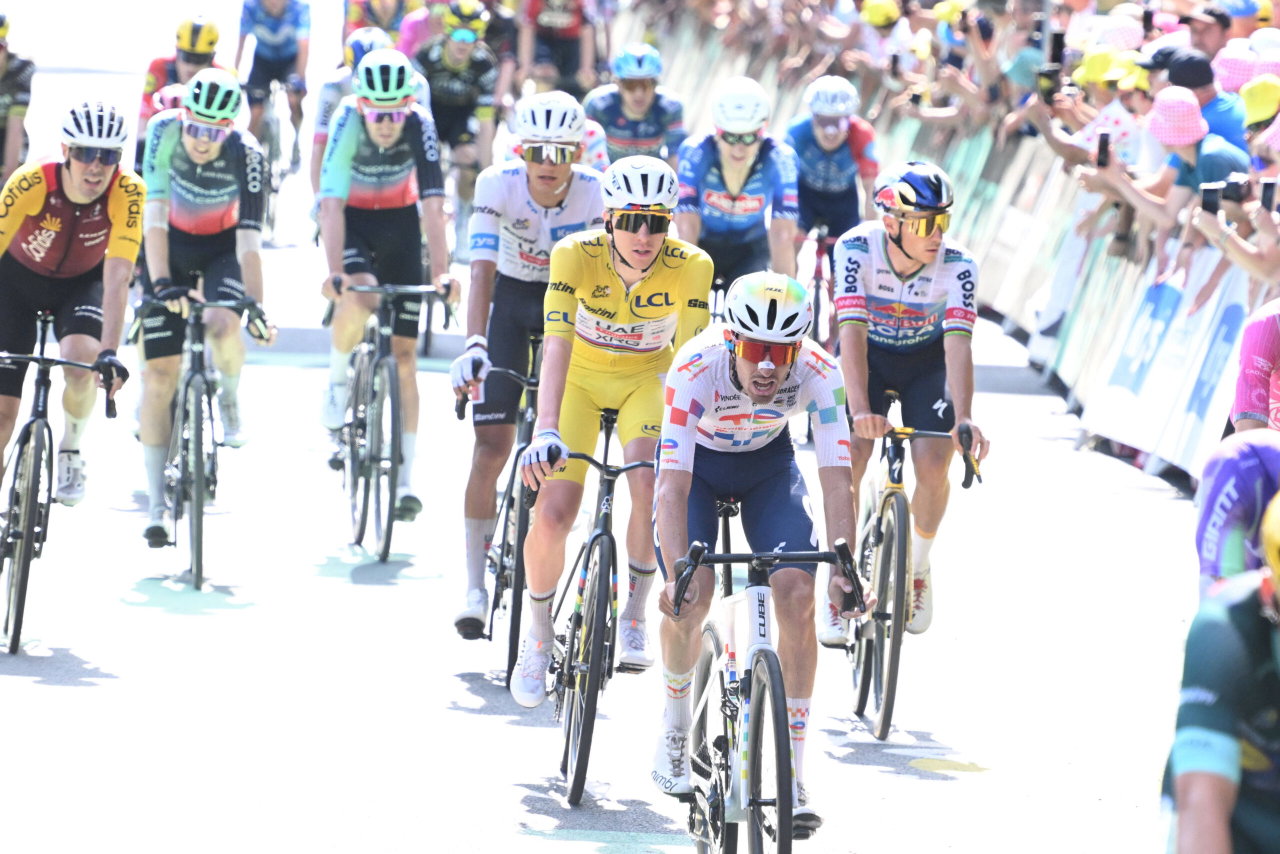
Despite being the reigning UCI Road World Champion, Tadej Pogačar missed out on a Stage 9 victory at the Tour de France as Mathieu van der Poel claimed the win. Pogačar finished 11th, six seconds behind Van der Poel, but the Slovenian kept the yellow jersey as the stage was shortened by 30 kilometers due to a red heat alert in France’s Corrèze department. Just after the race, Pogačar reacted strongly as he raised concerns about the growing impact of extreme heat on the sport.
Watch What’s Trending Now!
Speaking at his post-stage press conference on July 12, the four-time Tour de France winner said, “If I could have the power to change it all, I would change all the calendar. I would not race in July and August in the hot places and do a completely different calendar, but that’s something that you need to think through very well,” Pogačar said.
The Slovenian admitted that changing the entire cycling calendar would require careful consideration, but he believes earlier stage starts could be one option to reduce the impact of high temperatures. He explained that starting slightly earlier may not be enough because riders could still finish during the hottest part of the day.
Even though stage 9 was already shortened because of the heatwave, the reduced distance did not make the race easy. The route to Ussel still featured three steep climbs in the final 80 kilometers and almost 2,700 meters of elevation gain, creating a tough battle among the riders. And seeing this all unfolding, Pogačar further added, “Yesterday there was one proposal that we could start at 10, but for me, starting at 10 it doesn’t change anything because then you finish with the big heat.”
Pogačar suggested that races may need to begin much earlier, possibly around 8 or 9 a.m., even if it means riders would have to adjust their routines. Despite raising concerns about the conditions, Pogačar praised his UAE Team Emirates-XRG squad for handling the heat effectively. He said, “In our team, we’ve managed pretty well with this heat. We did a super good job to cool down our systems, and I’m pretty satisfied with how it went,” the Tour leader said.
His concerns are not without reason. Earlier in this year’s Tour de France, the 27-year-old revealed that the extreme temperatures had already affected him during Stage 4, when conditions approached 40°C. “When we started, I had a full headache and was thinking, ‘This is going to be one long day,'” Pogačar recalled.
The Slovenian explained that riders were forced to rely on constant cooling measures, with teammates regularly pouring water over one another and using ice to keep their body temperatures under control. The conditions were so demanding that UAE Team Emirates-XRG opted not to defend the yellow jersey that day.
With those experiences fresh in his mind, it is perhaps no surprise that Pogačar has become one of the most outspoken riders on the issue. But Pogačar was far from the only figure raising concerns about the extreme heat.
Riders’ Union joins Pogačar in calling for heat-related changes
The Cyclistes Professionnels Associés (CPA), the riders’ union, also warned that the conditions seen during this year’s Tour de France showed that existing measures may no longer be enough to protect riders. The organization called on race officials to apply the UCI Extreme Weather Protocol more strictly and argued that cycling must begin adapting to increasingly frequent heatwaves.
In a statement, the CPA said: “Given the increasing frequency of extreme heat waves, the CPA reaffirms that summer race start times must evolve in order to protect athletes’ health. Riders remain fully committed to putting on the best possible show, but this must go hand in hand with adapting to the climate realities that cycling now faces. The CPA urgently calls for discussions to be held with all stakeholders this winter, in order to find a solution before the 2027 season.”
Riders’ union has requested a number of extra safety measures for Stage 9 after talking with race organisers, including a 2% increase in the time limit due to the hot conditions. The agreement also stipulated that the leaders of the riders would get involved in future decisions relating to extreme weather, and that the UCI’s Extreme Weather Protocol would continue to be followed.
Tour de France director Christian Prudhomme admitted he was aware of the concerns. But he said significant pre-event arrangements begin to cause huge logistical problems, because of the need to coordinate with local governments, police, medical staff, volunteers, race personnel, race spectators and television companies.
“The protection of riders and the public is our priority. The key word is to adapt,” Prudhomme said before the race. Both Prudhomme and the CPA voiced their concerns with a growing consensus in the sport that cycling could need to adapt to increasingly extreme summer conditions.