
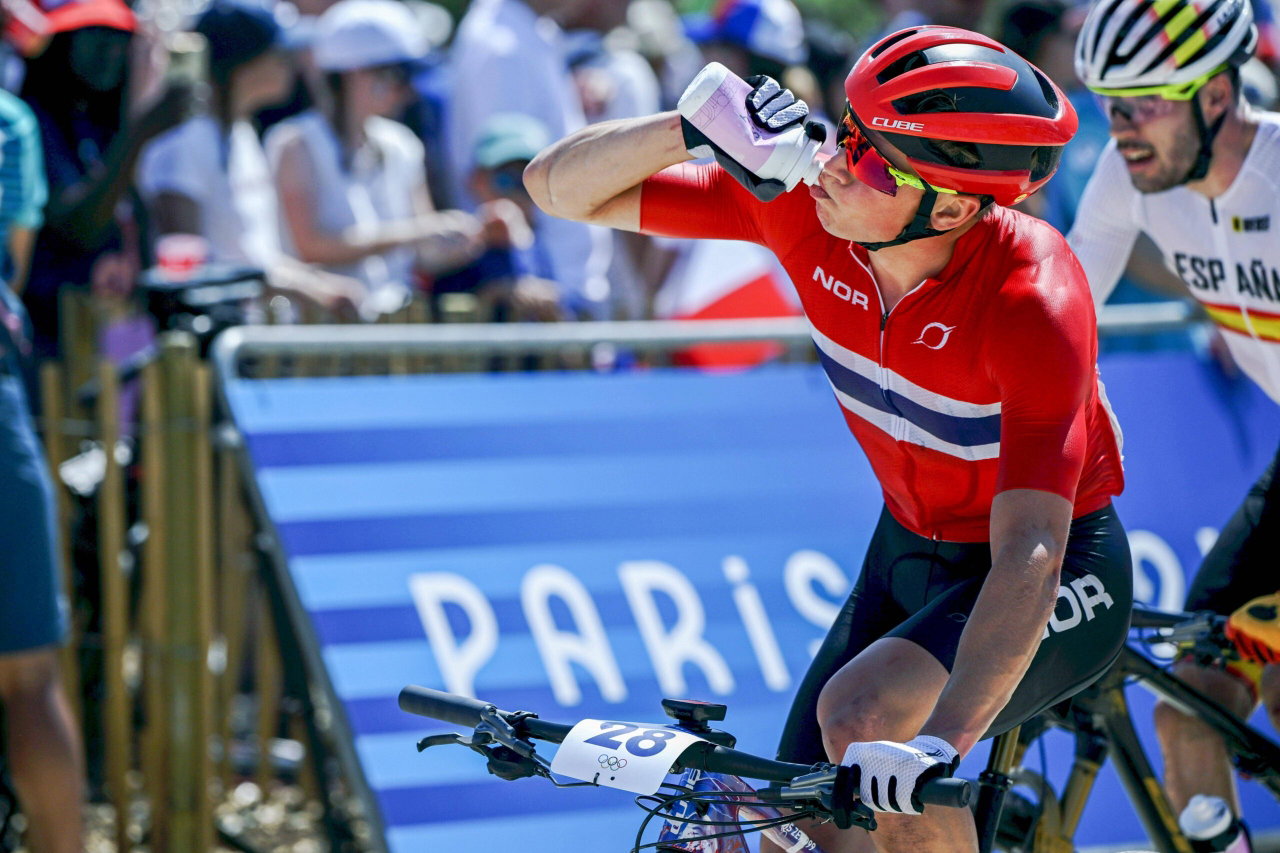
Knut Røhme thought he was taking his regular asthma medication. Instead, the Norwegian Olympian is now facing an anti-doping case that has forced him away from competition.
Watch What’s Trending Now!
The 26-year-old mountain biker revealed that the International Testing Agency (ITA) notified him on August 28 of an Adverse Analytical Finding from a sample collected during the European Championships in Monteceneri, Switzerland. The substance was later identified as terbutaline, a prohibited beta-2 agonist found in some asthma medications.
For Røhme, the news came as a shock. He said that when his established asthma treatment was renewed, a different medication was prescribed because of a doctor’s error. Røhme said he was not informed about the change and believed he was taking the same medication he had always used.
“Today, I am sharing news that I never imagined I would have to share,” Røhme wrote while announcing the development. “This came as a complete shock to me.”
Røhme has since submitted his explanation to the ITA and said he will fully cooperate with the investigation. He has also voluntarily suspended himself from racing and all organized sporting activity while the case is reviewed. The ITA and UCI are handling the matter, and no final sanction has been announced at this stage.
The Norwegian Cycling Federation has acknowledged the seriousness of the situation while also making clear that it will support Røhme through the process.
“This is a sad and serious day for cycling in Norway,” federation president Heidi Stenbock-Haakestad said, reiterating the organization’s zero-tolerance approach to doping.
At the same time, she said the federation would “look after Knut as a fellow human being” while the independent proceedings continue.
The case is particularly difficult for Røhme because terbutaline is prohibited under the World Anti-Doping Agency’s S3 category covering beta-2 agonists. According to the information released by Norwegian cycling authorities, traces of the substance were detected in his sample after he used the asthma medication before competing at the European Championships.
Røhme has never been a stranger to the biggest stages. He represented Norway at the 2024 Paris Olympics, finishing 20th in the cross-country event. He has also built a reputation on the international mountain-bike circuit, most recently finishing 22nd in the Short Track World Championships and 32nd in the European Championships XCO.
Now, however, his season has been put on hold while he waits for the case to be resolved.
Who was the last rider on the World Cup circuit to face an anti-doping violation?
Røhme’s situation also brings back memories of another recent mountain-bike anti-doping case involving Romanian cross-country star Vlad Dascălu.
Dascălu was handed a 17-month suspension in 2024 after the UCI Anti-Doping Tribunal found him guilty of three whereabouts failures within a 12-month period. The sanction ruled him out of the Paris Olympics and the remainder of the 2024 World Cup season, as well as the 2025 campaign.
His case was not about a positive test. As part of the Registered Testing Pool, Dascălu was required to provide detailed whereabouts information and remain available during a designated 60-minute testing window. Three failures within 12 months constituted an Anti-Doping Rule Violation.
The punishment brought a promising career to an abrupt halt. Dascălu had already established himself as a regular World Cup contender and had won the European XCO title in 2023. But for 17 months, racing had to wait.
Then came the comeback.
After completing his suspension, Dascălu returned to competition with Trek Factory Racing XC, describing the period away from racing as a lesson in “professionalism and resilience.” The team, which had suspended his contract during the case, ultimately continued its relationship with the Romanian.
His return offered a reminder that an anti-doping case does not necessarily have to define an athlete’s entire career. But it can change everything in an instant.
For Røhme, that chapter has only just begun. He insists the substance came from medication he believed was safe to take, has submitted his explanation, and is cooperating with the authorities. Until the proceedings are complete, there is no final ruling on what consequences he will face.
For now, the bike remains parked, and the next race remains uncertain. Røhme’s focus has shifted from chasing results to clearing up how an asthma prescription turned an ordinary treatment into the most difficult setback of his career.