
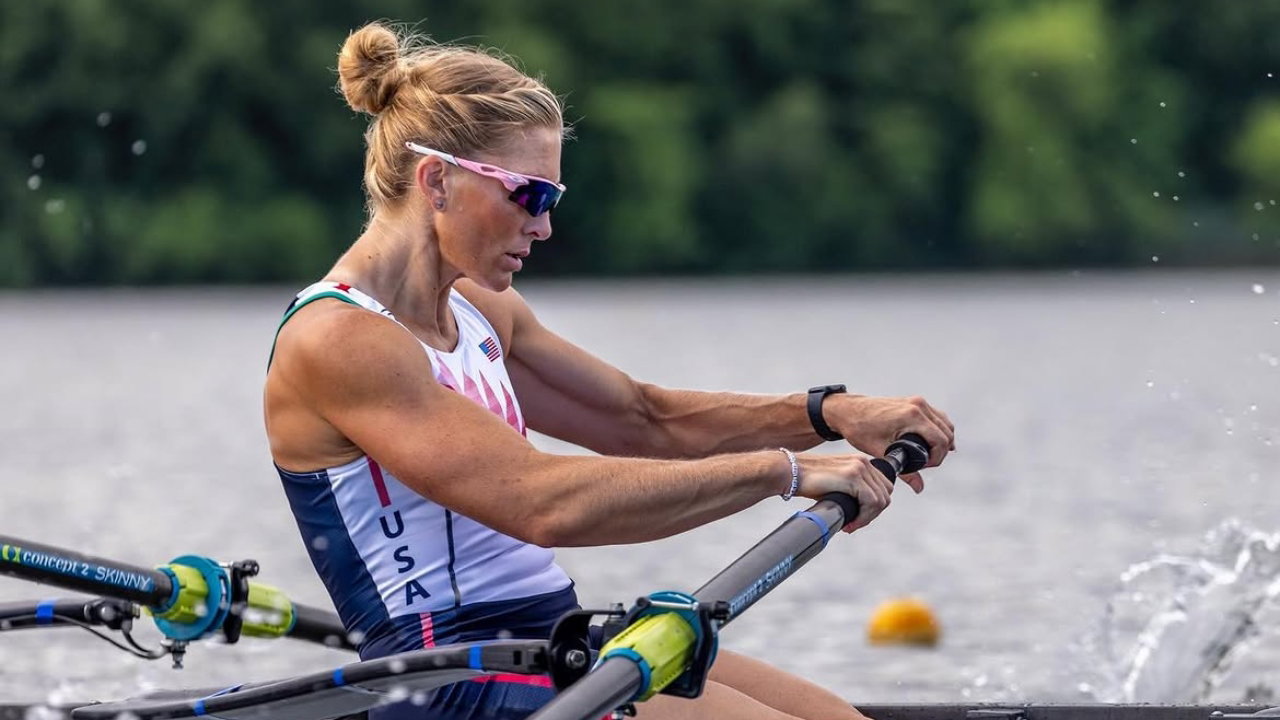
After winning Olympic gold at the 2012 London and 2016 Rio Games, Meghan Musnicki wanted to add another title to her collection. She returned to the Olympics for Tokyo 2020, but the U.S. women’s eight finished fourth. Musnicki later earned her fourth Olympic berth for Paris 2024 at age 41, becoming the oldest American woman to row at the Games. However, the U.S. boat again fell short of a medal and soon after she retired. But her journey did not end there, as she began exploring a new path beyond the sport.
Watch What’s Trending Now!
After spending most of the last 15 years as an elite athlete, Musnicki suddenly had to think about life and work outside rowing. She started searching for only her second “real job”. But her résumé was unusual because almost her entire adult career had been devoted to rowing rather than a conventional corporate career.
Her next opportunity came through a friend of a friend, who introduced her to Biograph, a preventive health company with locations in New York and San Francisco. She eventually joined Biograph in membership development and partnerships. For Musnicki, the new role was not just about finding work after retirement. It also gave her a chance to look at her own health differently.
As part of her involvement with Biograph, Musnicki underwent a detailed health assessment. After spending years training at the highest level of sport, she expected that she would generally look like a picture of good health. The results, however, revealed something she had not expected.
Musnicki learned that she had elevated LDL cholesterol and high Lp(a), a genetically influenced lipoprotein associated with a higher risk of cardiovascular disease. The testing also flagged a genetic risk for cardiovascular disease. The finding was particularly personal because her father died suddenly from a heart attack at 49 when Musnicki was a freshman in college.
Musnicki said the results made her pause. No one looking at her would necessarily assume she had a cardiovascular risk because of her background as an Olympic athlete. Instead of seeing the discovery only as something frightening, she chose to view it as information she could act on. “The value for me wasn’t just discovering that I had the issue,” Musnicki said. “It was having people that could interpret the information and give me tangible things to do.”
She worked with a dietitian and an exercise physiologist and began making lifestyle changes. Musnicki said that within six months, she lowered her Lp(a) by around 25 to 30 points and reduced her cholesterol by about 30 points. A statin was one possible option, but Musnicki said she did not want to immediately take medication.
Instead, she wanted to see what she could accomplish through changes to her diet, exercise and other lifestyle habits. Her experience also changed the way she viewed data.
From a basketball tryout to two Olympic gold medals
Meghan Musnicki’s journey in rowing began almost by accident in 2001, during her freshman year at St. Lawrence University in New York. She had gone to the athletic offices hoping to try out for basketball, but a rowing coach spotted her and suggested that she give the sport a chance. The funny part was that Musnicki did not even know what rowing was at the time. She decided to try it anyway, drawn to the idea of learning something new and being part of a team.
Musnicki transferred to Ithaca College in her sophomore year so she could be closer to her family. She quickly established herself as a key member of the varsity eight and helped Ithaca win back-to-back NCAA Division III championships in 2004 and 2005. After graduating in 2005 with a Bachelor of Science in Psychology, Musnicki appeared to be heading toward a career in nursing rather than professional rowing.
However, she continued training and attending national team selection camps. Her persistence eventually paid off when she earned her first U.S. national team spot in 2010. That same year, she won her first World Rowing Championships gold medal in the women’s eight.
Her success continued at the biggest stage. Musnicki won Olympic gold in the women’s eight at the 2012 London Games and defended her title at the 2016 Rio Olympics. She later returned to the Olympics in Tokyo and eventually made her fourth Olympic team for Paris 2024, competing at age 41. Over those years, Musnicki also witnessed how much rowing changed.
In 2010, when she first joined the U.S. team, athletes were primarily using “heart rate” and “perceived exertion” to understand their performance. By the time she arrived in Paris, technology and data had grown to a more significant dimension of the sport, and telemetry, among other measurements, allowed for detailed analysis of the athletes and the boat.
The experience changed the way that Musnicki now feels about her own health. During her rowing career, data was largely about finding ways to get more performance from her body. After retiring, her focus shifted toward a longer-term question: how could she keep her body strong and healthy for years to come?
That change can also be seen in the way she trains today. Rather than preparing for another Olympic rowing race, Musnicki focuses on heavy lifting to maintain muscle mass and bone density, along with Zone 2 cardio, sprint work, jumping and plyometric exercises. She also works on mobility.
And her next athletic challenge is very different from rowing. Musnicki recently bought a Garmin smartwatch and is now training for her first marathon.