Imago
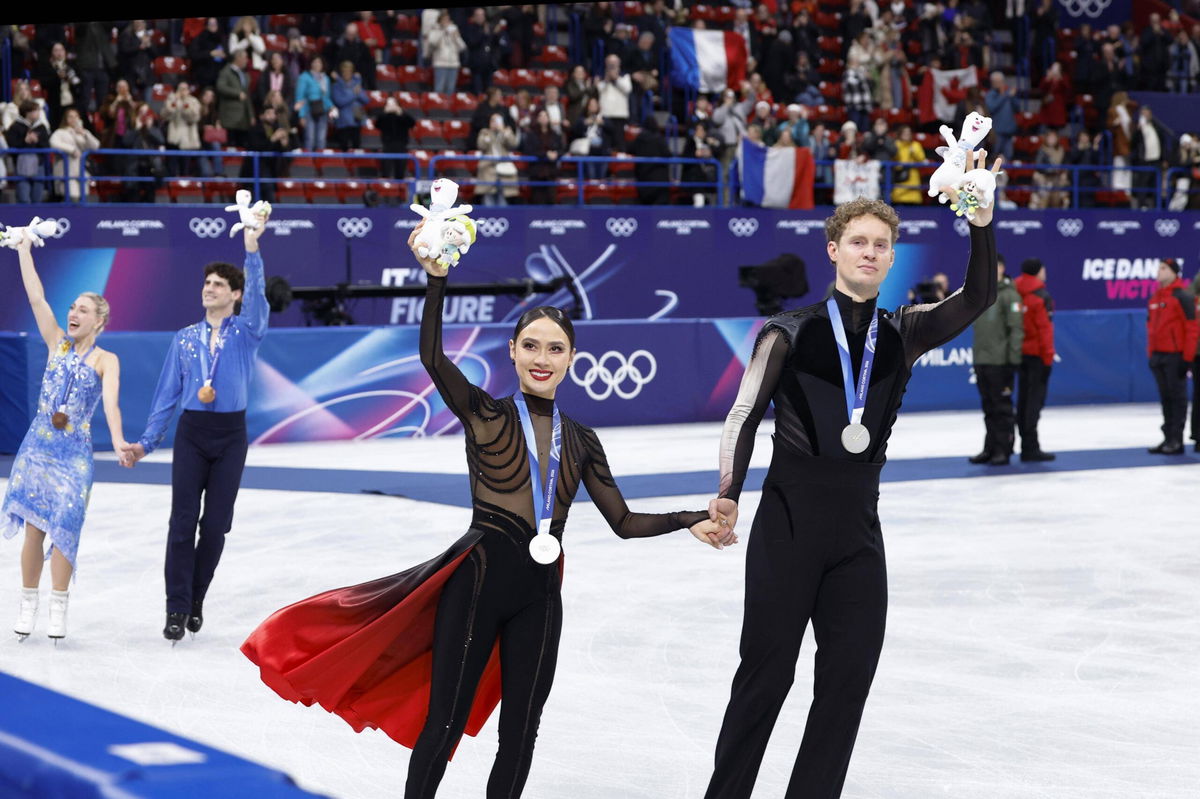
Milan Cortina Olympics: Figure skating, Eiskunstlauf from R Silver medalists Evan Bates and Madison Chock of the United States and bronze medalists Paul Poirier and Piper Gilles of Canada acknowledge the crowd after the ice dance medal ceremony in figure skating at the Milan Cortina Olympics at Milano Ice Skating Arena in Milan on Feb. 11, 2026. PUBLICATIONxINxAUTxBELxBIHxBULxCZExDENxESTxFINxFRAxGEOxGERxGRExHUNxISLxIRLxITAxLATxLTUxLUXxLIExMKDxNORxPORxPOLxROUxSVKxSUIxSRBxSLOxESPxTURxUKxUAExONLY A14AA0005272697P
Imago
Milan Cortina Olympics: Figure skating, Eiskunstlauf from R Silver medalists Evan Bates and Madison Chock of the United States and bronze medalists Paul Poirier and Piper Gilles of Canada acknowledge the crowd after the ice dance medal ceremony in figure skating at the Milan Cortina Olympics at Milano Ice Skating Arena in Milan on Feb. 11, 2026. PUBLICATIONxINxAUTxBELxBIHxBULxCZExDENxESTxFINxFRAxGEOxGERxGRExHUNxISLxIRLxITAxLATxLTUxLUXxLIExMKDxNORxPORxPOLxROUxSVKxSUIxSRBxSLOxESPxTURxUKxUAExONLY A14AA0005272697P
As the old sporting adage goes, gold medallists celebrate triumph, bronze medallists celebrate survival, but silver medallists are often left wondering what could have been. For Madison Chock and Evan Bates, that reality unfolded once again on Olympic ice. After the event, the two expressed their disappointment.


Chock and Bates went 19th of 20 teams. Their toreador-inspired skate to Ramin Djawadi’s cover of “Paint It, Black” mesmerized the fans in the stadium and the millions watching from their homes. Chock’s brilliant red matador’s cape stood as one of the competition’s highlights. However, Chock and Bates received a final combined score of 224.39, which remained just short of France’s Laurence Fournier Beaudry and Guillaume Cizeron, who outperformed it with a score of 225.82.
Watch What’s Trending Now!
“It’s definitely a bittersweet feeling at the moment. We have so much to be proud of. We’ve had the most incredible career, 15 years on the ice together, “Madison Chock said. “We delivered four of our best performances this week. I’m really proud of how we’ve handled ourselves and what we’ve accomplished here.” Bates also maintained that they couldn’t have done any better.
“We just performed four times in six days at the Olympics. We’ve never done anything like it, and it took so much mental strength and discipline to stay focused over the last six days and to deliver four great performances,” He said. “At the end of the fourth one, the emotions just came flooding out because it’s just a lot. And we really did our best. I think that is something that we’ll try to remember and focus on most. We really did our best. We delivered every time we stepped on the ice.”
Ultimately, the controllables are all that matter. Yes, the goal is always to win, but even your best cannot achieve that sometimes. The couple has accepted the loss with grace. There are murmurs of some bias from the judges, with the fans setting social media on fire. However, Bates brushed it off.
“Life is… Sometimes you can feel like you do everything right and it doesn’t go your way,” He said. “And that’s life, and that’s sport, and it’s a subjective sport, it’s a judge sport. One fact, we did our best, we skated our best. We felt like we were very close.”
🥈 Madison Chock / Evan Bates 🇺🇸 135.67
/ 224.39Madison: “It’s definitely a bittersweet feeling at the moment. We have so much to be proud of. We’ve had the most incredible career, 15 years on the ice together. We delivered four of our best performances this week. I’m really… pic.twitter.com/A1jKCdxO85
— Golden Skate (@goldenskate) February 11, 2026
The subjective nature of the sport plays a huge part in the final result. For example, in this case, the Spanish and the French judges ranked Chock and Bates lower than their counterparts. The French judge had an almost 8-point differential between 1 and 2. While point trimming might have cancelled some of it out, it wasn’t enough to give them the win.
Even the Spanish judge ranked the Americans third. This discrepancy may have contributed to their final finish below the French pair. After this loss, the couple has also hinted at a possible retirement.
While Chock and Bates’ silver carries its own unique sting. Coming after years of dominance, a team event gold at these Games, and a performance they both called their “best,” such razor-thin margins and lingering “what ifs” are part of figure skating’s storied history.
The 2002 Salt Lake City Olympics pairs event remains one of the most infamous examples: Canadians Jamie Salé and David Pelletier delivered a seemingly flawless free skate, only to be awarded silver behind Russia’s Elena Berezhnaya and Anton Sikharulidze.
Similarly, American legend Michelle Kwan, despite unmatched artistry and five World titles, twice came agonizingly close to Olympic gold, taking silver in 1998 (behind Tara Lipinski’s technical edge) and bronze in 2002, leaving fans with enduring “what could have been” narratives.
These moments remind us that in judged sports like ice dance, excellence doesn’t always align perfectly with the medals, yet the resilience Chock and Bates showed in processing their result echoes the grace under pressure that defines the sport’s greatest competitors.
Evan Bates And Madison Chock Might Have Appeared At Their Final Olympics
Even as the Milano Cortina Winter Olympics approached, there was speculation about the couple’s Olympic future. 4 Olympics, a gold medal, a distinguished career. The couple added another gold to the team event and a silver to that tally. When asked if this was their last dance, Bates candidly said, “I’m not sure.” Chock echoed the same.
“We’ve got a lot to be proud of and a lot to be grateful for because we’ve had an incredible career,” added Chock. “Sometimes that’s just how it shakes out. This is this story for us, and I wouldn’t change anything.”
Ahead of the games, Madison Chock explicitly stated their goal: winning the individual gold medal. They fell short in achieving that. And the urge for redemption might push them to make another appearance in 2030 in front of the current gold medalists, France. That would be the ultimate ending to their careers.
“Immediately right now, it’s really hard to say what the career plans will be, but TBD,” Bates said. Bates is 36, turning 37 later this month, while Chock is 33. In 2027, they will touch 40. There haven’t been Olympic medallists that old in recent history. The couple would have to break all the barriers to do so. However, if anyone can, it is this power couple.
Written by

Edited by

Tanay Sahai