
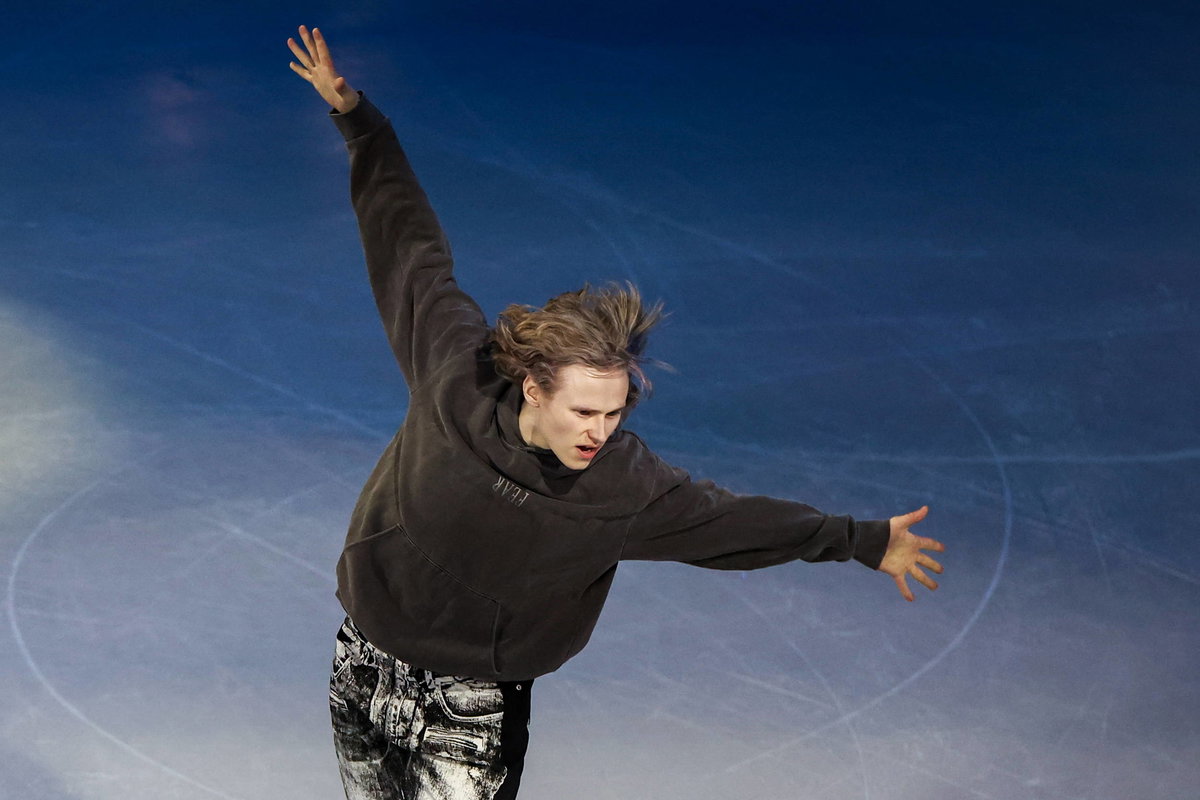
Ilia Malinin arrived in Tokyo fresh off a record-breaking performance, but his biggest challenge at the NHK Trophy came when his body refused to cooperate. Battling dizziness and nausea, the American had to dig deeper than usual to finish his free skate. Yet, even on a difficult day, the three-time world champion found a way to stand atop the podium.
Watch What’s Trending Now!
Malinin entered Saturday’s competition with a commanding lead after scoring 114.81 points in the short program on Friday, setting a new world record and surpassing Nathan Chen’s previous mark of 113.97 from the 2022 Beijing Olympics. However, the 21-year-old’s second appearance on the ice looked nothing like his record-breaking display.
During the six-minute warm-up, Malinin suffered an unusual fall, offering an early indication that something was not quite right. His troubles continued when he opened his free skate with a planned quadruple flip but managed only a double. Although he recovered with four more quadruple jumps, his performance lacked the usual fluidity and connection.
The American eventually secured the free skate with 190.50 points, taking his overall tally to 305.31. It was enough to finish comfortably ahead of France’s Kevin Aymoz (270.49) and Switzerland’s Lukas Britschgi (266.02). But the victory came at a cost, as Malinin later revealed just how difficult it had been to make it through the routine.
“When I went out there, my goal wasn’t to skate my best; my goal was to make it out in one piece alive,” the American admitted at the post-competition press conference.
For someone who has built a reputation on pushing the limits of figure skating, Saturday demanded a different kind of resilience. Malinin revealed that he started feeling unwell shortly before taking the ice, leaving him uncertain about how much he could manage. “I think it was just last minute, I was feeling a little bit dizzy and a little bit nauseous,” he explained.
The three-time world champion also ruled out an injury as the reason behind his struggles, pointing out that he had felt perfectly healthy before arriving at the competition. “It’s definitely not an injury because going into this competition, I felt really good,” he said, adding that he was still unsure what had triggered the symptoms.
Despite the discomfort, Malinin refused to abandon his routine or settle for a cautious performance. Skating to music from Blue Eye Samurai, he maintained the Japanese-inspired theme of his program, complete with a backflip that thrilled the Tokyo crowd.
“Honestly, it felt like a battle out there, and I think it kind of represented the character that I play in the song,” he said. “I was not feeling the best today. But I tried my hardest to push through the whole program.”
His determination helped him secure his first NHK Trophy title on his debut appearance at the competition. However, he could not replicate the record-breaking standards of the previous evening. His total also fell short of his personal best of 333.81 and Nathan Chen’s all-time record of 335.30.
Nevertheless, the victory extended Malinin’s remarkable Grand Prix run, marking his ninth consecutive title on the circuit since 2023. Having also won Skate America earlier this season, he booked his place at the Grand Prix Final in Chongqing, China, scheduled for December 10-13.
A special NHK Trophy victory for the Malinin family
Beyond the competition and the points, Saturday’s victory carried a personal significance for the American. His first NHK Trophy triumph also allowed him to follow in the footsteps of his mother and coach, Tatiana Malinina, who won the same event in 1999 and 2001.
With Tatiana watching from the sidelines, the achievement became another special chapter in their shared figure skating journey. Malinin has often acknowledged the influence his mother has had on his career, making the Tokyo victory particularly meaningful.
“I feel very happy to follow my mom’s footsteps. She has been an inspiration for me, she’s always been there for me no matter what, all the good times and bad times, hard and easy times,” he said.
Now, the American will have to shift his attention toward recovering before the season’s next major challenge. He admitted that the difficult performance could at least give him some valuable time to rest before the Grand Prix Final. “I definitely tried my hardest out there. It can give me some time to rest before the final,” he added.
Malinin will hope to return to his usual best in China, where he will chase a fourth consecutive Grand Prix Final crown. For now, though, his Tokyo triumph stands as a reminder that even the sport’s most dominant skaters sometimes have to fight through more than just their competition to reach the podium.