
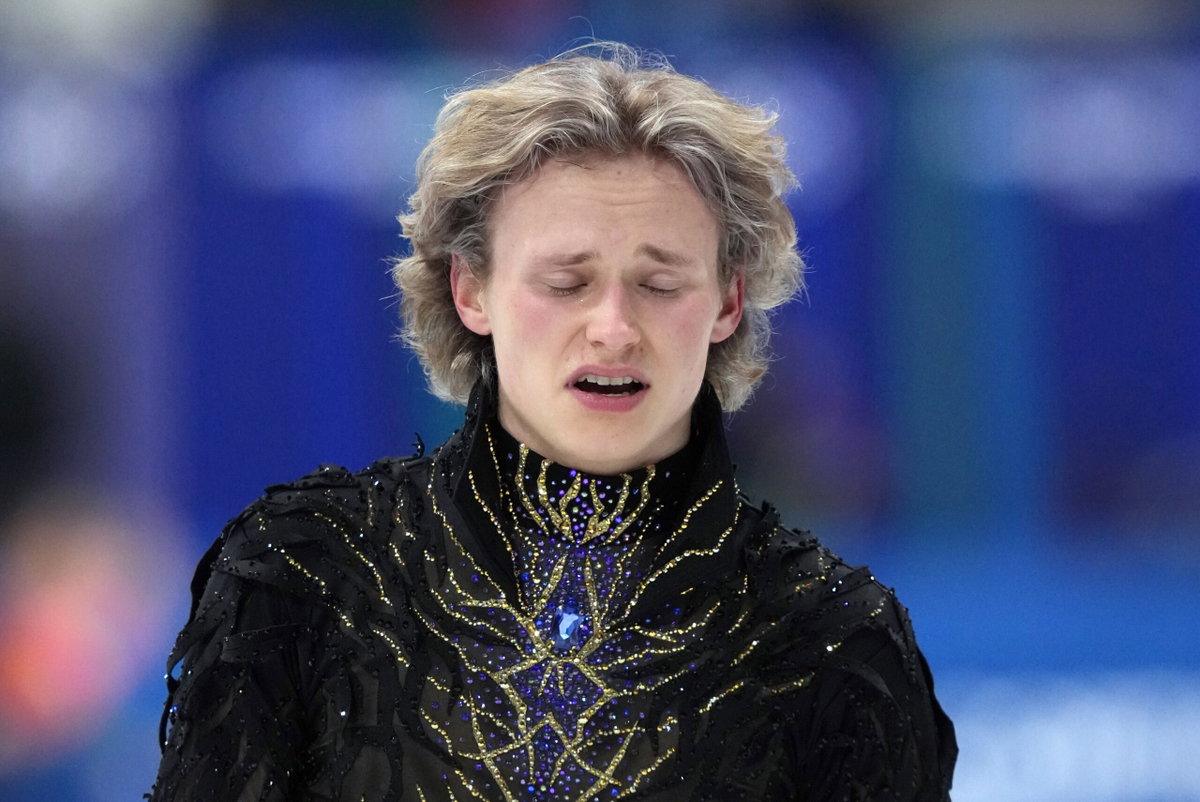
Ilia Malinin arrived at the 2026 Winter Olympics believing he could conquer anything on the ice. Instead, Milan left him questioning who was really in control of his career. Months after his shocking eighth-place finish, the American figure skating star now says external forces – federation demands, people around him – not the competition itself, broke him at the Olympics.
Speaking to Mikaela Shiffrin on the What’s the Point? podcast, Malinin opened up about the pressure surrounding his Olympic debut and his decision to stop letting others dictate his journey. “This is controversial, but it’s just the fact that I’ve, you know, started learning to say no,” he explained.
“You know, something that I felt very like angry about. I was, you know, that day of the free program. I was angry, not at, you know, I spent the last four years of my life training for this to happen. The on-ice, you know, expectations, the pressure. It was everything outside of that that really just affected me, you know, people around me you know the federation all of these things together just yeah like it was almost like a bubble closing in on me, and I was like had no idea what to do, and it’s like it just broke me, and I was like I’m not letting this happen anymore I’m done being this like puppet,” Malinin added.
To understand the frustration behind those words, it helps to remember the expectations Malinin carried into Milan. Nicknamed the “Quad God,” the American had dominated the sport for more than two years, winning consecutive world titles and establishing himself as the man to beat. His ability to land the quadruple axel, a jump involving four and a half rotations in the air, only strengthened the belief that Olympic gold was his to lose.
Malinin had already helped the United States capture team gold, and his commanding short program in the individual event appeared to put him on course for another triumph. Then came the free skate. He abandoned his planned quadruple axel, downgraded other jumps, and fell twice. Instead of standing on the podium, the 21-year-old finished eighth as Kazakhstan’s Mikhail Shaidorov delivered a clean performance to claim his country’s first Winter Olympic gold in 32 years.
The result stunned spectators. But Malinin’s frustration was not about the medal itself – it was about the forces he felt had stolen his control. Malinin later admitted that he had struggled to handle the Olympic pressure. In February, he shared a social media video pairing images of his achievements with a black-and-white photograph of himself holding his head in his hands. His caption described how online hatred, fear, and relentless expectations could overwhelm even the strongest competitors.
His podcast comments now offer a clearer picture of what he believes went wrong. Malinin insisted that the training and the pressure to perform were not the only problems. The demands surrounding him, including those from people and organizations connected to his career, made him feel trapped. He had spent four years preparing to skate at the Olympics, only to feel that forces beyond the rink had taken control of the moment.
Learning to say no is how Malinin plans to reclaim his sport from the people and organizations that he believes took control of it. It is a way to reclaim ownership of a sport that can consume an athlete’s identity. He argued that figure skaters often have little room to make independent choices, even as they face the physical and emotional demands of elite competition.
He also pointed to the difficult reality awaiting athletes after retirement. Some must return to college to build another career, while others turn to coaching simply to make ends meet. In his view, the lack of control over their own futures remains a major issue in figure skating.
That realization has forced Malinin to reconsider what success means. Rather than allowing every decision to revolve around expectations, he wants to remember that he is the person stepping onto the ice. The shift does not mean he has stopped chasing greatness. Instead, he is trying to protect the passion that made him such an extraordinary talent in the first place.
His Olympic collapse also showed how quickly years of dominance can unravel under extraordinary pressure. Before the Milan Olympics, Malinin had gone unbeaten across 14 competitions over more than two years. Yet even his remarkable technical ability could not shield him from the weight of the occasion. His experience serves as a reminder that the athlete capable of performing seemingly impossible jumps can still struggle with the burden of expectation.
A different road toward the next Olympics
Malinin now has another four-year Olympic cycle ahead, with the 2030 Winter Games in the French Alps offering a chance to return on his own terms. His immediate challenge, however, is not simply to perfect another jump or add another world title. It is to build an environment in which he can compete without feeling that he has surrendered control of his life.
“I have to skate for myself because I have to remember that I’m actually the one who’s skating,” he said in his latest conversation with Mikaela Shiffrin. Speaking about the expectations that come around with the “Quad God” tag, he added, “It wasn’t more like, ‘Wow, this guy’s doing so many quads’. It was like, ‘Oh, this is his usual’. There would be times when I felt burnt out because I was just trying to kind of, you know, be a people pleaser.”
However, his decision to speak openly about the experience could also encourage a wider conversation about athlete welfare in figure skating. The sport celebrates discipline, resilience, and technical brilliance, but Malinin’s account highlights the need to give athletes room to express their limits and make their own choices.
The eighth-place finish will remain a painful chapter in his career. But it may also become the moment that changed his relationship with skating. Malinin still has the talent to chase history; now, he wants the freedom to decide what that journey looks like.
For the Quad God, reclaiming that freedom may prove just as important as reclaiming Olympic gold.