
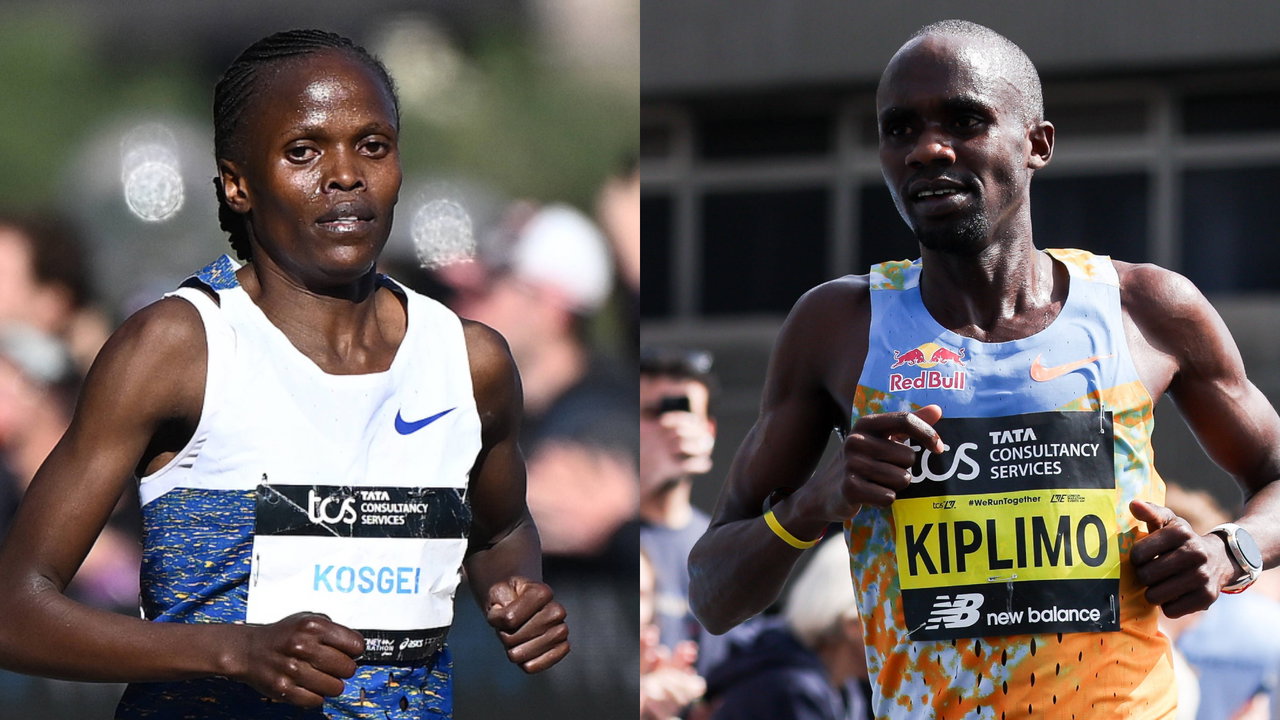
When Ruth Chepngetich ran 2:09:56 at the 2024 Chicago Marathon, it left the running world amazed. But just months later, that excitement turned to disappointment when she was suspended in 2025 following a positive doping test. The news left many fans disheartened, with even American runner Emily Sisson calling it “a punch in the gut.” The incident not only shocked the sport but also raised difficult questions about trust in marathon running. Now, as those concerns continue to linger, Brigid Kosgei and Jacob Kiplimo are taking extra steps to show their commitment to clean competition ahead of this year’s Chicago Marathon.
Kosgei, the former women’s marathon world-record holder from Kenya, and Kiplimo, the Ugandan distance-running star who won the 2025 Chicago Marathon, have voluntarily joined an enhanced anti-doping testing programme run by the Athletics Integrity Unit.
According to CITIUS MAG, the initiative is funded by Nike and the athletes’ management agency, Rosa Associati. Both runners entered the programme after their spring marathons in 2026. The testing requirements go well beyond the usual schedule for marathon runners. Each athlete must undergo at least 25 out-of-competition tests per year, with between 100 and 120 analyses performed on their samples.
For comparison, athletes in the marathon testing pool average around six out-of-competition tests annually, with 12 to 16 analyses. All 25 required tests are unannounced, comply with World Anti-Doping Agency rules and are independently administered by the AIU. Additional tests can be arranged using intelligence and data to determine when testing may be most useful.
The programme follows the model used by fellow runner Sabastian Sawe before the 2025 Berlin Marathon and the 2026 London Marathon. For this year, the AIU recommended spreading the same volume of testing across a full year rather than concentrating it into just a few months.
Kosgei has spoken openly about the frequency of her tests in Kenya, saying she sometimes undergoes testing two or three times a week. “It’s to prove to the juniors and young generation that I am clean,” Kosgei said.
The Kenyan runner knows what it takes to reach the top of marathon running. She won the Chicago Marathon in 2019 in 2:14:04, setting a women’s world record that stood until Ethiopia’s Tigst Assefa ran 2:11:53 in Berlin in 2023. Kosgei’s decision to undergo extra testing sends a message to younger athletes about the importance of competing fairly. Rather than relying only on the standard testing schedule, she has chosen to accept additional scrutiny.
Kiplimo has also explained why he wanted to take part in the programme. “For me, I decided on extra tests because I want clean sport and people can trust and know that we are running clean,” he said. The Ugandan runner won the 2025 Chicago Marathon in 2:02:23. He also ran 2:00:28 at the London Marathon in April 2026, finishing third in one of the fastest marathon performances in history.
Yet, in a sport where several high-profile athletes have faced doping sanctions, even extraordinary performances can prompt questions about trust. That does not mean every record-breaking run should be viewed with suspicion, but past cases have made clean competition a bigger concern for many fans.
Doping cases that have shaken Marathon running
Chepngetich made history at the 2024 Chicago Marathon, clocking 2:09:56 to become the first woman to complete the 26.2-mile distance in under two hours and 10 minutes. Her performance broke the previous women’s world record of 2:11:53, set by Ethiopia’s Tigst Assefa in Berlin in 2023, by almost two minutes.
The result attracted widespread attention because of the scale of the improvement and the speed of her run. However, questions surrounding the performance became more serious in July 2025, when the AIU announced that Chepngetich had been provisionally suspended after testing positive for hydrochlorothiazide, a prohibited diuretic. Chepngetich later received a three-year ban after admitting anti-doping rule violations in October 2025.
Chepngetich was not the only prominent marathon runner to face an anti-doping case in recent years. Albert Korir, who won the 2021 New York City Marathon, received a five-year ban in 2026 after positive tests for CERA.
Geoffrey Yegon also faced consequences after winning the 2024 Singapore Marathon. A post-race test detected a prohibited substance, leading to a two-year ban and the loss of his race prize. Meanwhile, former Boston and Chicago Marathon champion Lawrence Cherono received a seven-year ban in 2024 following a positive test for trimetazidine and additional anti-doping violations.
More recently, Ethiopian marathon runner Tiruye Mesfin received a three-year ban in September 2026 after admitting an anti-doping violation established through abnormalities in her Athlete Biological Passport. The case added to a growing list of high-profile sanctions in elite distance running.