Imago
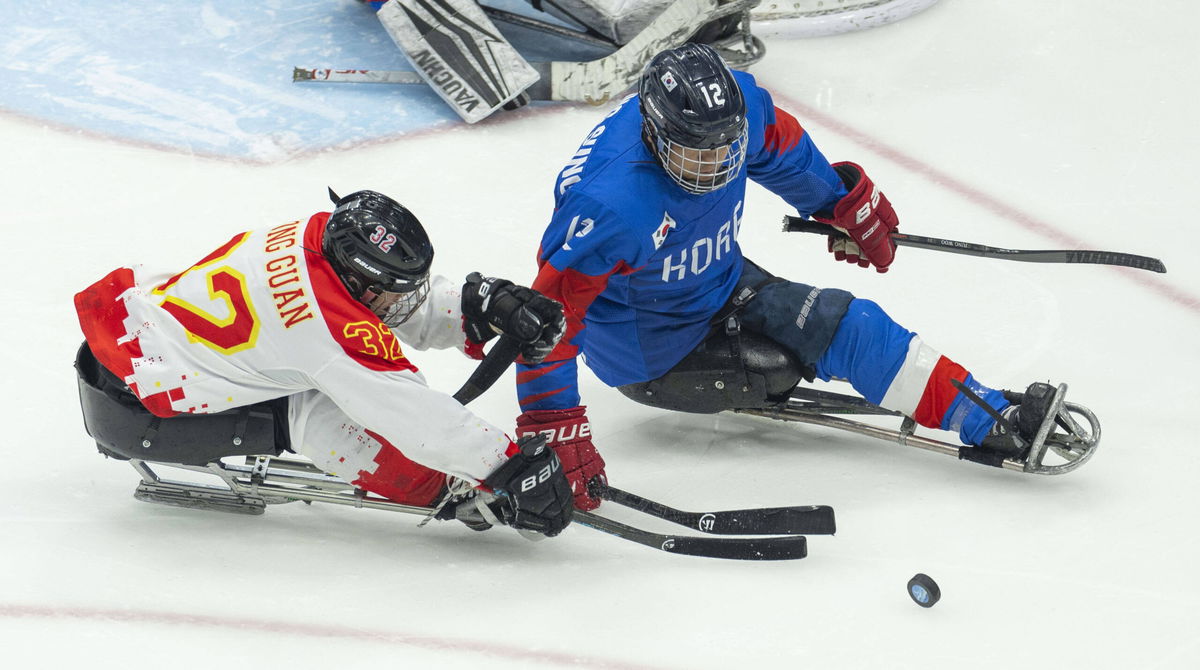
Paralympics, BEIJING 2022, Eishockey, Frauen, China – Südkorea 220312 — BEIJING, March 12, 2022 — Li Hongguan L of China vies with Kim Young Sung of South Korea during the Para Ice hockey, Eishockey Bronze Medal Game between China and South Korea of the Beijing 2022 Paralympic Winter games, Winterspiele,Spiele, Summer games at National Indoor Stadium in Beijing, capital of China, on March 12, 2022. SPCHINA-BEIJING-WINTER PARALYMPICS-PARA ICE HOCKEY-BRONZE MEDAL GAME-CHN VS KORCN CaixYang PUBLICATIONxNOTxINxCHN
Imago
Paralympics, BEIJING 2022, Eishockey, Frauen, China – Südkorea 220312 — BEIJING, March 12, 2022 — Li Hongguan L of China vies with Kim Young Sung of South Korea during the Para Ice hockey, Eishockey Bronze Medal Game between China and South Korea of the Beijing 2022 Paralympic Winter games, Winterspiele,Spiele, Summer games at National Indoor Stadium in Beijing, capital of China, on March 12, 2022. SPCHINA-BEIJING-WINTER PARALYMPICS-PARA ICE HOCKEY-BRONZE MEDAL GAME-CHN VS KORCN CaixYang PUBLICATIONxNOTxINxCHN
With the 2026 Milan Paralympics approaching, questions about gender balance are back in focus. Despite the International Paralympic Committee’s long-standing pledge to promote equality, women account for only about a quarter of the competitors. Official figures show that of 665 total quota places, just 176 (approximately 26.1%) are reserved for women. That’s a stark contrast to the near-even gender split seen at recent Games, and much of the disparity stems from how events themselves are structured.


“There are no men’s and women’s events like at the Olympics, so female athletes are selected alongside male athletes. This has historically led to more men being chosen. Out of 135 ice hockey players currently competing in Italy, only one is a woman,” shared the BBC on X. Sure, Para ice hockey is technically a mixed-gender sport, but in practice, mixed does not mean equal.
Watch What’s Trending Now!
In the Milan Paralympics, only two teams, Japan and Slovakia, feature a female player, and women remain a very small presence in the field. Even Kelsey DiClaudio, a world champion and one of the best female para ice hockey players, could not compete. Mixed-gender formats in themselves have not been sufficient to guarantee equitable representation.
The issue is historical in nature. Of the 32 years that para ice hockey has been a part of the Paralympics, only four women have ever competed, though there is an optional 18th spot on the squad, which is designated to a woman. This year, Akari Fukunishi of Team Japan was the only woman among 135 participants.
Why are so few of the athletes at the Winter Paralympics female? pic.twitter.com/AIb9eWrHGk
— BBC Sport (@BBCSport) March 12, 2026
The IPC has, however, always indicated a desire to have gender parity. The Summer Games are much closer to balance, with 44.7% female athletes in Paris 2024, but at the Milan Paralympics, women account for just 26.1%. So, yes, introducing standalone women’s events is not simple: a sport must meet several criteria, including multiple World Championships, representation from at least eight national teams across three regions, and sustained participation.
However, Women’s para ice hockey has not yet reached these benchmarks, which means a separate tournament is likely several Paralympics away, possibly 2030 or 2034. But the gender challenge is not limited to ice hockey alone.
The Wider Struggle for Women at the Milan Paralympics
The challenge of female representation at the Milan Paralympics 2026 goes far beyond para ice hockey.
As the BBC noted, “It’s similar in wheelchair curling. In the mixed team event, only one of the team of four needs to be female, and in para snowboard, men have had three times as many events as women. There is a newly added mixed doubles event in wheelchair curling though, where teams are made up of one man and one woman, and this has increased female participation in the sport this year.” Sure, mixed formats help, but they also expose the limits women face.
However, wheelchair curling has one of the highest female participation rates. As with mixed doubles, female representation increased from 33% in Beijing 2022 to 38% in the Milan Paralympics. Yet participation alone does not solve structural inequality; so in other sports, mixed-gender participation still limits the overall development of women.
The gap is also stark in the Milan Paralympics para snowboarding. Men compete in six medal events compared with just two for women. Still, athletes like Cecile Hernandez and Kate Delson show that women can thrive even when opportunities are scarce. But if women can succeed under these conditions, why are there still so few chances for them?
Dr. Nikolaus, Dean of the University of British Columbia, analyzed wheelchair rugby, curling, para ice hockey, and para equestrian. In 2023, he concluded that “in practice, these sports provide little to no opportunity for women to get involved in the wider Paralympic movement.”
Even IPC President Andrew Parsons acknowledged that gender parity “is not happening fast enough.” But emphasized that the direction is clear: “Once we are able to have a female tournament in para ice hockey this will help a lot to fill the gap.” Nevertheless… the standalone events timeline is years away!
So to make standalone women’s events a reality, there have to be sufficient competitive athletes, representing sufficient countries, in order to maintain a meaningful tournament. What’s your take on this? Share it with us in the comments below.