
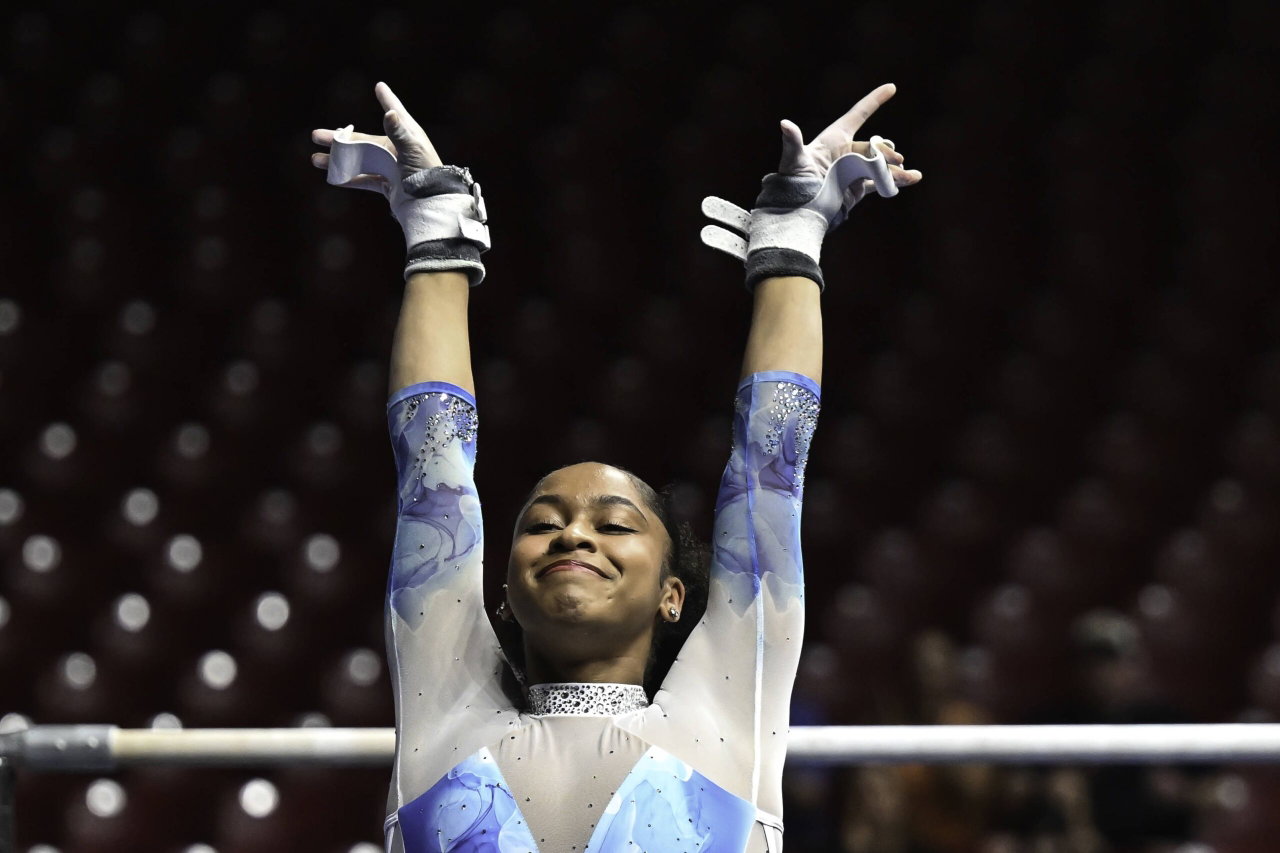
Expectations were low for the United States at the 2026 World Gymnastics Championships, as the women’s team competed without a single gymnast with previous Olympic experience for the first time since 2011. The disappointment grew further when the women missed team gold by just 0.233 points, while the men’s team finished sixth. But amid a difficult championship for America, Skye Blakely, an NCAA gymnast from the University of Florida, gave the nation something to celebrate by winning all-around gold with 55.733 points. And in doing so, she finished ahead of Paris 2024 Olympic uneven bars champion Kaylia Nemour. For Blakely, who missed the Paris Olympics after an Achilles injury, the victory was an emotional moment as she reflected on her long road back to the top.
Watch What’s Trending Now!
Speaking after her victory, Blakely struggled to put the moment into words as shared by InsideGymnastics on X on October 23. “Full of emotions. Full of joy. Just so thankful to God,” she said, describing the mindset that carried her through the competition. “It’s just fighting for my faith. Believing in myself. And really telling myself there’s no other option. I know how to do it, and I need to do it.”
She explained that she kept praying throughout the meet, asking God to keep her steady and calm while reminding herself of what she could achieve. “Because I know what I’m capable of, and it’s all going to come together at the right time,” she said. “And I couldn’t have asked for a better night, or a better moment.”
Her victory was also a result of a carefully planned strategy. Blakely did not attempt to show all the difficulty she had available, choosing instead to protect her health and build steadily after her injury. “I think that it’s important to pace myself,” she said. “I don’t think I need to bring it out all at the same time.”
That approach paid off. Blakely built her advantage with consistent performances on vault, uneven bars and balance beam before finishing on floor exercise. She scored 14.200 on vault, 14.400 on bars and 14.200 on beam, giving herself enough room to withstand a lower floor score of 12.933. Her total of 55.733 secured the world all-around title.
Blakely finished 0.534 points ahead of silver medallist Liudmila Roshchina, while China’s Ke Qinqin took bronze with 55.032. Kaylia Nemour, the Paris 2024 Olympic uneven bars champion who had qualified first for the final, finished fourth with 54.998.
Blakely’s decision to hold back some of her difficulty was not always easy. She admitted that she had considered attempting harder skills when she felt ready, but ultimately trusted the plan she had set for herself. “It’s important for me to stick to the plan that I have for myself because I believe that it’s building the foundation for these next couple of years,” she said. The victory also carried a personal meaning tied to the gymnast she had been before the setbacks.
Blakely had been close to making the U.S. Olympic team in 2024 when her Achilles injury ended her hopes of competing in Paris. Looking back at that difficult period, she said she was not sure her younger self would have believed she could reach this moment. “Do it for the girl in 2021 and the girl in 2024. When I couldn’t do everything, just fight for her,” she recalled telling herself. “That’s what I kept telling myself is I am capable, I am ready. And I think I made every version of myself extremely proud.”
Blakely’s world title also gives her confidence as she looks towards the Los Angeles 2028 Olympics. She knows there is still room to improve, and she was clear that winning gold does not mean she has reached the limit of what she can do. “Especially knowing that I still have more to give,” she said. “There’s more to clean up from today, and there’s more difficulty to show.”
For now, Blakely’s patient approach has delivered the biggest individual title of her career. But while she had every reason to celebrate, the wider picture was less encouraging for the United States, as costly mistakes kept both men’s and women’s teams from winning gold.
Costly mistakes leave Team USA without gold
The disappointment for the United States began on Tuesday, October 20, when the men’s team finished sixth in the team final with 245.161 points. Fred Richard fell on pommel horse, while Danila Leykin lost points after a fall on high bar and difficulties on parallel bars. Japan won gold with 251.928, leaving the Americans unable to challenge for a place on the podium.
Things came painfully close to turning around for the women the following evening, Wednesday, October 21. The U.S. team had started strongly, leading after vault and uneven bars, but the balance beam rotation proved costly. Dulcy Caylor fell on her dismount and scored 12.333, while Skye Blakely received 13.266 after her switch-half leap combination was not credited as expected. An inquiry into Blakely’s score was rejected, leaving the mark unchanged.
China took advantage of the American errors, scoring 43.366 on beam compared with 39.199 for the U.S. Zhang Qingying led the way with 15.066. The Americans fought on during the final floor rotation, but Reese Esponda’s 13.400 was not enough to close the gap. China needed 12.600 from Qiu Qiyuan to secure the title, and she scored 12.833. China finished with 165.764 points, just 0.233 ahead of the United States on 165.531, ending America’s long unbeaten run in the women’s world team final.
With the women settling for silver and the men finishing outside the top five, it was a frustrating championship for the United States. Blakely’s all-around gold, however, gave the team a major individual success amid a difficult week.