
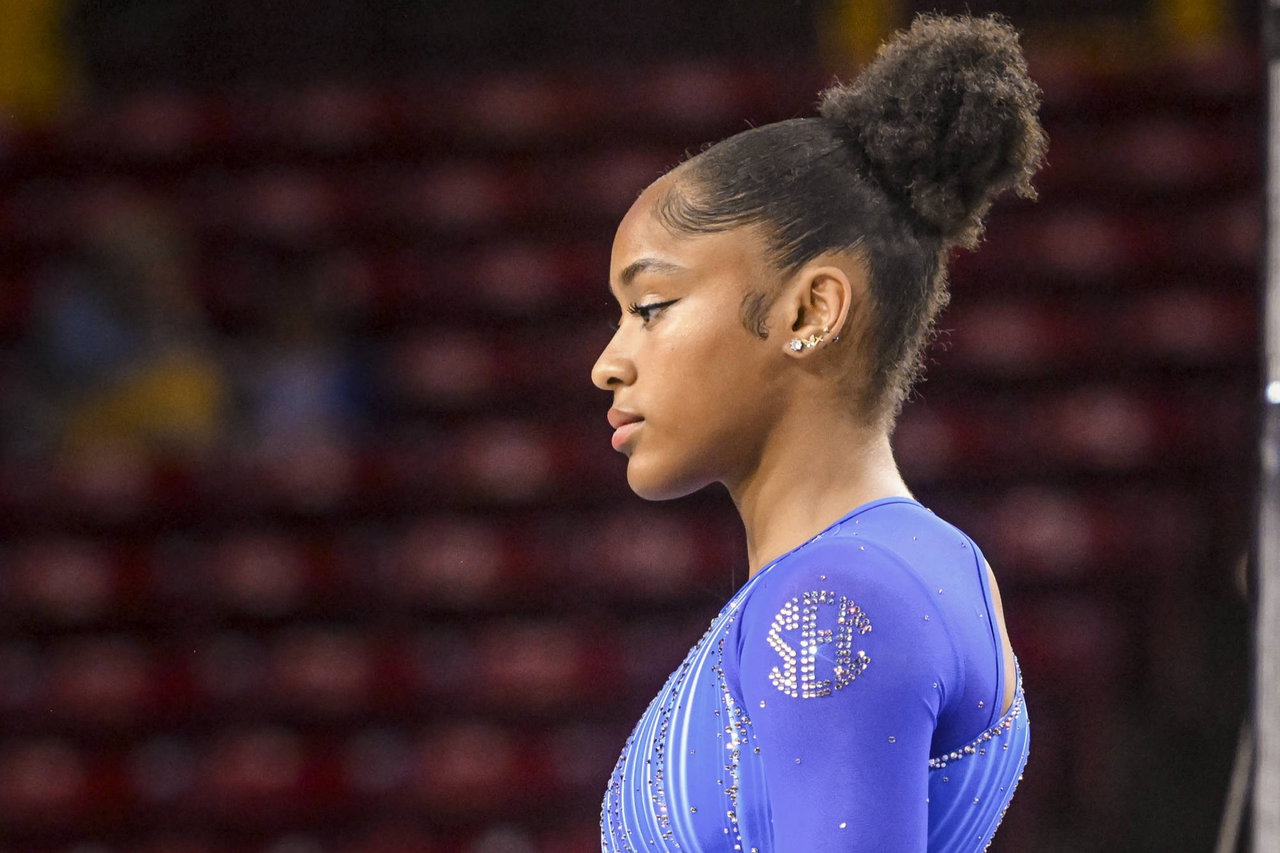
0.233 points. That was the margin by which the U.S. lost to China in the women’s team final at the 2026 World Artistic Gymnastics Championships. While the narrow defeat ended America’s streak of seven consecutive world team titles, NCAA-bound gymnast Skye Blakely’s balance beam mistake became a talking point after she failed to credit her planned switch-half connection, which cost her valuable difficulty points. Now, after the Americans settled for silver, USA Gymnastics high-performance technical lead Chellsie Memmel has explained what went wrong and what Blakely can do differently going forward.
Watch What’s Trending Now!
Speaking to reporters after the final, Memmel broke down the scoring issue behind Blakely’s 13.266 beam score, explaining how the missed credit affected the routine’s difficulty and dance series. “It’s a learning experience from here,” Memmel said, describing her conversation with Blakely after the routine.
She acknowledged that the issue had not caused problems in the past, making its appearance during such an important competition particularly unfortunate. The discussion then turned to whether Blakely had a backup connection she could use if her planned skill did not receive credit. Memmel clarified that the gymnast knew she could perform an alternative, but it was not an obvious choice for either Blakely or the coaching staff in the moment.
“She knows she can do one,” Memmel explained, adding that the alternative had not immediately come to mind during the routine. Asked whether Blakely could work on another option before the beam final, Memmel replied, “Absolutely, yeah.”
Interestingly, Blakely was not the only American gymnast to lose points on the balance beam. Dulcy Caylor made a mistake on her dismount, while Claire Pease delivered a stronger routine and scored 13.600. The United States finished with a combined beam score of 39.199, well behind China’s 43.366.
The Americans had performed strongly on the other three apparatuses. They recorded the highest team totals on vault, uneven bars and floor exercise, but China’s advantage on beam proved too large to overcome. The final scores were 165.531 for the United States and 165.764 for China. Despite the disappointment, Memmel praised the team’s ability to recover from mistakes and support one another under pressure.
She also highlighted Caylor’s strong response on floor exercise. “It speaks to their fight, it speaks to their heart, and can’t ask for anything more today,” Memmel said. The United States had deliberately pursued difficulty in its routines because the coaching staff knew China held an advantage on beam. “We knew we needed every tenth that we could get,” she said, referring to the decision to include difficult skills in the team’s routines.
The silver medal marked the end of the United States’ run of seven consecutive women’s world team titles, which began in 2011. China claimed its first women’s world team title since 2006, while the Americans were left to assess what had gone wrong and where they could improve. Despite the silver medal, Memmel believes the result will motivate the program to improve. “It’s going to light a fire,” Memmel said, explaining how the result could inspire the Americans to push harder over the coming year.
Beam connections will be one area of focus, but Memmel also wants the gymnasts to improve their floor exercise landings and overall execution. She believes the team can put itself in a stronger position by combining great difficulty with cleaner performances. While the U.S. women took silver after a narrow loss to China, the men finished sixth after struggling to maintain consistency across all six apparatuses.
U.S. Men’s team faces major challenge in World Championships final
The men’s gymnastics team qualified for the final in fifth place with 245.961 points. But as soon as the final began, they struggled to maintain the same level of performance, ending the competition with 245.161 points. The result left them outside the medal positions and prevented them from securing an early team quota for the 2028 Los Angeles Olympics.
The Americans began strongly on floor exercise, recording a team score of 41.466, the highest of any team in the final. Kameron Nelson led the way with 14.133 points, while Shane Wiskus and Frederick Richard also contributed to the team’s strong start. However, the momentum proved difficult to sustain across the remaining apparatus, as the U.S. lost ground to the leading teams.
On pommel horse, the Americans scored 41.499 points, with Patrick Hoopes delivering a standout performance of 14.833. The team also placed fifth on still rings, scoring 39.565 points, well behind China’s 42.766 on the apparatus. Although the Americans remained competitive, the gap between their scores and those of the leading teams continued to grow.
Vault and parallel bars offered further opportunities to recover points, but the U.S. could not make up enough ground. The team scored 42.133 on vault, placing fourth, and 41.599 on parallel bars, finishing fifth. Wiskus contributed one of the team’s stronger parallel bars performances with 14.333, but the overall scores were not enough to bring the Americans back into medal contention.
High bar proved to be the team’s most difficult event. The U.S. recorded a combined score of 38.899, ranking seventh among the eight finalists. Frederick Richard scored 14.100, while Danila Leykin earned 11.466 and Wiskus added 13.333. The lower scores on the final apparatus further affected the team’s overall total, leaving the Americans unable to challenge for a place on the podium.
Japan ultimately won the men’s team title with 251.928 points, followed by Russia with 250.329 and China with 249.193. Great Britain finished fourth and Switzerland fifth, while the U.S. settled for sixth place with 245.161 points. The Americans finished 6.767 points behind Japan, highlighting the difference between their performance and that of the eventual champions.
While the U.S. women took silver after a narrow loss to China, the men finished sixth after struggling to maintain consistency across all six apparatus. With both teams now looking ahead to the 2028 Los Angeles Olympics, the Americans will aim to learn from their mistakes and return stronger at the next major competition.