
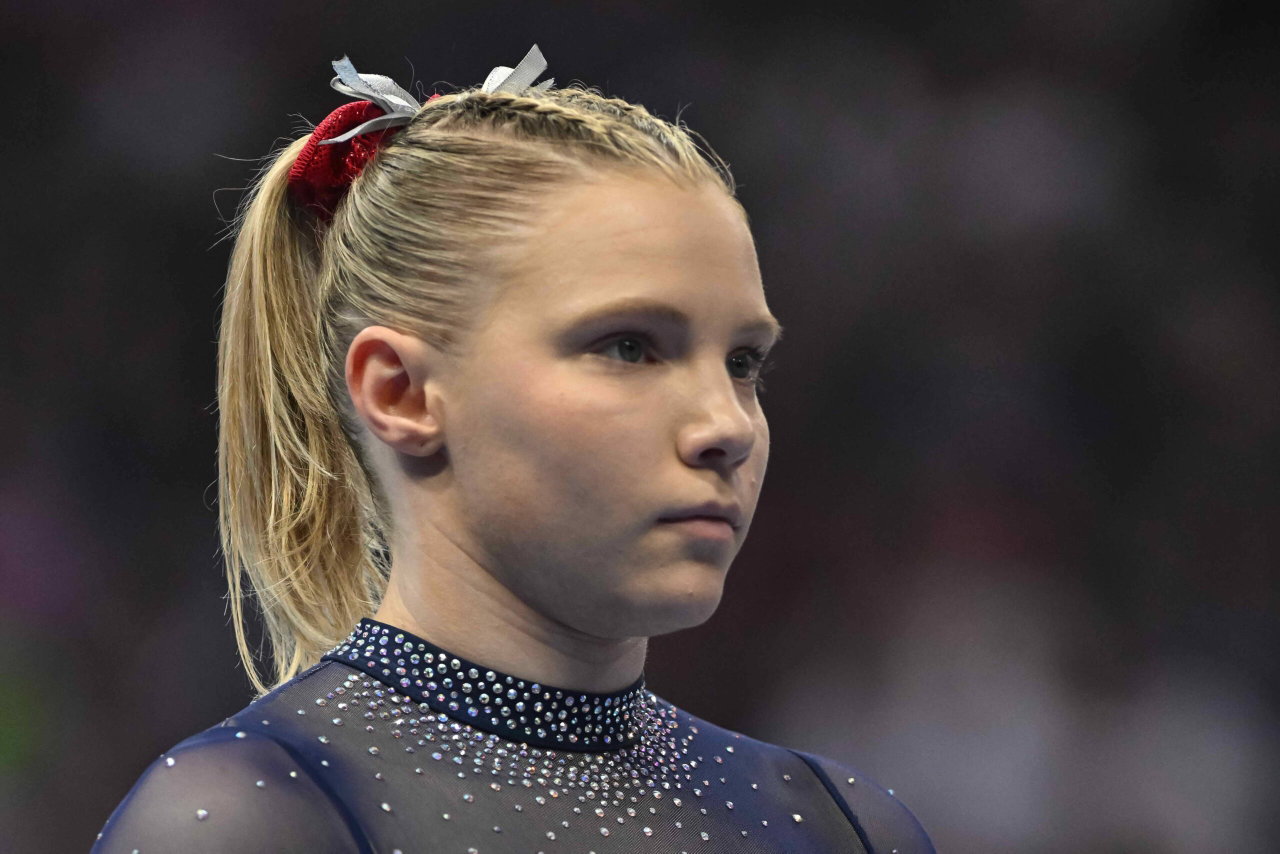
Despite being a seven-time World medalist and Olympic champion, Jade Carey, 26, was named a non-traveling replacement for the 2026 World Championships. Instead, the main team features young talents Charleigh Bullock, Reese Esponda, Claire Pease and Hezly Rivera. However, after missing out on the traveling squad, Carey has now opened up about why she was not selected and the challenges she faced during her return to elite gymnastics.
Watch What’s Trending Now!
Carey had only just returned to elite competition after nearly two years away following the Paris 2024 Olympics. As she worked her way back, her skills did not all return at the same pace. “I feel like it came and go in waves,” Carey said while speaking to the media on October 2 after the World Team Selection Event. “Sometimes some things came back easy and some things came back not so easy.”
The uneven progress made the comeback a “roller coaster” for Carey. Still, she felt herself getting more comfortable as the season went on, with the U.S. Championships becoming an important step in rebuilding her confidence. “I feel like championships went pretty well for me,” Carey said. “So just building off of that in the gym really helped me continue and push forward.”
Her road back to competition began in June at the American Classic, where she finished second in the all-around. She then placed second again at the U.S. Classic in July. By the U.S. Championships in August, Carey had moved into stronger form, finishing fifth in the all-around, winning vault and placing third on floor. Those results gave Carey an opportunity to make the World team, but the final selection process proved difficult.
At the World Team Selection Event in Crossville, Tennessee, she finished seventh in the all-around on Day 1 with 53.450. Carey was behind Claire Pease, Skye Blakely, Charleigh Bullock, Reese Esponda, Dulcy Caylor and Hezly Rivera after the first day. The result mattered because Day 1 made up 60% of the calculation for the two automatic team spots, while 40% came from the athlete’s two-day all-around total at the U.S. Championships.
Carey had scored 108.750 at nationals, which combined with her selection-event score to give her a composite of 75.570. Pease recorded 78.340 and Bullock 77.610, earning the two automatic spots. Carey still had another opportunity to show what she had rebuilt on Day 2. She competed on vault and beam, scoring 14.250 and 13.200. Her vault also marked the return of her Cheng, one of the skills she was especially proud to regain during her comeback.
The second-day scores, however, did not simply wipe away the Day 1 all-around score. Instead, those performances were taken into account by the selection committee with the other selection criteria in the process of determining the remaining three places. The committee finally had to choose Skye Blakely, Reese Esponda and Hezly Rivera. Carey was named a non-traveling replacement and Dulcy Caylor was named the traveling replacement.
The final team featured a much younger group alongside the more experienced Blakely. Bullock, Esponda, Pease and Rivera are all teenagers and are set to make their World Championships debuts. Blakely, 21, already has three World Championships appearances, while Carey, 26, has competed at three Olympic Games and won seven World medals.
Still, Carey did not make her selection result about the younger gymnasts. Instead, she looked back at how much she had accomplished since returning to elite competition after Paris. “First year getting back out there obviously didn’t go like super great for me,” Carey said. “But I’m proud of the way I showed up today for the second day.”
Carey felt that Day 2 showed progress even though her scores did not necessarily reflect how much better she felt during her routines. “I think I felt definitely better about it,” she said. “I know it’s still not great, but it’s a start for me this year.” That feeling was important to Carey because she was trying to measure her comeback by more than just the numbers. “I think today definitely felt a lot better,” Carey said. “Just focusing on how I felt about it and knowing that it was better than yesterday.”
One of the clearest signs of her progress was the return of her Cheng vault. Carey revealed that she and her team had not even been seriously discussing the skill until later in the season. Carey also managed to rebuild her bars and beam routines during the season. Those skills had initially seemed less certain when she first began her comeback.
“I feel like I got bars all the way back in beam, which in the beginning didn’t feel like it was going to come together,” Carey said. She took a different approach with floor. Rather than rushing to restore all of her previous difficulty, Carey wanted to use her first year back to rebuild carefully and give herself more time over the next two years.
That plan also influenced her Day 2 routine. Carey had a double-double ready but decided not to use it because of the competition conditions. Instead, she used a full-in as her final pass. For Carey, adding a small amount of difficulty was not worth changing the careful approach she had taken throughout her comeback, especially with a much bigger goal still ahead.
Carey’s comeback begins with LA28 in mind
At the Paris 2024 Olympics, Carey helped the U.S. win team gold before adding a vault bronze to her Olympic medal collection. She competed despite becoming seriously ill during the Games, managing low energy while still contributing to the team and reaching the vault podium. After Paris, Carey initially thought she was finished with elite gymnastics.
She completed her final NCAA season with Oregon State in spring 2025 and then took the longest break from gymnastics she could remember. During that time, she joined the Oregon State staff as a student assistant coach, which eventually changed her perspective on walking away from the sport.
Being back in the gym and around other gymnasts made Carey realize how much she missed gymnastics. She has recalled thinking, “I miss going upside down,” after spending time coaching and watching athletes train. That feeling eventually led her to reconsider her decision and ask herself why she should not try again if her body still felt good.
Carey returned to training in December 2025 and made her return to elite competition at the American Classic in June 2026, nearly two years after her last elite competition at Paris. Her comeback was not about immediately returning to the gymnast she had been before her break. Instead, she wanted to rebuild her skills carefully and give herself time to improve.
The longer-term goal was always Los Angeles 2028. Carey has been working toward a possible third and final Olympic appearance. Carey has also said that competing at a home Olympics would be a special way to finish her career, describing it as a potential “perfect way to go out” before moving on to what comes next.
That made her cautious approach in 2026 part of a much bigger plan. Carey was not trying to force everything back at once. She was using this season to find her confidence, rebuild her difficulty and understand what her body could handle.