
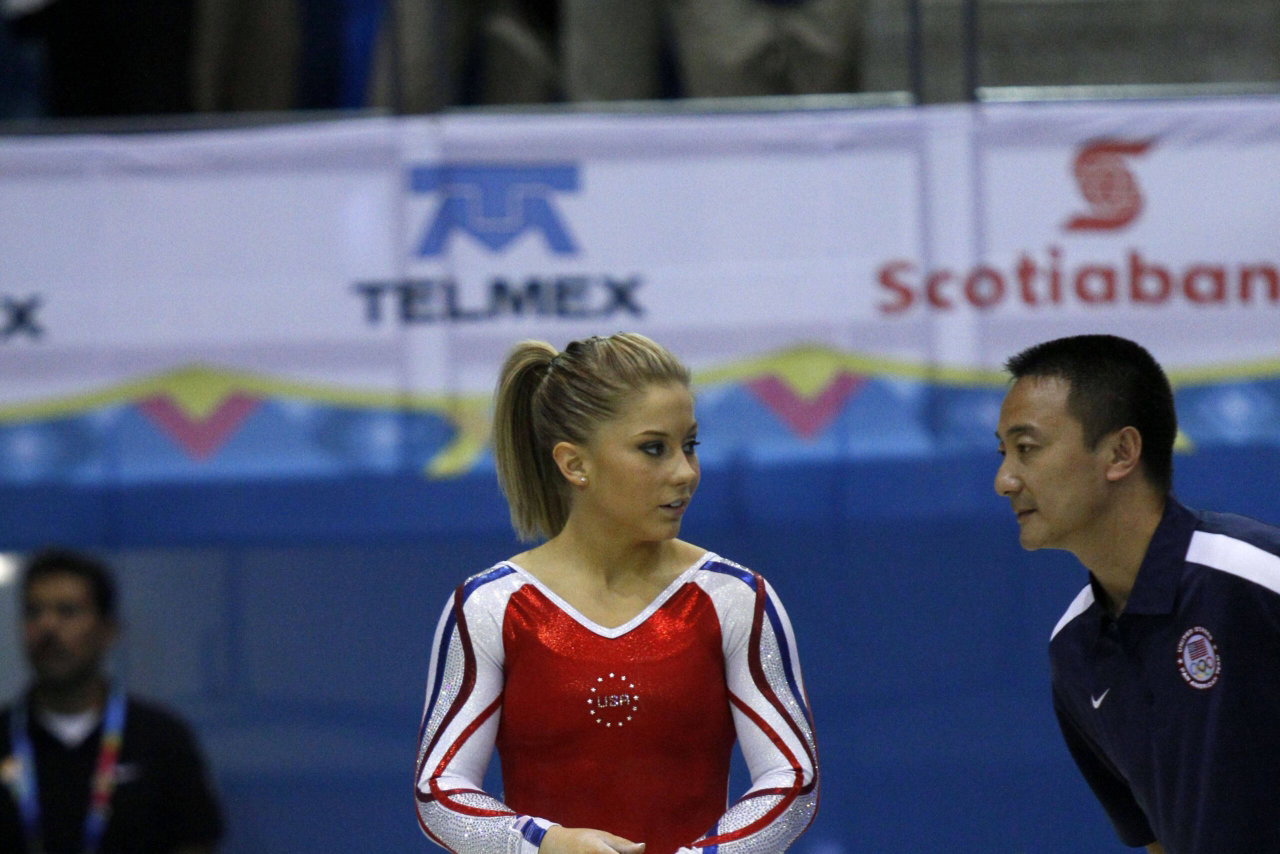
Even eight years after Larry Nassar was sentenced to spend the rest of his life in prison, the damage he caused has not faded from American gymnastics. The former USA Gymnastics team doctor s**ually abused hundreds of young athletes over several years, including Olympic champions Simone Biles, Aly Raisman, McKayla Maroney and Jordyn Wieber. But while many gymnasts became victims of his abuse, former Olympic champion Shawn Johnson says her experience was different. Despite spending around 15 years under Nassar’s supervision, she escaped his abuse because of one decision made by her coach.
Watch What’s Trending Now!
Johnson recently opened up about her experience during an appearance on Ken Rideout’s podcast on October 28. During the conversation, the host asked whether she had been exposed to the same environment that other gymnasts described when speaking about Nassar. Johnson confirmed that she had been under his supervision but said she was fortunate because of the way her coach, Liang Chow, whom she calls her “second father,” handled her medical treatment.
“Larry was my doctor for 15 years. I am a lucky one, but I was under his supervision for 15 years,” Johnson said. She also explained how Nassar’s position within USA Gymnastics gave him access to athletes whenever they needed medical attention. After all, Nassar had spent years building his reputation in the sport. He began working with the USA Gymnastics national team in 1986 as an athletic trainer and later became a doctor. In 1996, he was appointed the organisation’s national medical coordinator.
“Larry was the team doctor. If you needed any type of treatment, he’s the only option to get it from,” she added. However, her coach had a different approach to medical treatment. Johnson explained that Liang Chow preferred Chinese and Eastern medicine over American medical practices and did not fully agree with the treatment methods used in the United States. “I was never allowed to get treatment from Larry without my coach present,” she revealed.
That rule meant Johnson was never alone with Nassar during her medical appointments. When the interviewer reacted to her revelation, she expressed her gratitude towards Chow, calling him a blessing. “He was a blessing,” Johnson said. She also spoke about the authority Nassar held within USA Gymnastics.
“He was the sole doctor for many, many years. And I mean, he traveled the whole world with us. He’s the only person who ever had access to our hotel rooms. And dang, he was kind of the confidant of the team because the atmosphere of gymnastics back in the day was survival of the fittest.”
Johnson described the gymnastics culture at the time as an environment where athletes were expected to hide their pain and avoid showing weakness. “It’s like you don’t tell people when you’re hurt. You don’t tell people when you’re having a hard time, but you can tell the doctor,” she explained. Looking back, Johnson said she now understands how unhealthy that system was, especially as a mother. “The cycle of it was very unhealthy,” she said.
Although Johnson was protected by her coach, many of her closest friends and teammates were not. She admitted that it remains difficult to process why she escaped the abuse while so many people she considered family became victims.
“I was protected by my coach, which made me a lucky one. It’s really hard in the long run because it was all of my best friends and my family and my girls who were victims to Larry Nassar,” Johnson said. But exposing Nassar’s crimes was not easy. He had spent years building a reputation as a trusted doctor in American gymnastics, earning the confidence of athletes, coaches and parents. Even when complaints began to surface, it took years for the full extent of his abuse to come to light.
Larry Nassar’s abuse went unchecked despite early warnings
It took years for Larry Nassar’s crimes to come to light. One of the early warnings came in 2014, when Michigan State University student Amanda Thomashow reported that Nassar had touched her inappropriately during a medical examination. The university investigated but concluded that his treatment was medically appropriate. Nassar was allowed to continue working, with some restrictions on his procedures.
In June 2015, USA Gymnastics received another complaint involving a young gymnast, later identified as Maggie Nichols. The organisation launched an internal investigation, but it took around five weeks to report the allegations to the FBI. On July 28, 2015, then-CEO Steve Penny and other officials met with FBI agents to share the information. Nassar was removed from USA Gymnastics assignments the following day, but he was still able to treat athletes through his work at Michigan State University and other facilities.
The FBI also failed to act promptly. Its Indianapolis office did not properly follow up on the allegations, and its Lansing office was not informed through the bureau until October 2016. A later Justice Department investigation found that these failures allowed Nassar to continue abusing young athletes. At least 70 victims were reportedly abused during the period after the FBI first received the allegations.
The case finally gained national attention in September 2016, when The Indianapolis Star published an investigation featuring allegations from former gymnast Rachael Denhollander. She had reported Nassar to Michigan State University police the previous month. As more women came forward, police searched his home and discovered child s**ual abuse material.
As the investigation grew, several Olympic gymnasts publicly identified themselves as survivors. McKayla Maroney, Aly Raisman and Jordyn Wieber shared their experiences, while Maggie Nichols also came forward about being the gymnast whose report had helped trigger the USA Gymnastics investigation. Their accounts showed that Nassar had abused athletes who had trusted him to provide medical care.
Simone Biles also revealed in January 2018 that she was among his survivors. She criticized USA Gymnastics for failing to protect its athletes and later spoke through tears during a 2021 Senate hearing alongside Raisman, Maroney and Nichols. The gymnasts questioned how Nassar had been allowed to continue abusing young athletes despite earlier reports. FBI Director Christopher Wray apologised to the survivors during the hearing, acknowledging that the bureau had failed them.
Nassar’s sentencing hearings in 2018 brought more than 150 survivors forward to address him in court. Many described the abuse they had suffered as children, while others spoke about the lasting effect it had on their lives. Raisman and Wieber were among the Olympic gymnasts who delivered statements, while Maroney’s account was read aloud.
Nassar received a 60-year federal prison sentence in December 2017 for possessing child s**ual abuse material. He was later sentenced to 40 to 175 years in Michigan in January 2018 for s**ual assault, followed by another 40 to 125 years in February for additional assaults. With these sentences, he is expected to spend the rest of his life in prison.