
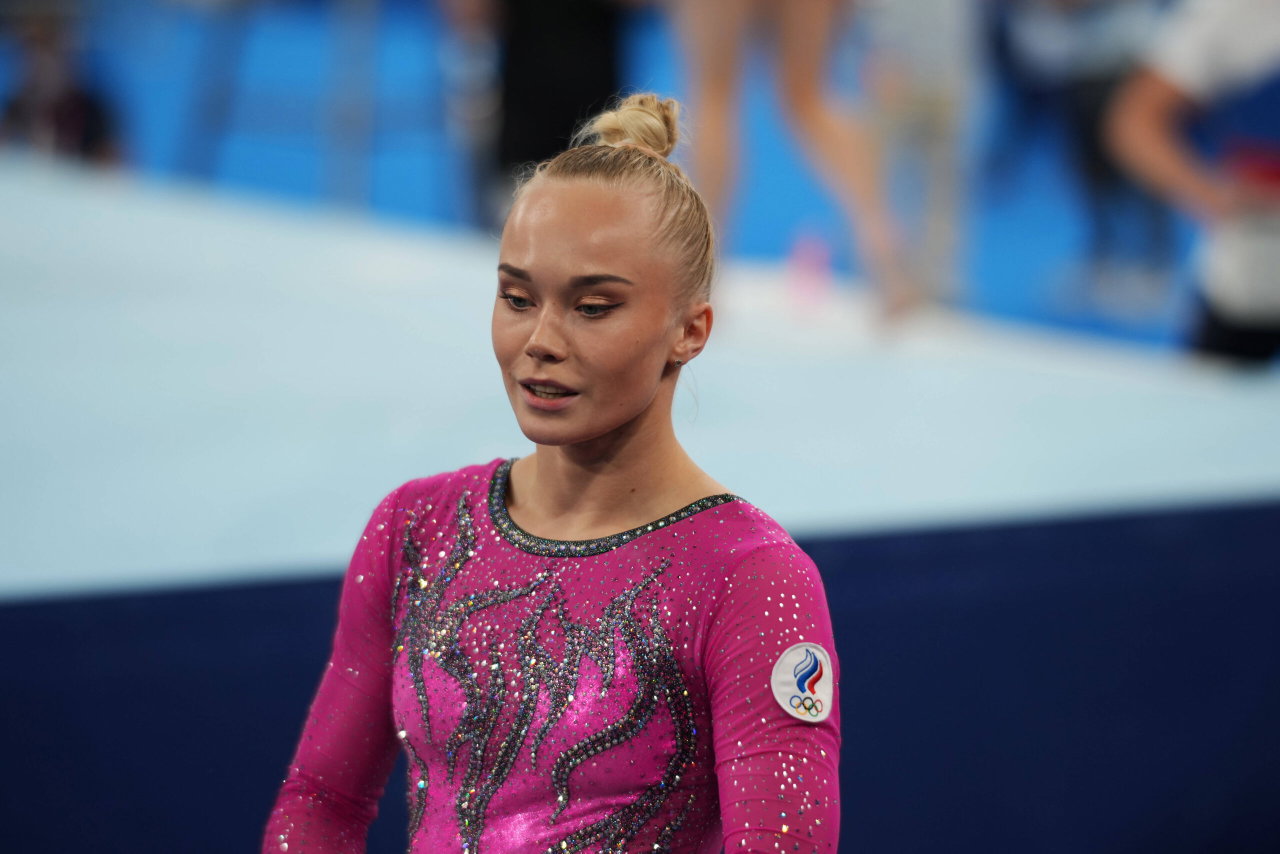
For Russian gymnasts, the road back to international competition has taken another unexpected turn. The ban is no longer in place, yet the flags are still missing. Russian and Belarusian gymnasts will head to Rotterdam with permission to compete, but they will do so under neutral identities instead of their countries’ national banners.
Watch What’s Trending Now!
As per Gymnastics Now, World Gymnastics confirmed that athletes from both countries will appear under neutral designations at the October 17-25 championships. Russian gymnasts will be listed as World Gymnastics 2 (WG2), while Belarusian athletes will compete as World Gymnastics 1 (WG1).
The decision comes only months after World Gymnastics made a major change to its policy. In May 2026, its executive committee lifted the restrictions that had kept Russian and Belarusian athletes from competing under their national flags following Russia’s invasion of Ukraine in 2022.
That decision appeared to signal a new chapter. But the return of the flags was never going to be quite that simple. World Gymnastics confirmed to Gymnastics Now that the previous restrictions had indeed been lifted. However, it also pointed toward an important exception for events that had already been allocated before the decision. According to the governing body, “some flexibility may be required where binding governmental restrictions apply.” That clause has now come into focus ahead of Rotterdam.
The Netherlands has maintained strict European Union sanctions against Russia and Belarus while also providing political, financial, and military support to Ukraine. As a result, Russian and Belarusian gymnasts will enter the World Championships under the neutral WG1 and WG2 designations rather than appearing with their national identifiers.
The arrangement mirrors what happened at the 2026 European Artistic Gymnastics Championships in Zagreb, Croatia, in August. Russian gymnasts still made their presence felt on the podium, but they did so as WG2.
And there is another concern hanging over the Russian delegation. Reports indicate that some Russian athletes have yet to receive their Dutch visas for the Rotterdam competition. It is an uncomfortable situation that echoes the problems the delegation encountered in Croatia earlier this year, when several athletes initially struggled to secure entry for the European Championships.
Russian gymnasts have already faced similar hurdles in Germany and Croatia
The situation in Rotterdam is not an isolated one. Russian and Belarusian gymnasts have encountered different versions of the same restrictions throughout the year, even as World Gymnastics has moved toward restoring their participation.
At the 2026 Rhythmic Gymnastics World Championships in Frankfurt, Germany, athletes from both nations were permitted to compete but had to do so without national flags or anthems. During medal ceremonies, the World Gymnastics flag replaced the national flags, while neutral music was used instead.
The Russian Gymnastics Federation, however, maintained that its athletes were still competing as a national team and would be identified as representatives of Russia in official competition documents. The contrasting positions highlighted the complicated line between allowing athletes to compete and allowing them to officially represent their countries.
Croatia presented another example. Ahead of the European Championships in Zagreb, the Croatian government introduced measures preventing Russian and Belarusian flags, anthems, national symbols and identifiers from appearing at the event. Official competition systems used WG1 and WG2 instead of the country names and three-letter codes BLR and RUS.
The restrictions even extended to uniforms, tracksuits, equipment and other items carrying national symbols or colors. The visa situation added another layer of uncertainty. Nine of the 65 members of the Russian delegation were initially refused Croatian visas. Among them was Olympic champion Viktoria Listunova, who had been preparing for her first international competition in more than four years.
Olympic champion and reigning world all-around champion Angelina Melnikova and 2025 world team member Anna Kalmykova also initially faced visa issues before eventually receiving approval. Melnikova voiced her frustration on social media, arguing that sport loses something important when the strongest athletes cannot compete against one another.
Most of the Russian delegation eventually secured their visas and arrived in Zagreb in time for podium training, but Listunova remained among those unable to make the trip.
For the athletes, the stakes in Rotterdam are even higher. The 2026 World Artistic Gymnastics Championships will not only crown new world champions but also begin the qualification pathway toward the 2028 Los Angeles Olympics, with the event awarding the first team quota spots for the Games.
Russia has historically been one of gymnastics’ powerhouse nations. At the Tokyo Olympics in 2021, its athletes won two gold medals and 10 medals overall while competing under the Russian Olympic Committee banner. They were then absent from Paris 2024 following the international ban.
Now, after years away, Russian gymnasts are finally back in the international picture. Yet in Rotterdam, they will still have to compete without the symbol they once carried so naturally.
World Gymnastics has made clear that it will continue to refer to the federations as Russia and Belarus in its own communications. But inside the competition arena, at least for this championship, the athletes will remain WG2 and WG1.
The ban may be gone. The road back to competing as Russia, however, is proving to be a much longer journey.