
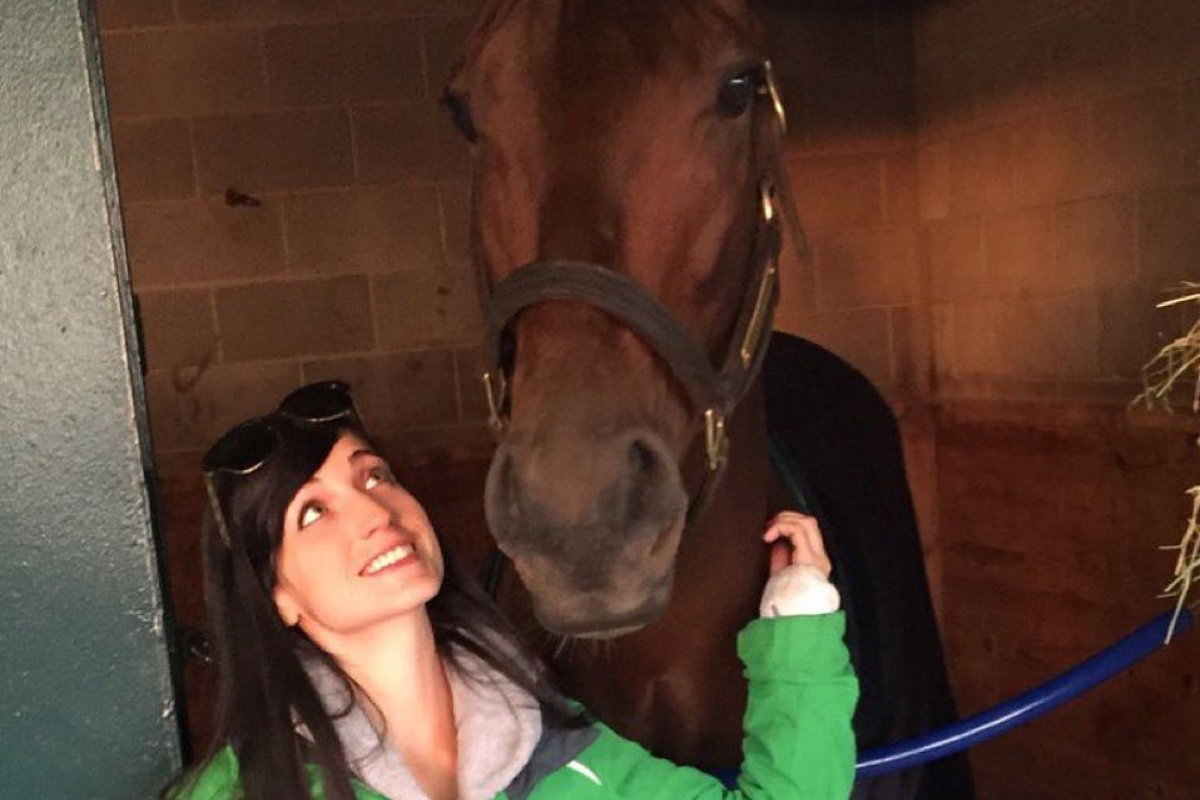
Maria Borell’s name has been tied to both success and controversy. The trainer made a name for herself after helping Runhappy to victory in the 2015 Breeders’ Cup Sprint. However, her career was put on hold in 2016 when charges of animal cruelty were laid against her and her father. Although the charges were dropped later, her fortunes took a turn in 2025 when Kentucky authorities indicated that her trainer’s application for a license would probably be rejected. Now, nearly a year later, that decision could be headed for reversal.
Watch What’s Trending Now!
A hearing officer on June 2 recommended that the Kentucky Horse Racing and Gaming Corporation grant Borell a trainer’s license, concluding that the agency failed to present sufficient evidence to justify denying her application. The recommendation is not final. The KHRGC can adopt, reject, or modify the proposed order.
Without making a start since May 2016, Borell was issued a trainer’s license in California in September 2024 and sought to retake her license in Kentucky. But her first effort hit a snag with state regulators. Members of the KHRGC’s License Review Committee gave her the option to withdraw her application since they were leaning towards denying it when she appeared before them in June 2025. Borell withdrew the application and submitted a new one in July 2025.
That application also faced obstacles. “On July 25, 2025, the Corporation informed Borell’s counsel that it was not inclined to take up her application at that time,” hearing officer Clayton D. Patrick wrote in his recommended order. “The Corporation did not provide reasons. Because she was denied consideration, Borell sought judicial review in Franklin Circuit Court.”
Less than a month later, on Aug. 13, 2025, the KHRGC formally denied the application. “The ruling did not state the factual reasons for the denial,” Patrick wrote. And this dispute eventually led to a formal administrative hearing on March 31, 2026. According to Patrick, the KHRGC’s case rested on three theories: candor, financial responsibility, and the question of “where have you been.”
The corporation argued that Borell had not been fully honest about her lengthy absence from Kentucky after the charges were filed. Regulators also pointed to financial judgments involving Rood and Riddle Equine Hospital and Walnut Springs Farm. In addition, they questioned whether Borell had remained active enough in the Thoroughbred industry to maintain the skills required to train racehorses.

Imago
Credits – Instagram @middlehampark
But Patrick was unconvinced. “Borell’s proof was more persuasive than the Corporation’s proof on the issue of whether her license should be renewed,” he wrote. “The Corporation’s case lacked substance and was not convincing on the issues presented. The Corporation failed to present evidence of conduct or inaction serious enough to justify nonrenewal of Borell’s license.”
Patrick also criticized the agency for failing to clearly explain its position throughout the process. “The asserted grounds for denying Borell’s license were vague and inconsistent throughout this matter,” he wrote. “Since Borell initially applied for renewal in November 2024, the Corporation’s position regarding her alleged noncompliance has been a moving target.”
Addressing the issue, Patrick wrote that regulators relied largely on suspicion rather than evidence. “The Corporation’s suspicion that Borell’s explanation was unsatisfactory, without more, is not enough to justify denying her license,” he wrote. On the financial judgments, Patrick noted that neither Rood and Riddle nor Walnut Springs met the regulatory requirements needed for those judgments to be used as grounds for denial.
The hearing officer also found little support for the claim that Borell lacked the skills necessary to return to training. According to Patrick, the KHRGC presented no witnesses who questioned her horsemanship. Borell, meanwhile, called veteran trainer Rosemary Hoemeister Sr. and horse owner Deanna Johnston, both of whom testified that she provided excellent care to her horses.
“The hearing officer concludes and recommends that Borell met her burden of proof by a preponderance of the evidence on all theories presented by the Corporation,” Patrick wrote. “The hearing officer further concludes that the Corporation failed to provide adequate due process and failed to present proof establishing a proper basis to deny Borell a Kentucky horse trainer’s license. Borell is therefore entitled to be granted a Kentucky horse trainer’s license.”
Borell’s attorney, Robert Heleringer, praised the ruling and accused regulators of unfairly targeting his client. “I’m ecstatic that someone finally, finally called this for what it was: a vendetta,” Heleringer said. The matter is not yet resolved. Both sides have 15 days to file written exceptions to the recommended order. After that process is completed, the KHRGC may adopt the recommendation, reject it, modify it, or send the case back for further proceedings.
The board shall make a final order within 90 days unless the case is remanded. While Borell awaits that decision, the controversy that derailed her career continues to loom over her comeback attempt.
The controversy that changed Borell’s career
In the 2015 Breeders’ Cup Sprint, Maria Borell had trained Runhappy to victory and looked like one of the young trainers who had carved out a niche for herself in the sport. But just one day after the victory, owner James McIngvale fired her. Things got even worse in 2016, when 43 of Borell’s horses were discovered in poor condition on her farm in Mercer County, Kentucky – a farm linked to Borell and her father, Charles “Chuck” Borell.
Some horses were found to be underweight, suffering from inadequate food and water intake, and were in need of emergency care, investigators said. Many of the horses required treatment for malnutrition, and three were said to be “emaciated”, according to the Lexington Herald-Leader.
As a result of the discovery, Maria and her father were both charged with 43 counts of 2nd degree animal cruelty. Authorities determined that Chuck Borell, who leased the farm, was the primary caretaker of the horses. He was subsequently arrested, discharged on bail and eventually pleaded guilty to animal cruelty charges in a plea bargain.
Maria Borell said she had no legal responsibility over the care of the horses, and she was living and working in Florida when they were discovered. The charges were dropped and her criminal record purged in 2023. Although the charges were ultimately dropped, the controversy effectively brought her training career to a halt.